

.png) 2 month_ago
31
2 month_ago
31
NE LAISSER PAS LE 5G DETRUIRE VOTRE ADN Protéger toute votre famille avec les appareils Quantiques Orgo-Life® Publicité par Adpathway

On a quiet late afternoon, while coffee is being sipped among a circle of friends or during a heated intellectual debate around a dinner table, a magical word suddenly fills the air: “Dialectics.” Time and place matter little; the moment the word is uttered, an invisible chime rings in the ears of the educated minds present. A look of familiarity and comfort gleams in their eyes—a safe haven recollected from high school philosophy classes or university campus corridor chats.
Then comes that famous, almost mechanical reflex, executing without a single skip: “Ah, yes. Thesis-antithesis-synthesis.”
These three words have become the Swiss Army knife of the intellectual world. It is widely believed that they can unlock any door. Need to explain a major historical turning point? Position the thesis, launch the antithesis, melt them down in the crucible, and extract the synthesis. Attempting to analyze an artistic movement, an economic crisis, or even a domestic dispute? The formula stands ready. When people stack these three words in succession, they flatter themselves with the illusion that they have domesticated two of the most formidable peaks in the history of human thought—Georg Wilhelm Friedrich Hegel and Karl Marx—and that they are fully privy to their mental maps.
Yet, underneath this comforting consensus lies a monumental deception—one that has been transmitted across generations and has hardened into an intellectual cultural gene.
Brace yourself: Neither in Hegel’s thousands of pages of dense text nor in any of Marx’s works, including “Das Kapital”, was a three-step formula ever used to explain dialectics. Furthermore, if Hegel were alive today and saw his dialectics imprisoned within these tidy little cardboard boxes, he would likely treat you to one of his most infamous philosophical tongue-lashings. Marx, upon hearing this mechanical formula, would probably leave the table altogether with his trademark biting sarcasm.
So, how did it happen that these two titans who shook the history of global thought came down to posterity as the inventors of a formula they never wrote—and in fact, thoroughly despised? Where did this massive historical public relations disaster begin? And more importantly, what actually was dialectics?
To chase down this mystery, we must first return to the scene of the crime, to the biography of the greatest “overshadowed” genius in the history of philosophy.

The year is 1794. The city of Jena, Germany, is the most volatile intellectual laboratory of the post-Enlightenment era. German thinkers of the period are still reeling from the shockwaves sent by Immanuel Kant. Kant had attributed immense power to the human mind, yet he erected an insurmountable wall right in front of philosophy: the “thing-in-itself” (Ding an sich). The notion that we can never truly know objective reality outside our minds as it actually is.
It was at this very impasse that a fiery, young, and radical philosopher took the stage: Johann Gottlieb Fichte.
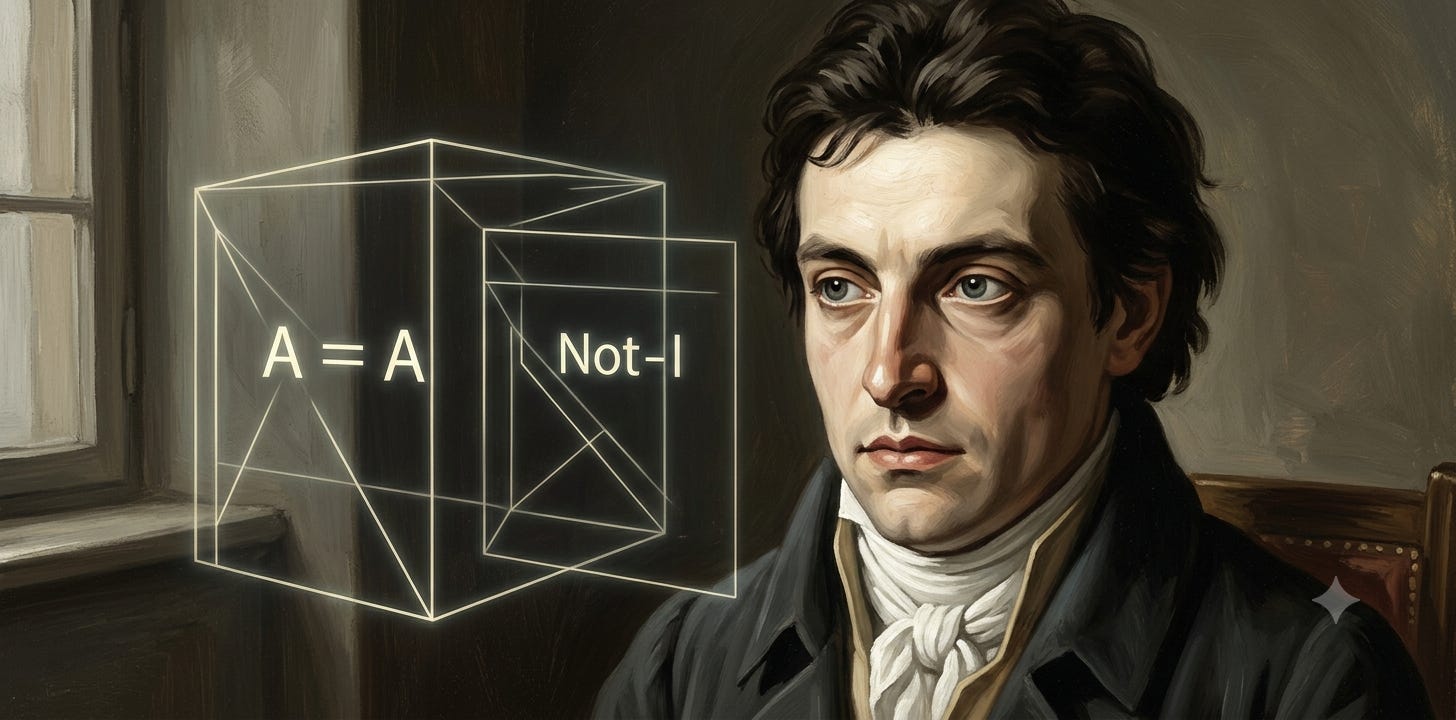
Fichte’s overarching ambition was to reconstruct the world and consciousness from scratch, starting from a single, absolute principle driven entirely by action. He had no patience for static, frozen categories. To him, the human mind was not a passive recipient, but an active deed that constructed reality. It was precisely in this context, in his 1794 masterpiece, Grundlage der gesammten Wissenschaftslehre (Foundations of the Entire Science of Knowledge), that he engineered a geometric formula in his intellectual laboratory to explain how human consciousness brings itself into being.
“Die jetzt aufgezeigte Handlung ist thetisch, antithetisch und synthetisch zugleich.“ (The action here described is at once thesis-like, antithesis-like, and synthesis-like.)
Fichte’s geometry of the mind consisted of three distinct movements:
Thesis: The self-positing of the ‘I’ (the Ego). In its primal act, consciousness validates its own existence. It declares, “I am I.” This is a contradiction-free, pure point of departure.
Antithesis: The positing of the ‘Not-I’ (the Non-Ego). However, for consciousness to move and exert its agency, it requires an obstacle. To draw its own boundaries, the ‘I’ must place an external world, a nature, right in front of itself—the ‘Not-I’. This is where tension, friction, and conflict ignite.
Synthesis: Limitation. Lest these two absolute forces (the Infinite ‘I’ and the Infinite ‘Not-I’) completely annihilate one another, consciousness limits both, creating a terrain of compromise where they can coexist.
Fichte’s intent was never to discover the laws of motion of the universe or history. He was merely formalizing the internal mechanism of the mind, treated like a psychological and logical “file opening-and-closing” procedure. Notice carefully: Fichte virtually never used the word “dialectics” while mapping this schema. It was, strictly speaking, a foundational formula for the architecture of consciousness.
Fichte manufactured this mechanical blueprint, placed the concepts side-by-side, and stepped away, his historical duty fulfilled. But this ticking time bomb he left behind would be dropped onto someone else’s lap a few decades later.
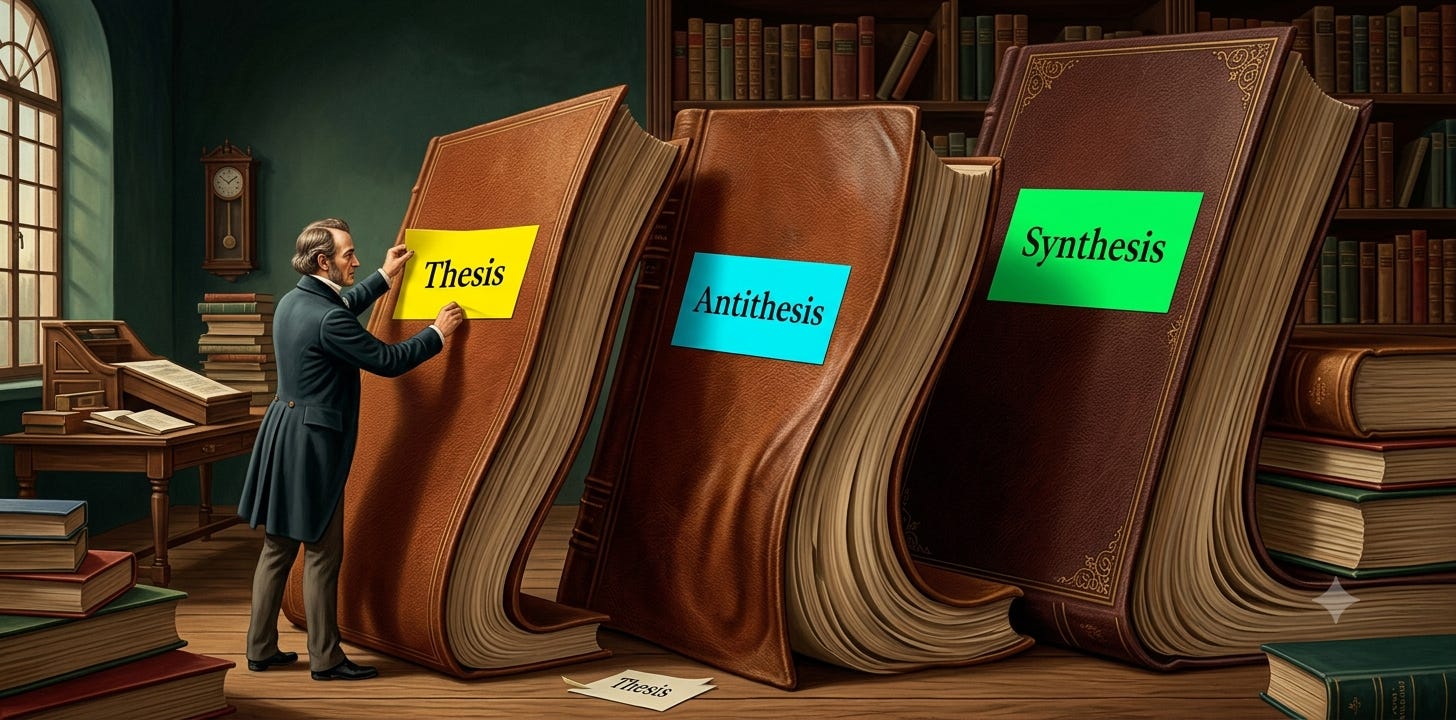
When Hegel died of cholera in 1831, he left behind an insurmountable corpus that had revolutionized philosophy but remained notoriously impenetrable. Hegel’s prose was dense, fluid, and elusive; he bent words constantly and narrated everything as a dynamic, ever-flowing river. His disciples promptly splintered into fiercely opposing camps, arguing over what the master actually meant.
It was in this hazy atmosphere, in the year 1837, that a popular historian of philosophy named Heinrich Moritz Chalybäus entered the arena. Chalybäus penned a textbook titled Historische Entwickelung der speculativen Philosophie von Kant bis Hegel (Historical Development of Speculative Philosophy from Kant to Hegel). His motive was practical and, on the surface, “admirable”: to translate this heavy, opaque German Idealism into a digestible, pill-like format that university students and lay educated audiences could easily swallow.
Chalybäus noticed a recurring “triple rhythm” built into Hegel’s architecture. Hegel examined everything in three phases. Chalybäus thought: “How do I quickly convey this fluid, agonizingly complex process to the masses?” He looked at the dusty shelves of his library and spotted the ready-made, mechanical boxes that Fichte had built forty years earlier to map the mind: Thesis-Antithesis-Synthesis.
Chalybäus took this Fichtean template and slapped it onto Hegel’s dynamic philosophy like a rigid stencil. “Look,” he told his readers, “Hegel is actually quite simple. First, there is a thesis, then an antithesis stands against it, and finally, a synthesis is born out of the two.”
The textbook was an astronomical commercial success. Mass-market philosophy had achieved its first major triumph. A complex, disruptive, and revolutionary mode of thought was tamed and reduced to a three-word soundbite. Chalybäus had pulled off the most successful marketing stunt in the history of ideas, but he left a massive intellectual trainwreck in his wake.
What would Hegel have said to this had he lived to see it? He had caught wind of such reductionist attempts during his lifetime. In the famous preface to his Phenomenology of Spirit (Phänomenologie des Geistes), Hegel launched a scathing critique against the popular figures of his day who tried to reduce his philosophy to such triadic stencils.
In his original German text, he explicitly condemned these ready-made templates as:
Lebloses Schema: A lifeless schema.
Geistloses Schema: A mindless, spiritless schema.
Hegel likened this stenciling habit to pasting colored labels onto random objects (das Aufkleben bunter Zettel). For him, squeezing dialectics into these three boxes was akin to skinning a living organism just to reduce it to the dry, skeletal lines of an anatomy atlas.

When you enter Hegel’s world, you exit Fichte’s sterile, laboratory logic-boxes and stand at the edge of a roaring, turbulent river. For Hegel, dialectics is not a “method” or an external “tool” to be applied to a topic; it is the very mode of motion of reality itself.
To understand Hegelian dialectics, we must discard mechanical boxes and think in terms of biological, organic processes. Let us recall his brilliant illustration of the bud, the blossom, and the fruit:
Consider a plant’s bud. When the blossom bursts forth, the bud vanishes. It is as though the blossom has refuted the bud, denying its existence. Later, the blossom withers away, giving way to the fruit. Now, the fruit steps forward to declare that the blossom was a mistake, a phase that must be cast aside so that the fruit may claim its place.
Now, the crucial question: Is the fruit the “synthesis” of the bud and the blossom? No. In this entire lifecycle, there is no “anti-bud” imported from the outside, nor is there a hybrid mixture of the two. The blossom and the fruit are already latent within the internal nature of the bud, hidden in its dormant potential. Contradiction does not arrive from the outside; it springs directly from the organism’s own drive to exist and grow. It is entirely intrinsic.
Hegel established his own conceptual vocabulary to describe this movement:
Abstract (Affirmation) → Dialectical (Negation) → Speculative (Negation of the Negation).
At the absolute core of this journey lies one of the most enchanted words in the lexicon of philosophy: Aufhebung. In its clearest, most revolutionary definition, it means: transcendence through inclusion.
The “thesis-antithesis-synthesis” formula implies that a synthesis is a sort of middle-ground hybrid that throws away the two previous stages to build a compromise. But Aufhebung operates on an entirely different plane. When a historical or logical stage is superseded, it is never entirely annihilated. It is removed from the immediate stage of history (abrogated), but all its positive, constructive, and foundational essence is carried forward into the next level, preserved and elevated.
It is precisely like a human being leaving childhood behind to become an adult. The adult is no longer a child (childhood has been undone), yet all the experiences gained, the growth energy accumulated during childhood, remain vividly alive within their adulthood (preserved, elevated, and transcended).
What about Karl Marx? In the mid-19th century, working in the dim, soot-choked reading rooms of London, what was that bearded genius thinking as he poured over Hegel?
Marx was deeply enamored by Hegel’s dialectical insights—the dynamic logic that asserted everything moved via its own internal contradictions. But in his eyes, Hegel had committed a fatal error. He sought the engine of the universe and history within the realm of the Spirit (Geist), in the world of ideas and pure consciousness. As Marx famously put it, Hegel’s dialectics was standing on its head.
What did Marx do? He grabbed dialectics by the hair, flipped it right side up, and planted its feet firmly upon the ground—meaning the material world, the soil, the factory floor, the flow of capital, and concrete class relations. With that single, definitive stroke, Historical Materialism was born.
In Marx’s dialectics, too, there is absolutely no room for Fichte’s hand-me-down blueprint of “thesis-antithesis-synthesis.” For Marx, historical processes do not operate mechanically like mixing two elements in a laboratory. Marx’s dialectics is concrete, historical, and class-driven.
Let us attempt for a moment to apply that infamous cliché to the subject Marx knew best: social transformations. Let us say feudalism is the “thesis.” What will you cast as the “antithesis”? The peasantry? The bourgeoisie? If the bourgeoisie is the antithesis, is capitalism then the “synthesis” of the two?
As you can see, the stencil collapses upon its first contact with reality. Capitalism is not a mixture, a polite “middle way” between feudalism and the bourgeoisie. Capitalism is the result of the bourgeois class growing within the very womb of feudal productive forces, accumulating internal contradictions until it shatters the old feudal husk in a qualitative leap—a revolution. There is no “antithesis” imported from abroad.
To comprehend Marx’s dialectics, we must replace the word “schema” with “law of motion.” Friedrich Engels, in Dialectics of Nature and Anti-Dühring, distilled these laws of motion into three classical formulations:
The Law of the Transformation of Quantity into Quality: You raise the temperature of water degree by degree (a quantitative change). The water remains water. But the moment it hits 100 degrees Celsius, in a sudden, qualitative leap, the liquid snaps into gas. Social transformations mirror this physical law: small, cumulative contradictions build up quietly until a moment arrives when they rupture the old order in a revolutionary leap, yielding a brand-new social formation.
The Law of the Unity and Struggle of Opposites: Like two sides of a single coin, capital and labor necessitate one another’s existence, yet they exist in a state of perpetual warfare. One cannot exist without the other, yet their coexistence generates a relentless, structural friction.
The Law of the Negation of the Negation: History does not advance in a straight line. An old system (for instance, primitive communal society) is negated and replaced by class societies. Class societies, in turn, are negated by their own internal contradictions, superseding themselves at a higher stage—a classless society (communism). Yet this new stage is not a primitive rerun; it is a moment of preservative transcendence (Aufhebung) that retains and leverages the entire technological and historical inheritance of the past.
Let us return to where we began. Given that this triadic schema exists neither in Hegel nor comports with the material dynamism of Marx, why does every lay educated person scream “thesis-antithesis-synthesis” the moment “dialectics” is mentioned?
The answer is buried deep within the most fundamental vulnerability of human psychology and modern culture: the desire for cognitive ease.
The human mind detests fluidity, ambiguity, and complex processes that harbor internal contradictions. It craves neatness. It demands clear-cut boxes, plug-and-play formulas, and rigid stencils. The “thesis-antithesis-synthesis” formula conjures the grand illusion that you can solve the most tortuous philosophical problems of humanity in three easy steps. It completely eliminates the agony of critical thought. This three-word soundbite is the most contagious virus in the intellectual world because it is lightweight to carry, elegant to present, and effortless to consume.
Yet, the price of this cognitive shortcut is exorbitant. When you reduce dialectics to this rigid stencil, you become blind to the revolutionary, earth-shattering nature of history, the deep-seated contradictions churning within societies, and the way an old system carries the seeds of a new world within its very womb. You end up viewing change as merely two external forces colliding to strike a deal in the middle. In doing so, you reduce dialectics to a conciliatory, tame, and static art of “finding the middle ground.”
But dialectics is not the art of finding the middle ground. It is the very name of that immense, unstoppable historical dynamism that shakes the old world to its foundations, exposes its inner cracks, and coaxes a new future out of those very fractures.
The next time someone in a circle of friends confidently proclaims, “Ah, yes, dialectics—meaning thesis-antithesis-synthesis,” take a calm sip from your coffee. Tell them about the “lebloses Schema“—the lifeless blueprint—concocted by a textbook historian named Chalybäus nearly two centuries ago. Invite them to pull their minds out of those comfortable boxes and step into Fichte’s architecture of consciousness, Hegel’s roaring river, or Marx’s material world of factories and class contradictions.
For motion has never fit into cramped little boxes; it has always advanced by shattering them.【●】



















.jpg)


 French (CA)