

.png) 13 hour_ago
35
13 hour_ago
35

The arrest of a U.S. Marine on suspicion of murdering a Japanese woman in Okinawa has reopened one of the most sensitive fault lines in the U.S.-Japan alliance: how long can Okinawa be expected to bear the social and political costs of a military presence that Tokyo and Washington consider essential to Japan’s security?
Lance Cpl. Devin Jacob Ballard, 20, of the III Marine Expeditionary Force, was arrested after the body of 39-year-old Anna Yagi was found at a hotel in Naha. Authorities suspect she was strangled and robbed. Ballard denies the allegations.
Prime Minister Sanae Takaichi formally protested to Washington, calling the crime “extremely brutal and vicious” and demanding full cooperation with the investigation and stronger preventive measures (Reuters, October 4, 2026). For Okinawa, this is the latest episode in a long history of serious crimes involving U.S. personnel.
A History of Recurring Crimes
The most notorious case came in 1995, when three U.S. servicemen kidnapped and raped a 12-year-old schoolgirl. Mass demonstrations followed (Stars and Stripes, October 4, 2024).
In 2008, Marine Staff Sgt. Tyrone Hadnott was arrested over the alleged rape of a 14-year-old girl. Japanese authorities released him when she withdrew her complaint. The Marine Corps then prosecuted him itself, and he pleaded guilty to abusive sexual contact with a child and received four years’ confinement (CNN, May 16, 2008).
In 2016, Kenneth Franklin Gadson, a former Marine working as a contractor at Kadena Air Base, was charged with the murder and rape of 20-year-old Rina Shimabukuro (Stars and Stripes, June 30, 2016).
More recently, Air Force Senior Airman Brennon Washington was convicted in 2024 of kidnapping and sexually assaulting a 15-year-old girl and sentenced to five years; the conviction was upheld on appeal (Stars and Stripes, December 20, 2024; September 10, 2025). Marine Lance Cpl. Jamel Clayton was sentenced in 2025 to seven years for nonconsensual sexual intercourse resulting in injury, and his conviction was upheld in 2026 (Stars and Stripes, June 24, 2025; March 5, 2026).
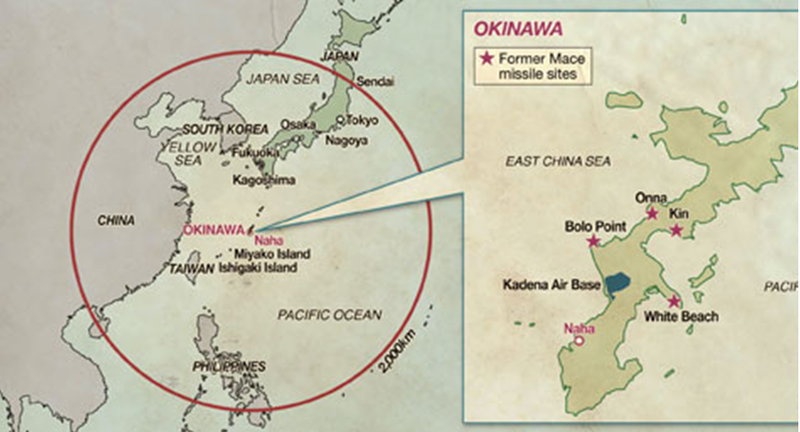
Crime Is Not Simply Rising, and the Data Cut Both Ways
It would be misleading to claim that crime by U.S. military personnel has risen continuously. Okinawa Prefectural Police data analyzed by Stars and Stripes show that felony crime attributed to the U.S. military community has generally fallen since the 1972 reversion to Japanese control.
The numbers are less one-sided than often presented. Between 1972 and 2024, police investigated 2,049 robberies, 1,555 sexual assaults and 1,181 murders across Okinawa. Personnel covered by the Status of Forces Agreement (SOFA) were involved in about 20 percent of the robberies, 9 percent of the sexual assaults and 2 percent of the murders. SOFA-status residents number roughly 80,000, about 5.5 percent of the population, so their share of robbery and sexual assault is well above their share of the population, while their share of murder is well below it. Since 2020 they have been suspected in about 1.5 percent of all offenses (Stars and Stripes, October 4, 2024).
Separate figures cited by Japan’s Defense Ministry cover only the American military community: 6,409 cases involving 6,284 people between 1972 and 2025, of which 600 cases, involving 772 people, were serious crimes such as murder, robbery, arson and nonconsensual sexual intercourse (Japan Ministry of Defense, October 6, 2026). This is a different dataset from the island-wide totals above.
None of this shows that U.S. personnel are inherently more criminal than Japanese citizens. What it shows is that after five decades, serious crime keeps recurring despite repeated promises of discipline.
A Disproportionate Burden
For Washington and Tokyo, Okinawa is central to deterrence. For many Okinawans, the presence is felt in aircraft noise, land restrictions, accidents, environmental worries and, periodically, violent crime.
That gap between strategic logic and local experience also feeds the long dispute over relocating Marine Corps Air Station Futenma to Henoko, which the prefecture has opposed for years.
Why Reform Has Been Slow
Okinawan officials have long pressed to revise the SOFA. Japan shares jurisdiction with the United States, but suspects in U.S. custody are not routinely handed over before indictment. After 1995, Washington agreed to give “sympathetic consideration” to such requests in heinous crimes. That is a courtesy, not a right.
Practical measures have followed the 2024 cases. A forum of about 35 local officials and U.S. military leaders has reviewed liberty restrictions, arrival briefings and crime-prevention lectures for troops (Stars and Stripes, May 9, 2025). Joint patrols began in Okinawa city in April 2025, and by October ten service members had been arrested in four days for violating off-base drinking restrictions.
Yet when the Marine Corps asked to extend joint patrols to Naha, Mayor Satoru Chinen declined, saying the city’s “situation is different from Okinawa city” (Stars and Stripes, October 17, 2025). Yagi’s body was found in a Naha hotel. That does not make the decision wrong, but it shows how hard it is to cover the whole island.
The Question Is No Longer Only About Crime
Tokyo and Washington argue that U.S. forces are indispensable as Japan faces growing tensions with China, North Korea and around Taiwan. Okinawa counters that the alliance’s security should not automatically override the interests of its host communities.
The alliance will not collapse because of one case, and this case does not prove that the American presence itself causes crime. But it strengthens those who say patrols and briefings are not enough. The question is whether one part of Japan can indefinitely carry a disproportionate share of the risks of an arrangement meant to protect the whole country. Unless that is answered through real changes to jurisdiction and base distribution, each new crime will be another argument against the presence itself.
*
Click the share button below to email/forward this article. Follow us on Instagram and X and subscribe to our Telegram Channel. Feel free to repost Global Research articles with proper attribution.
Alan Callow graduated from Western Mindanao State University (Philippines). He is a freelance journalist with experience in writing about the Asia-Pacific region.
He is a regular contributor to Global Research and Asia-Pacific Research.
Featured image: A demonstrator holds placards during a protest outside the Prime Minister’s office following the killing of a Japanese woman in Okinawa, for which a US Marine is a suspect, in Tokyo, Japan, October 5, 2026. REUTERS/Kim Kyung-Hoon
Global Research is a reader-funded media. We do not accept any funding from corporations or governments. Help us stay afloat. Click the image below to make a one-time or recurring donation.






















.jpg)


 French (CA)