

.png) 1 day_ago
9
1 day_ago
9
NE LAISSER PAS LE 5G DETRUIRE VOTRE ADN Protéger toute votre famille avec les appareils Quantiques Orgo-Life® Publicité par Adpathway
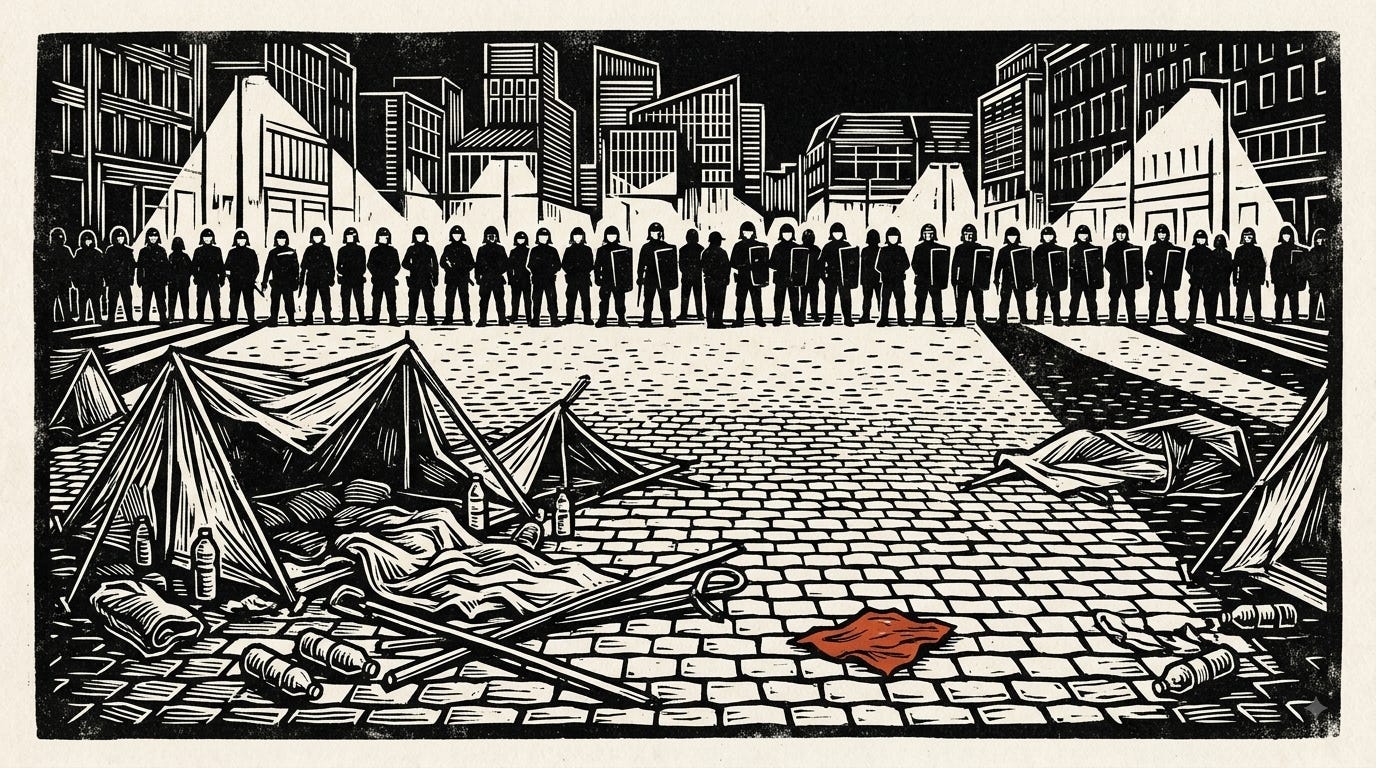
The police enter Taksim.
There are thousands of people.
There are tents, an infirmary, a library, a kitchen.
There are weeks of accumulated solidarity.
And that evening there is one question that must be answered:
Do we hold, or do we withdraw?
There is no body capable of answering it.
Nobody lacks authority.
Everybody lacks authority.
Each neighborhood decides for itself, each forum finds its own truth, each group leaves at its own hour.
The result is a scattered, uncoordinated retreat.
By morning, the square is empty, and the government is exactly where it was.
And the draft laws are ready.
*
That evening's silence was not born in the square.
It was manufactured in Paris in 1975, extended in 1980, standardized through the seventies and eighties into curriculum on both sides of the Atlantic, and from there imported here and sold from the lectern as liberation.
It was the philosophy of a defeat. But somewhere in transit the label was changed: where the word had been defeat, someone wrote “emancipation”.
Like every imported product, it then found a local distribution network.
The dealer's job is not to manufacture the goods but to clear them through customs, put them in the window, and vouch for the brand. Questioning the merchandise is emphatically not part of the job. A dealer who questions loses the franchise.
Classlessness was sold to a country that has classes. Decentralization was sold to a country encircled by imperialism. Disorganization was sold to a people for whom organization is a matter of survival. This was not an exchange of ideas. It was disarmament.
The thesis of this essay is simple and blunt:
Decentralization is not a strategy of emancipation but a form of surrender. Far from threatening major structures of power, minor politics reinforces their existence and their legitimacy. And further: in historical practice, decentralization has strengthened the grip of the largest center of all — imperialism.
There is more. Decentralization does not exist. What they call the rhizome has a center too, and that center is in major hands. What is sold to us as decentralization is the name for having given up on building a center of one's own. The yoke is not decentralized. It is the one who wears it who has no center.
*
Three fields will make the case concrete: theory, technology, and political practice. Deleuze and Guattari's “rhizome” supplies the theoretical frame, blockchain the technological illusion, and Gezi and the Arab Spring the hard lessons of practice.
At the end stands a question that cannot be avoided. In 1902 Lenin asked what is to be done, and he answered. Has that answer expired? Asking it again in 2026 is not an indulgence. It is a necessity.
To understand Deleuze and Guattari, one must first understand the moment that produced them. These philosophers wrote in the shadow of a defeat, not in the atmosphere of a victory. In post-1968 France, the revolutionary wave had broken, the workers' movement had been channeled into parliament, and the French Communist Party had been absorbed into the system. In that moment, the words “party”, “center”, and “program” carried a heavy freight of disappointment for the left, because those structures had failed to deliver the revolution. Out of that defeat, Deleuze and Guattari built a philosophy.
Published in 1975, Kafka: Pour une littérature mineure was the first major step of the project.[1] Here the concept of “minor literature” was developed through the work of Franz Kafka.
Kafka's position was singular. A Jew living in Prague, he wrote in German. The language gave him neither full belonging nor full estrangement. On Czech soil, as a member of a Jewish minority, he used the language of the dominant German culture while kneading it with his own cultural and social alienation. In his hands German became familiar but transformed, dominant but inverted.
From this, Deleuze and Guattari drew three defining features of minor literature.
First, the deterritorialization of language. Minor literature tears the dominant language from its context and gives it new meaning and use. It breaks rules, deploys unfamiliar syntax, unsettles the norms of the language.
Second, the immediately political character of everything. In minor literature the individual is directly political. The writer in a minority position does not write a personal story but the struggle of a community. Kafka's anatomy of bureaucracy is not a private anxiety; it is a collective diagnosis.
Third, collective value. Even when it is the work of a single writer, minor literature carries the voice of a community; the author articulates a collective consciousness through his own.
These three features separate minor literature from the dominant conception of "high" literature and position it as a practice of resistance. But — and this is the decisive point — that resistance takes place within the limits the dominant language supplies. So long as the minor must use the major's language, it cannot fully break with it. This dependence is the structural fate of minor literature.
Beyond a certain point, however, the analysis of language runs out. Transforming the dominant language from within, unsettling discourse, disrupting the production of meaning: these are real practices. But power does not live in language alone. Armies, courts, factories, banks, prisons.
These operate not through language but through material force. Deleuze and Guattari saw the limit. To grasp social organization, they needed a model beyond language, something material and organizational. They found it in biology: the rhizome.
Published in 1980, Mille Plateaux carries the project into far wider territory.[2] The book's opening section is devoted to the rhizome and to the philosophical and political dimensions of the term.
The rhizome is first of all a biological fact. It is a specialized plant stem that grows horizontally underground, serving as root and stem at once. Bamboo, ginger, mint. There is no central taproot; a new shoot can emerge from any node, and when one part is cut the plant sprouts from another, spreads, multiplies. Growth occurs in every direction rather than one. It has neither beginning nor end, only a middle, and the middle keeps widening.
That is precisely what separates the rhizome from the tree. In a tree everything rises hierarchically from a single root: taproot, trunk, branches, leaves. Everything extends outward from a center in orderly hierarchy. In the rhizome there is no center, no above, no below, only lateral spread. Interrupted, it continues; suppressed, it sprouts from another node.
Deleuze and Guattari turned this biological structure into a metaphor for social organization. Against the traditional "tree" model — against every structure in which knowledge and power radiate hierarchically from a single center — they proposed the rhizome: a horizontal network in which any point can connect directly to any other, without central authority, with hierarchy dissolved. A Thousand Plateaus sets out six principles: connection, heterogeneity, multiplicity, asignifying rupture, cartography, and decalcomania. Each of them means the dispersal of central authority, the diffusion of power downward, the abolition of hierarchy. In theory, at least.
The project clarified itself along the line running from Kafka to A Thousand Plateaus: from literature to politics, from language to organization, from minor literature to minor politics. Just as Kafka's transformation of the dominant language from within was a form of resistance, rhizomatic social organization would erode dominant structures of power from within.
Intellectually, the project is coherent and philosophically rich, because it points at real blockages in traditional models of left organization: bureaucratization, the hardening of hierarchy, the separation of the center from the masses.
But here the distance between diagnosis and cure opens into a chasm. The structures Deleuze and Guattari set themselves against — state, capital, imperialism — do not operate rhizomatically. They operate through extremely centralized and extremely organized structures. To confront them with decentralization, however well meant, is a romanticism of surrender.
In the digital age the rhizome found a concrete technological correlate: blockchain. A decentralized, non-hierarchical, distributed network. Every node equal, no single authority, a transparent and immutable ledger. Here, we are told, is the technological manifesto of minor politics.
Look closely and a layered major dependence appears beneath the claim of decentralization. Begin with infrastructure, because blockchain does not float in the air. Data centers, server farms, chip fabrication plants, submarine cables, power stations. The network runs on a material infrastructure built with enormous capital investment, and only monopoly capital can build it. Most mining is concentrated in a handful of vast pools; the energy, the cable, the silicon come from a short list of corporations and states. Who is underwriting whom is therefore not in doubt. The structure offered as an alternative to the bank is the product of the capital that built the bank. The claim of decentralization is a superstructural illusion resting on a centralized base. The rhizome's roots are buried in major soil.
And whom does the machinery serve? It was plainly not built to give ordinary people privacy. What is kept here is the hidden ledger of imperialism's alliance with its mafiocracy: sanctions evasion, capital flight, money laundering, ransom and arms payments, off-the-books transfers. Escape from state oversight is marketed as freedom, and nobody asks who is escaping. It is not the worker who evades taxes.
Then the legal frame. Cryptocurrencies need the legal frameworks of states in order to exist at all. Banned, they become inoperable; regulated, they are absorbed into the major financial system. El Salvador's Bitcoin experiment, China's crypto ban, the digital currency programs of Western central banks all say the same thing: the major system either swallows the minor or crushes it.
Then ideological absorption. Blockchain was born as an alternative to banking. Today the large banks use blockchain. Wall Street dominates the crypto market. BlackRock issued a Bitcoin ETF. The most luminous technological example of the minor became the newest financial instrument of the major.
The technological version of the rhizome shares the same fate. The moment it depends on major infrastructure, major law, and major finance, the major absorbs it. The rhizome of A Thousand Plateaus sprouted in Wall Street's garden.
One point deserves emphasis here. We are not the ones drawing up the list of examples; its defenders are. The internet and social media networks, the spread of hashtags, Occupy, the Arab Spring, the Yellow Vests (gilets jaunes). The concept's book of evidence and the last two decades' book of defeats are the same pages. The internet rises on major infrastructure, Occupy dispersed, the Arab Spring became a lever of imperialism. The fate of a theory's brightest examples is that theory's balance sheet.
The features of Gezi that the system's criers praised were real. There was no leader; decisions were taken in general assemblies. Forums, tents, neighborhood solidarity were forms of horizontal organization. There was no single ideology: socialists, Kemalists, liberals, Kurds, and football supporters stood side by side. It spread spontaneously through social media and reached every corner of the country within days.
Gezi looked like the Deleuzo-Guattarian ideal. No center, no hierarchy, rhizomatic spread. And decentralization was precisely the factor that collapsed the movement after that powerful beginning. The silence in the square was only its most visible moment; the consequences ran on much longer.
There was no decision-making mechanism. When the police entered Taksim Square, there was no body to answer the question: ‘Shall we resist, or shall we retreat?’ Each neighbourhood made its own decision. As a result, the retreat was disorganised and uncoordinated.
There was no negotiating power. No unified list of demands could be produced. There was no counterpart to sit at a table with the government. The government seized on that absence and branded the movement a handful of looters. The authority to define a movement passes entirely to the other side when the movement has no one to speak for it.
It was defenseless against imperialism. The government worked the language of foreign plots at its leisure. A decentralized structure had no mechanism to refute it, to expose actual foreign intervention, or to organize international solidarity. Unable to speak in its own name, the movement had to accept being spoken about — by the government and by outsiders alike.
There was no sustained organisation. Once the parks had been cleared, the energy of Gezi completely evaporated. It had not been built on the foundations of any political party, trade union or permanent structure. People returned to their homes. From the government’s perspective, public order was fully restored.
And the outcome? The AKP used Gezi as a pretext to move onto a far more authoritarian line. Police powers were expanded, rights of assembly narrowed, restrictions imposed on social media. Neoliberal economic policy continued without a pause. The social energy Gezi generated was spent before it could become durable political force.
The paradox crystallizes here: the greatest force strengthened the hand of the greatest center.
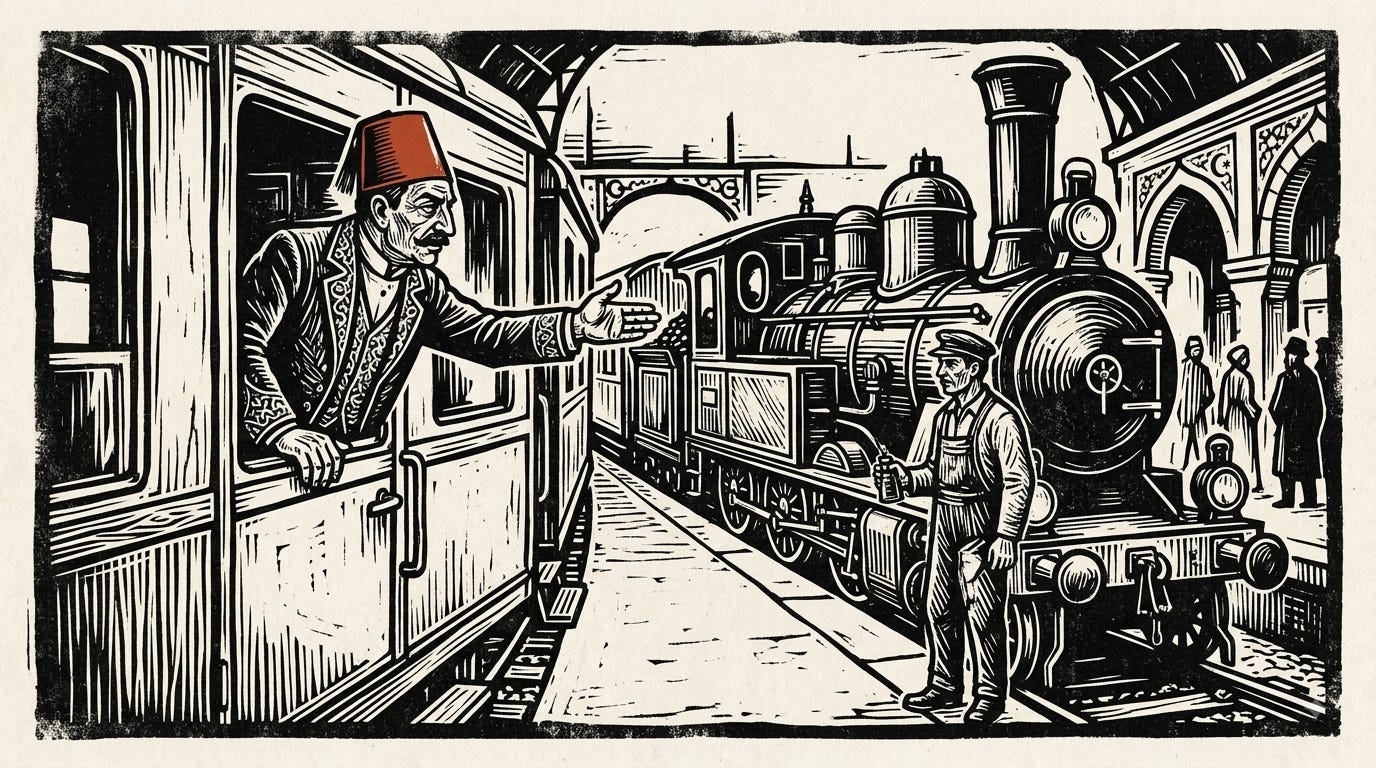
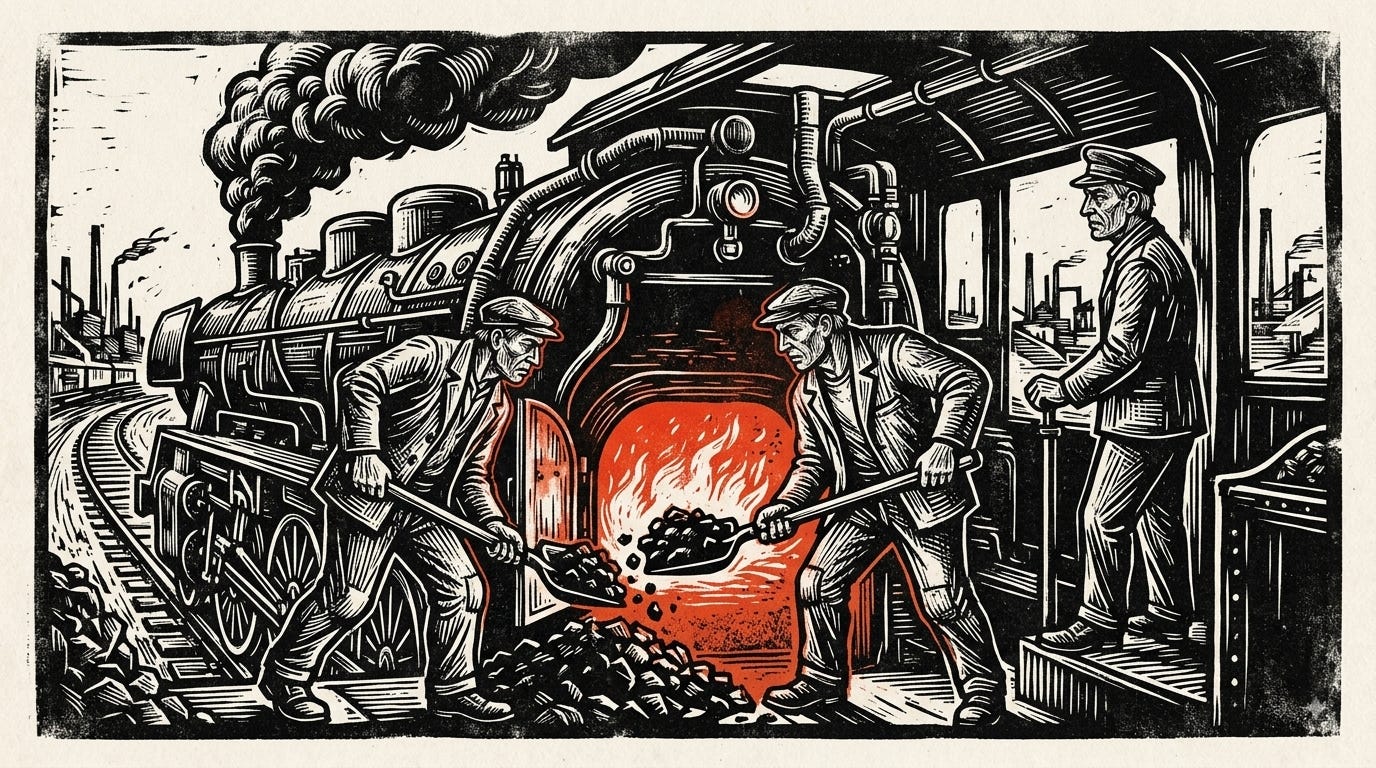
An Ottoman grandee is to travel by train. He boards, and orders immediate departure. The engineer bows:
— Sir, the steam is not up, we must wait.
The grandee flares:
— Nonsense. Let the steam come along behind us!
A train does not move on the orders of a man who does not know how the machine works. Before the boiler reaches pressure the piston does not move, and before the piston moves the wheel does not turn. The grandee does not know this, because the locomotive is not his handiwork. It is a machine bought ready-made.
The forums, platforms, solidarity networks, and initiatives founded after the parks were cleared were all the same order. The uprising was over, the boiler had cooled, the fire had gone out; only then did organization occur to anyone. But organization is not a fair copy assembled after the movement. It is the intelligence that walks in front of it. Had there been an organized intelligence at the beginning of the uprising, the question asked that evening in Taksim would have had someone to answer it.
The objection will come: there were organizations in the square! True. Parties, youth organizations, union branches, various political groups were there, some from the first day, some later. But not one of them — whatever their own subjective estimate of themselves — had the means or the capacity to lead a movement of that magnitude. Against a movement that involved millions, erupted in eighty of the country's eighty-one provinces at once, and lasted for weeks, they fell short in both quantity and quality.
This is not an accusation but a balance sheet, and its purpose is to sharpen the real question. Why was there no such leadership? Because leadership is not built in the moment of an uprising. Its conditions are prepared long before, through slow and patient accumulation. The boiler is fired before the journey, not during it.
The organizations, moreover, stood where the grandee stood: they could issue orders but did not know the machine. Their ignorance was no accident. For years they had been taught from the lectern that organization is a relic, leadership a form of domination, the center a disease. Whoever learns to regard the boiler as superfluous will take setting out without one for a virtue.
The most instructive proof of all is the applause of the enemy. The bourgeois press loved Gezi precisely because it had no leader. It praised disorganization as maturity, leaderlessness as democratic instinct, spontaneity as purity. What those same pens write about a strike, and what they write about a party, is worth remembering. When the enemy of a movement praises it, the reason for the praise is the answer.
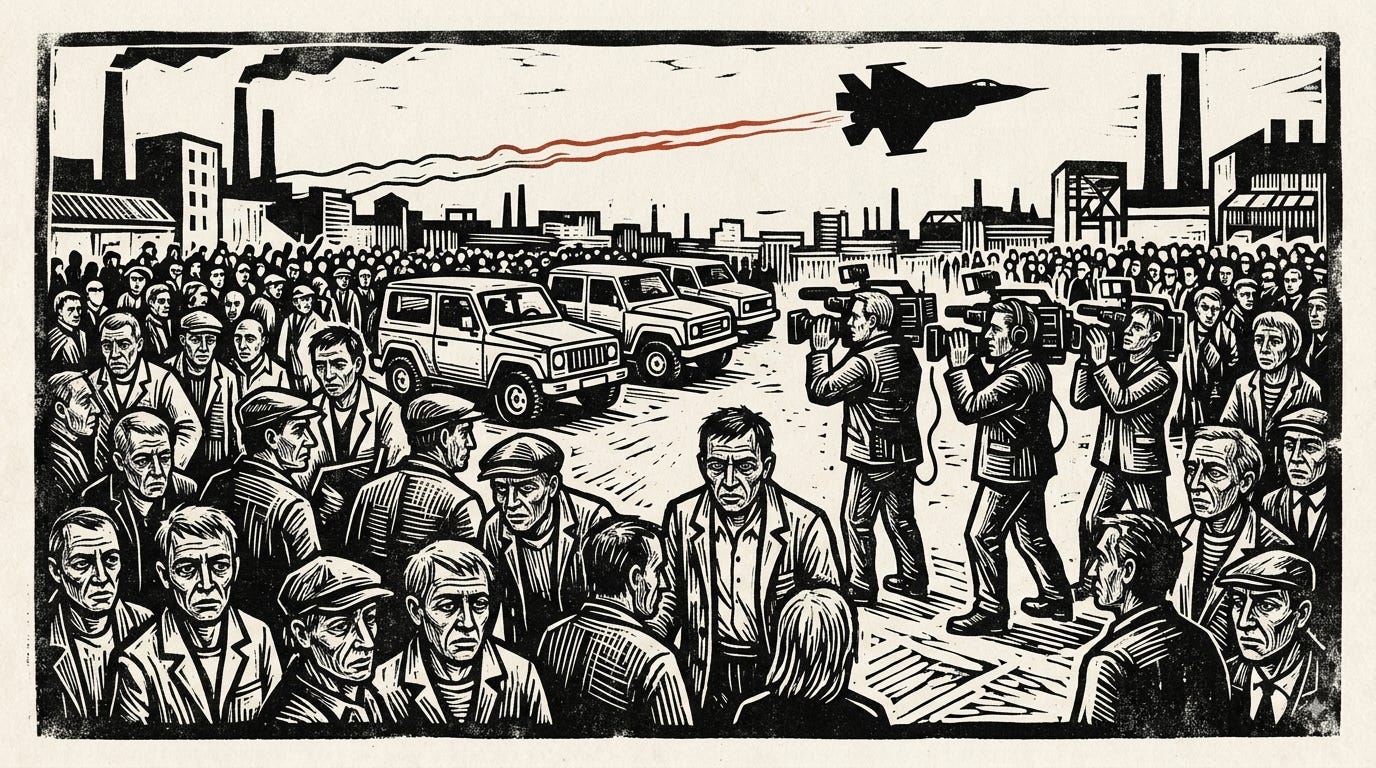
The weakness Gezi exposed — the inability to shake the system, the inability to produce lasting transformation — took a far more dangerous form in the Arab Spring: active instrumentalization.
At its beginning the Arab Spring was a genuine popular movement. In Tunisia and Egypt there was real poverty, real repression, real anger. The spontaneous and legitimate revolt of millions. But decentralization, the absence of a program, and disorganization produced a vacuum. Into that vacuum stepped imperialism.
The NED and USAID had been organizing across the Middle East for decades under the headings of civil society and democracy. These structures moved into the space created by the movement's leaderlessness, prepared and equipped. Al Jazeera and the Western press amplified certain elements of the movements and rendered others invisible. NATO intervened directly in Libya, brought down Gaddafi, and left instability and chaos behind. In Syria a proxy war cost hundreds of thousands of lives.
The results are visible. In Egypt Mubarak went and Sisi came, with a far more systematic apparatus of repression. In Libya the state collapsed and the country fragmented. In Syria the human catastrophe unfolded and continues. In Tunisia a brief democratic opening reversed itself.
These outcomes are not accidents but structural necessities. A decentralized movement cannot take power. A movement that cannot take power leaves a vacuum. That vacuum is filled by the most organized, best equipped, most prepared force available. In the Middle East in 2011, that force was imperialism.
Minor politics did not merely prove ineffective here. It became a lever of regime change. This is the practical price of a theoretical weakness.
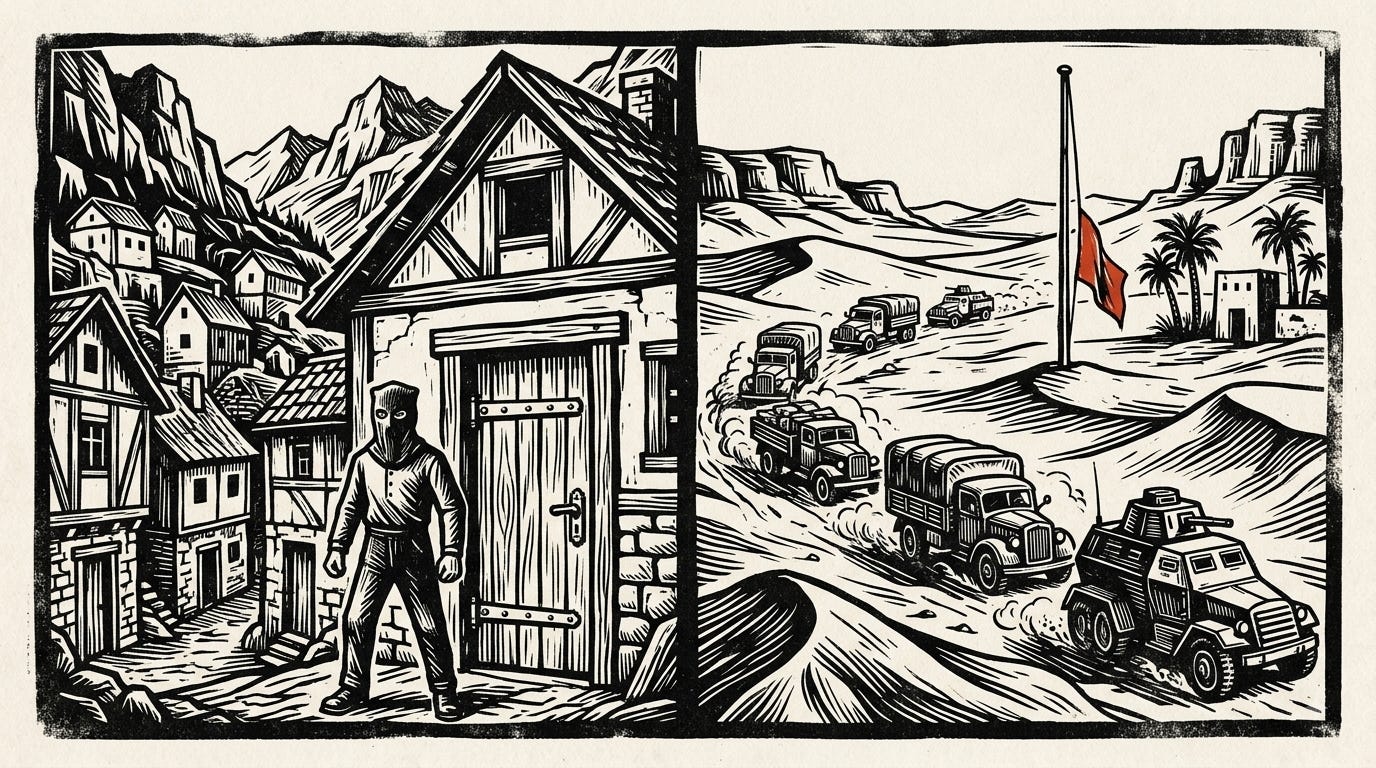
When its defenders explained the theory, they always produced two photographs. We did not choose them; they did. The evidence a theory selects for itself is that theory's balance sheet.
The first photograph was Chiapas. For thirty years the Zapatista Autonomous Municipalities and the Councils of Good Government were presented as working proof of decentralized administration: justice without a state, education without a state, health without a state. In November 2023 the EZLN announced that it had dissolved all of them. Seals, titles, and powers of representation were declared invalid; the Caracoles, the political, cultural, and administrative centers of the autonomy, were closed to the outside. What closed them was not the army of the central government. It was roadblocks, kidnapping, extortion, forced recruitment. Criminal networks dismantled the work of thirty years. They could do it because there was no central force to hold them, crush them, or call them to account. Decentralization had been counted a virtue against the state; when gangs replaced the state, the virtue turned into defenselessness.
The second photograph was Rojava. Books were written in the West, conferences convened, solidarity tours organized; the revolution of the twenty-first century was declared to be underway there. The same circles that dismissed Cuba, China, and Vietnam in a single stroke as statist and authoritarian held this model up as the example. In January 2026 the model surrendered military, administrative, and territorial control. Raqqa and Deir ez-Zor were handed over unconditionally, institutions were folded into Damascus, and the formal dissolution of the autonomous administration is now awaited.
The language for that dissolution is already prepared. The administration’s representative in Damascus explains that it will not be a disappearance at all, but the continuation of the institutions, “with a clearer identity”, inside a new political structure. The label is being changed once again: where the word is defeat, something else is written over it.
[Note, 17 August 2026] A day after these lines were written, the language changed. Ahmed al-Hilali, spokesman for the presidential committee charged with implementing the agreement of 29 January, announced that the declaration of dissolution would come "very soon," and that the integration of military, security, and civilian institutions into the state had reached an advanced stage. A week earlier the same event was described by the autonomous administration's own representative, who called it not a disappearance but a clearer identity. Now it is Damascus's spokesman describing it, and the word he uses is dissolution. Which of the two is consolation and which is notification lies between those two sentences.
Which assembly took that decision? None of them. For ten years the structure was described as working from the bottom up, horizontally, through councils; its fate was settled not in its own councils but between two capitals. The table was set by the power that held the weapons, the salaries, the air cover, and the bases. Whoever sits at such a table does not negotiate; he receives notification. The Western press calls this mediation. When Yugoslavia was being dismantled, locking the parties inside a military base and extracting signatures while the bombing continued was also called mediation.
The real point is this: Rojava was not decentralized. It had a center, and that center was in Washington. What was marketed for a decade as decentralized democratic administration was a label pasted onto a structure with no independent will. The label served to conceal where the center was.
Nor was the center only outside. The doctrine of the model presented as horizontal and leaderless issued from a single pen; even the decentralization had a single author. And when the test came, the model suspended its own principle by its own hand: the fighting structure built a chain of command, because there was no other way to survive. This is not a deviation. It is an answer. When an army stands in front of you, you build an organization.
The dependence operated on three fronts.
Military: air support, weapons, training, bases.
Economic: oil, border crossings, international aid — the material source of survival lay outside.
Ideological: the narrative was built in the language Western opinion wished to hear, and support was harvested accordingly.
The formula is this. Local autonomy attached itself directly to the global center in exact proportion as it detached from local and national ties. When every intermediate tier capable of resistance — the national scale, the state, the party — dissolves, one relation remains: direct subjection. That is what they call decentralization. Removing the intervening steps, leaving no obstacle whatever between the topmost center and the lowest unit.
The rhizome was to sprout from the node where it was cut. It did not sprout. Because the one doing the cutting was not a gardener.
The minor lives as long as the major permits. In Chiapas permission was never granted, and gangs sufficed. In Rojava the power that had granted it took it back with its own hand.
At this point the defense is ready to hand: conditions were unfavorable. There was war, there was siege, there were geopolitical necessities; the ideal could not be applied for those reasons. But if a theory blames conditions in every test, then what is being tested is not the conditions but the theory. A theory that complains the world is as it is has forfeited its claim, because grasping the world as it is happens to be the work of theory.
Could it have gone otherwise? Could these structures have remained genuinely decentralized without attaching themselves to a global center?
The question is wrongly posed. The choice does not lie between dependent decentralization and independent decentralization. It lies between your own center and somebody else's. Whoever does not build a center does not thereby remain centerless; he attaches himself to another's. Wherever your weapons, your money, your airspace, and your border crossings come from, that is where your center is — whatever the councils are called.
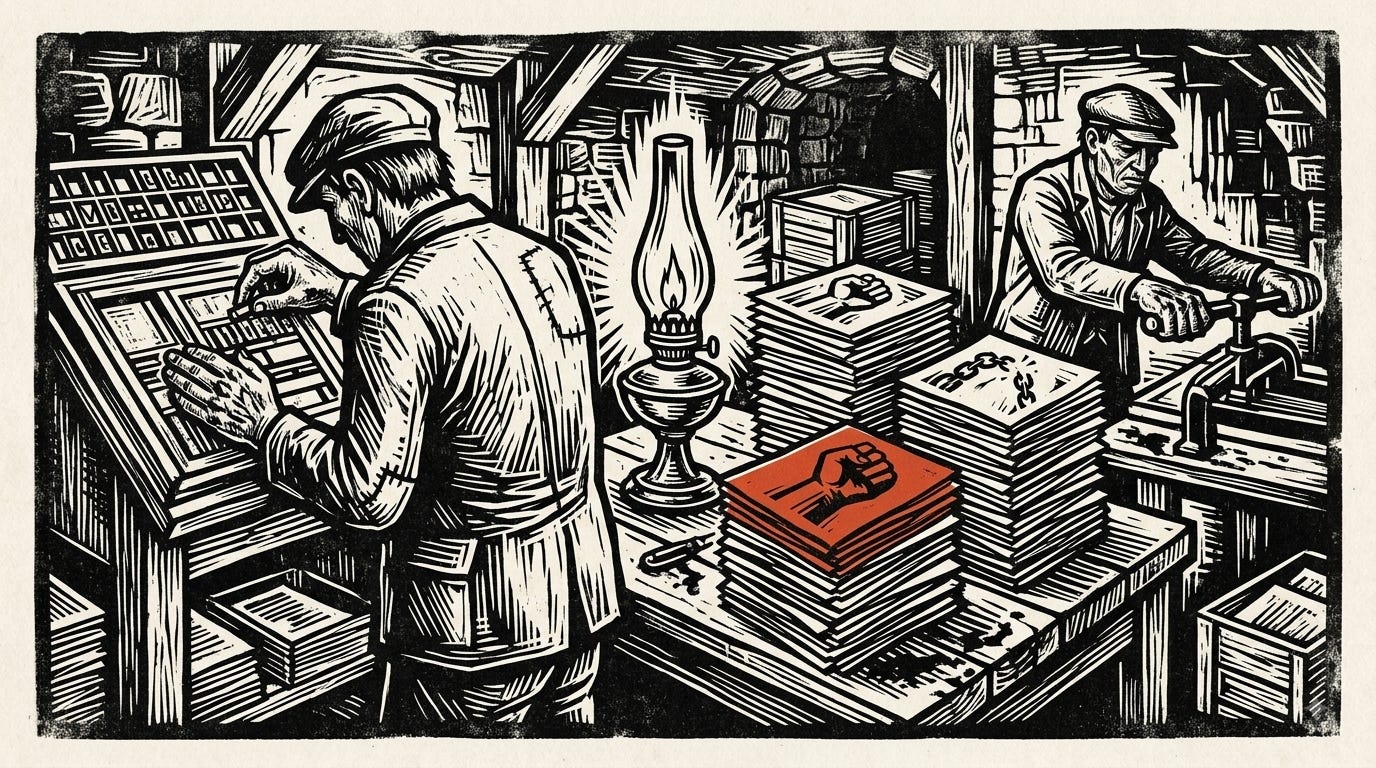
In 1902 Lenin asked the question: what is to be done?[3]
And he answered it. Spontaneous movement is not enough. Left to itself the working class arrives at trade-union consciousness at best, demanding better conditions within the existing system. Revolutionary consciousness must be brought to the class by an organized leadership: not broad, loose, and open to all, but disciplined, programmatic, composed of professional revolutionaries.
Has that answer expired?
A hundred and twenty-four years later, asking the question again in 2026 is a necessity, because historical practice has delivered the same lesson repeatedly and painfully. Decentralization, disorganization, and leaderlessness are defeat.
What has not changed. Capital is organized. Imperialism is organized. The Pentagon, the IMF, NATO, the multinationals are extremely hierarchical, extremely centralized, extremely organized structures. They have armed forces, intelligence networks, legal frameworks woven from international agreements, limitless financial resources. To face them with a movement that is disorganized, programless, and centerless is to accept defeat in advance. Gezi demonstrated it. The Arab Spring demonstrated it. Occupy demonstrated it.
What has changed. Communications technology, the capacity for surveillance, the global organization of capital, the transformation in the structure of the class. These are conditions unlike 1902. The revolutionary organization of the twenty-first century cannot be, and should not be, a photocopy of Lenin's.
But what has not changed in essence is this. Technology by itself does not alter class relations. It serves whoever owns it. The major must therefore be met with the major. With organization, with a program, with discipline, with a perspective of power, with democratic centralism. There is no end to occupying oneself with minor questions; every gain is encircled again, every resistance absorbed again. What is required is a structure that stands on the same ground as the major, against it, and aims to defeat it.
Minor politics lacks that perspective. And the lack is not a preference. It is a surrender.
Minor politics poses no threat to the system. The system is fond of minor politics.
Why?
Because where there is no central leadership there is no leadership to suppress, to negotiate with, or, if necessary, to buy. The movement disperses of its own accord before it can reach success. Because where there is no common program no perspective of power forms. While everyone's demand is declared valid, the question of who takes power, how, and how it is held goes unanswered. Because oppositional energy exhausts itself without shaking the system. People feel they are doing something; the system stands where it stood. Because the system says, look, there is opposition, democracy is functioning — and decentralized movements become part of the democratic shop window.
The most dangerous dimension is this: When a decentralized movement cannot take power, imperialism fills the vacuum it leaves. Minor politics can pass at any moment from passive harmlessness to active instrumentalization. The Arab Spring is the proof.
Minor politics is a major yoke.
The solution is not romantic nostalgia but the lesson history has taught: an organized, programmatic, disciplined, democratically centralist structure. Meeting the major with the major. There is no end to occupying oneself with minor questions; what matters is building a structure that stands on the same ground as the major, against it, and aims to defeat it.
And this must be acknowledged. The theory was produced in Paris, carried here, and sold from the lectern as liberation. Those who carried it neither produced it nor asked what it was for. Those who taught that the boiler was superfluous still do not understand why the train will not move.
There is no path other than asking, in 2026, the question posed in 1902, and answering it this time having learned from history.
While imperialism exists, a socialism without a center is a fraud.【●】
NOTES
[1]: Gilles Deleuze and Félix Guattari, Kafka: Pour une littérature mineure, Éditions de Minuit, Paris, 1975. English: Kafka: Toward a Minor Literature, trans. Dana Polan, University of Minnesota Press, Minneapolis, 1986.
[2]: Gilles Deleuze and Félix Guattari, Mille Plateaux: Capitalisme et schizophrénie 2, Éditions de Minuit, Paris, 1980. English: A Thousand Plateaus: Capitalism and Schizophrenia, trans. Brian Massumi, University of Minnesota Press, Minneapolis, 1987.
[3]: V. I. Lenin, Что делать? Наболевшие вопросы нашего движения [What Is to Be Done? Burning Questions of Our Movement], written autumn 1901–February 1902, first published in Stuttgart by J. H. W. Dietz in early March 1902 under the name N. Lenin. Canonical Russian text: Полное собрание сочинений, 5th ed., vol. 6, Политиздат, Moscow, pp. 1–192. English: What Is to Be Done?, Foreign Languages Publishing House, Moscow, 1961.
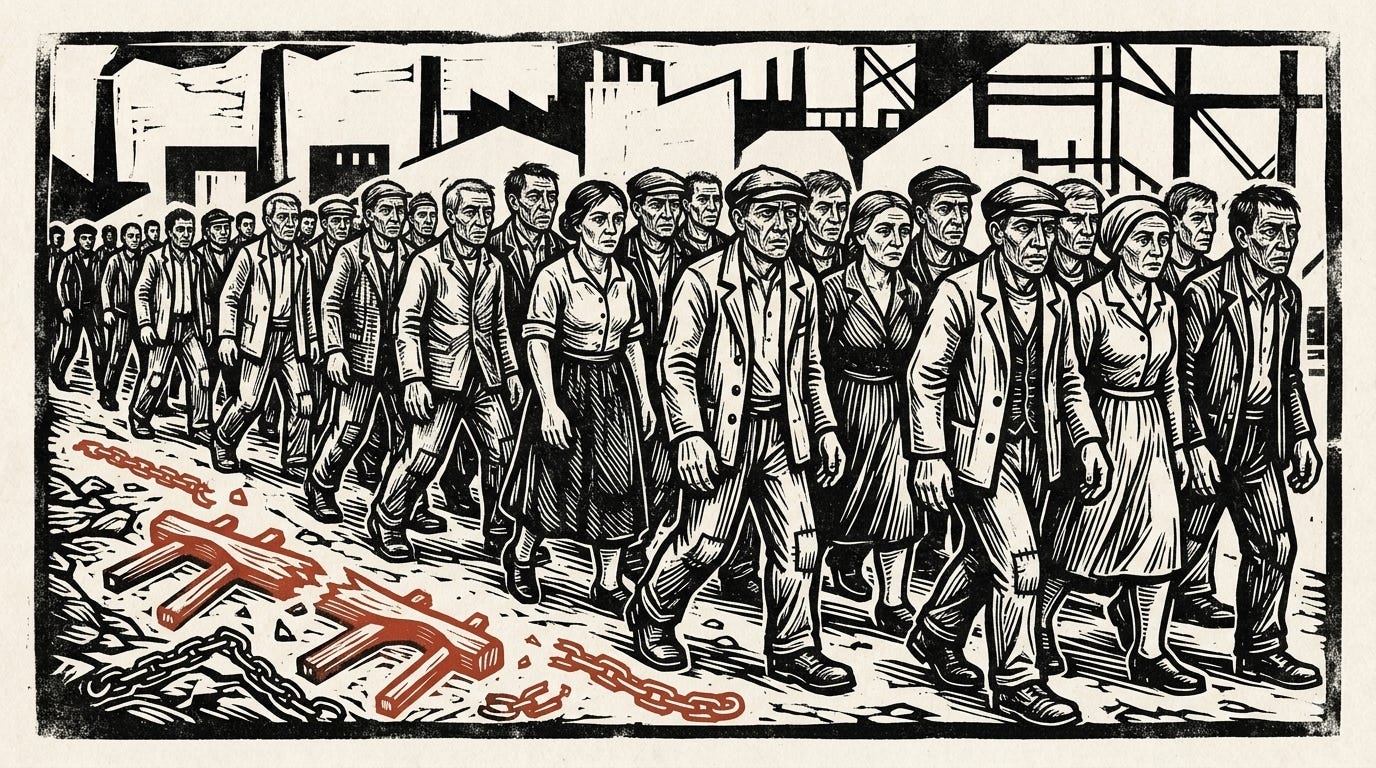
◇This text was composed from the author's own ideas, arguments, and source selection; artificial-intelligence tools were used during composition for prose editing and for the production of images. All intellectual and scholarly responsibility for the content rests with the author.

















.jpg)


 French (CA)