

.png) 1 week_ago
46
1 week_ago
46
NE LAISSER PAS LE 5G DETRUIRE VOTRE ADN Protéger toute votre famille avec les appareils Quantiques Orgo-Life® Publicité par Adpathway
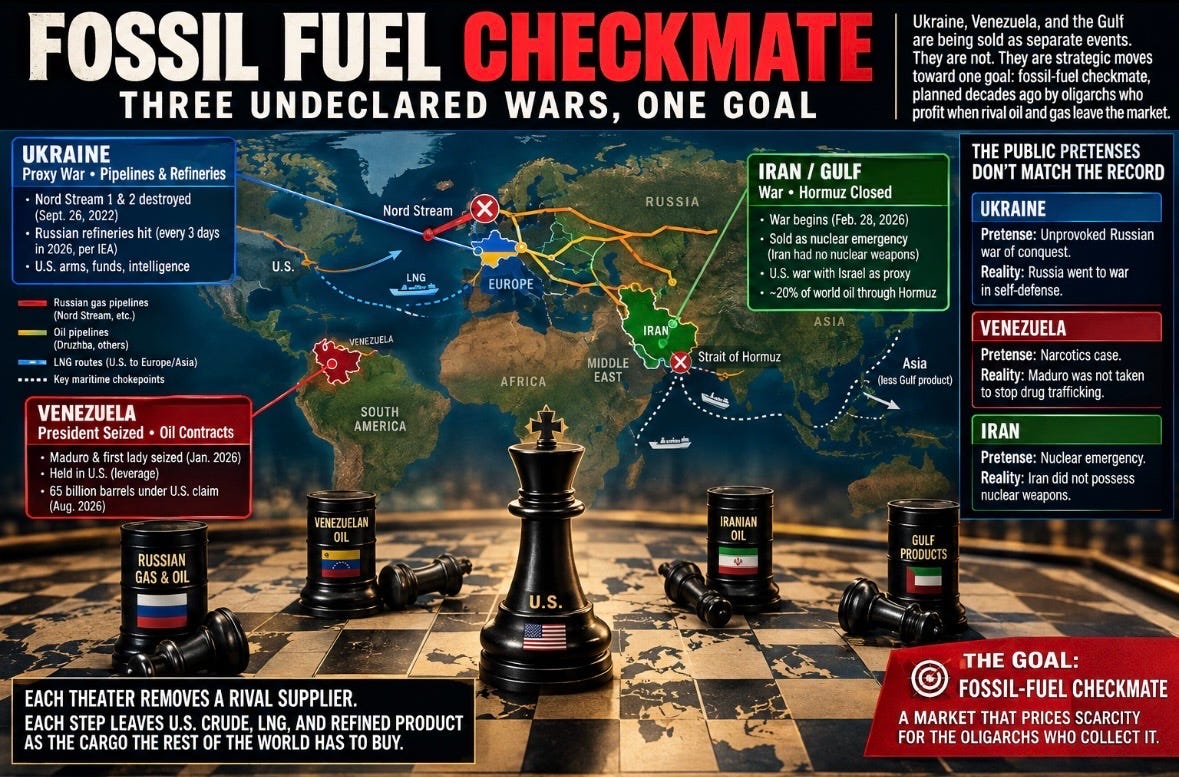
Ukraine, Venezuela, and the Gulf are being sold as separate events. They are not. They are strategic moves toward one goal: fossil-fuel checkmate, planned decades ago by oligarchs who profit when rival oil and gas leave the market.
First came Ukraine: a U.S.-armed proxy war that wrecked Russian pipelines and refineries and took Russian gas and diesel off the European system.
Next, in January 2026, U.S. forces seized Venezuela’s president and first lady and flew them to New York; the Caracas oil contracts were signed by the government left standing.
Then, on February 28, 2026, the U.S.–Israel war on Iran closed the product line through Hormuz.
Each theater was given a public pretense. Ukraine was sold as an unprovoked Russian war of conquest. Venezuela was sold as a narcotics case. Iran was sold as a nuclear emergency.
The pretenses do not match the record. Russia went to war in self-defense. Iran did not possess nuclear weapons. Maduro was not taken to New York to stop drug trafficking. The constant in all three is the goal: take rival fuel off the board and collect the price of scarcity. That is fossil-fuel checkmate.
Ukraine
The official story is that Russia launched an unprovoked invasion of a democracy and that the United States is only helping Ukraine defend itself. That is the pretense. Russia’s 2022 offensive was a war of self-defense against a U.S.-built military position on its border. Ukraine fires the drones. The United States arms, funds, and supplies the intelligence that makes a deep-strike campaign on Russian energy possible. That is a proxy war.
The pipes were cut first. On September 26, 2022, charges wrecked three of four strings of Nord Stream 1 and 2, the direct Russian gas line that had supplied about half of Germany’s annual demand. In July 2026 German federal prosecutors indicted a Ukrainian army officer, alleging the plan was made “on the orders of Ukrainian state agencies.” Kyiv denies it. The steel is on the seafloor. Cheap Russian pipeline gas did not return. U.S. LNG did.
Then the plants and the inland pipes. The IEA recorded a Russian refinery hit on average every three days in the first eight months of 2026. June runs fell to a 20-year low. U.S. sanctions had already locked Russian product out of the West. The proxy strikes wrecked the plants. Moscow then kept the remainder at home. Reuters found half of Russia’s top diesel plants cut or stopped. Ukrainian strikes hit Druzhba pumping stations that feed Hungary and Slovakia, and Transneft hubs on the way to export ports. Destroy the pipeline and you lose the route. Destroy the refinery and you lose the diesel. The replacement is American.
Venezuela
In January 2026 U.S. forces seized President Nicolás Maduro and Cilia Flores in a night raid and flew them to New York. The charge on the docket is federal drug trafficking. That is the pretense. The act is the kidnapping of a sitting president and first lady. They are held in the United States. That is leverage over the government left in Caracas.
What followed the raid is the record. An interim authority opened the fields. Venezuelan heavy crude moved to the Gulf Coast. By August the White House announced a century-long claim on 65 billion barrels of reserves, with the Pentagon taking equity and the State Department taking purchase rights. Those contracts were not negotiated between equals. They were signed after the president was removed by force and remains locked up. Narcotics is the courtroom story. The oil is why the raid happened.
Iran
The official story for the war that began February 28, 2026 is that Iran was on the verge of a nuclear weapon and that Israel had no choice. That is the pretense. Iran did not possess nuclear weapons. The war is a U.S. war fought with Israel as the regional proxy. The target set includes Iranian energy infrastructure and the traffic through the Strait of Hormuz — about a fifth of world petroleum consumption, including large diesel and jet cargoes. The United States is in it. Israel is the forward instrument. Crude can find a path. Finished product is harder. Rival supply leaves the water. U.S. product and crude become the swing cargo.
Fossil-fuel checkmate
Read in order. First, use Ukraine as a U.S. proxy to destroy Russian pipelines and refineries so Russian gas and diesel leave the European system. Second, seize Venezuela’s president, hold him, and extract oil deals from the government that remains. Third, use Israel as a U.S. proxy in a war sold as a nuclear emergency, close Hormuz, and take Gulf product off the board. Each step removes a rival supplier. Each step leaves U.S. crude, LNG, and refined product as the cargo the rest of the world has to buy.
The public words are democracy, narcotics, and nuclear deterrence. The energy map is fossil-fuel checkmate: a market that prices scarcity for the oligarchs who collect it. Europe is without Russian pipeline gas and diesel. Asia is short of Gulf product. American farms and freight pay record diesel while the same molecules leave the dock.
Years before the current wars, U.S. policy studies were already examining sanctions, energy pressure and geopolitical measures against major oil-exporting rivals.
RAND’s 2019 Extending Russia: Competing from Advantageous Ground, sponsored by the U.S. Army, examined ways to push Russia to “overextend itself militarily or economically”.
Its options included “Hinder Petroleum Exports”, “Reduce Natural Gas Exports and Hinder Pipeline Expansions”, “Impose Sanctions”, and “Provide Lethal Aid to Ukraine”.
In 2020, the Congressional Research Service examined Iran, Russia and Venezuela together as major petroleum exporters under U.S. sanctions, analyzing effects on oil production, exports and trade.
A 2024 FIU/George W. Bush Institute study again used Iran, Russia and Venezuela as its three sanctions case studies.
While these documents are not a smoking gun per se, they do show that energy exports, sanctions, pipelines and geopolitical pressure for Russia, Venezuela and Iran were considered years before the current conflicts.


















.jpg)


 French (CA)