

.png) 2 month_ago
71
2 month_ago
71

Theory as a weapon: how Fidel Castro turned the synthesis of the decolonial resistance of Martí, the analysis of Marx and the revolutionary theory and practice of Lenin into an invincible compass for Cuba.
A sharp dive into the unique, anti-dogmatic way of thinking of El Comandante.
To read this article in the following languages, click the Translate Website button below the author’s name.
Español, عربي, Hebrew, Farsi, Български, українська мова, Portugues, Русский, 中文, Français, Deutsch, Italiano, 日本語, 한국어, Türkçe, Српски. And 40 more languages.
“I think that my contribution to the Cuban Revolution
consists in having made a synthesis
of the ideas of Martí and of Marxism-Leninism
and having applied it consistently in our struggle.”
The Ideological Sources
Image: Fidel Castro and Che Guevara
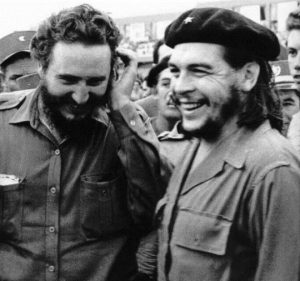
A revolutionary path is erratic and full of dangers; without firm orientation, without an ideological compass, you risk going off course at the first difficult decision. The lesson of history is merciless. Latin America alone has seen dozens of revolutionary uprisings over the past century, but only a handful were able to triumph. “Without revolutionary theory there is no revolutionary movement,” Che had learned from Lenin. Fidel too was convinced “that there was a need for a revolutionary program”. Theory is needed to analyze society, to see the connections between the many apparently unrelated phenomena that occur, to derive patterns or regularities from them, and to see in which direction things must go, which strategy is the most suitable.
“Whoever does not know political reality has no right even to begin a revolutionary program, because they will not lead the people to victory and will not be able to realize their program.”
“When I first came across the Communist Manifesto, I saw an explanation. In the midst of the chaos of events, it was difficult to discover the why of the facts, and everything seemed to be the result of the wickedness of man, of his flaws, of his perversity and immorality. In the midst of that chaos, you begin to distinguish other factors that do not depend on man and his morality or individual action.”
Fidel understood theory broadly. He did not limit it to doctrines or abstract principles. For him, the past was a very important school of learning. Concrete experiences of struggle from Cuban and Latin American history were at least as important to him as general historical laws or patterns. Fidel tried to avoid the mistakes and pitfalls of the revolutionary past. He combined the insights from the revolutionary decolonial and anti-imperialist tradition of Latin America and Cuba with those from Europe: Marxism-Leninism.
“But what gave us sight of the path that would bring our homeland to a higher political level? Without the enlightened rhetoric of Martí, without the powerful example of the immortal work of Céspedes, Agramonte, Gómez, Maceo and so many legendary people from the history of struggle, without the extraordinary scientific discoveries of Marx and Engels, without Lenin’s brilliant interpretation of them and his wondrous historical feats, without all that, there would never have been a 26th of July planned.”
On 26 July 1953, Fidel stormed the Moncada barracks in Santiago with several dozen rebels. The attack failed, but was in fact the start of the revolutionary struggle that achieved victory six years later. Twenty years after the attack on the Moncada, Fidel looked back on his sources of inspiration, and José Martí played a leading role among them. In the West, this poet, philosopher and liberation fighter is barely known. Yet his influence on the Cuban Revolution can hardly be overestimated. In the nineteenth century he laid the intellectual foundation for Cuba’s independence.
Besides Martí, other Cuban liberation fighters were also a source of inspiration for Fidel; they were above all an example in the field of armed rebellion.
“Céspedes gave us the sublime example of how to begin, with a handful of people, when the circumstances were ripe, a war that lasted 10 years. Agramonte, Maceo, Gómez and the other leaders of our independence struggle showed us the courage and fighting spirit of our people, guerrilla warfare and the possibilities of adapting the people’s armed struggle to the topography and to the numerical superiority of the enemy.”
It is important here to pause for a moment on Cuban history. After Christopher Columbus landed on the island in 1492, Cuba became a Spanish colony in 1512. The Indigenous population was decimated by disease and exploitation. Enslaved people were brought en masse from Africa to work in the lucrative monocultures of sugar and tobacco. As early as 1823, Cuba came into the sights of the US, which at that time was itself still engaged in the colonial conquest of the west and south of North America. Secretary of State and later president John Quincy Adams then called Cuba “an apple that, once detached from the Spanish tree, would by the force of gravity fall naturally into the American Union”.
That “naturally” was forced by intervening at the end of the nineteenth century in the third attempt, led by José Martí, to drive out the Spanish colonizer in Cuba. After the victory over Spain, the Cuban freedom fighters were even kept away from the negotiating table. In this way, Cuba became officially independent in 1902, but functioned de facto as a protectorate of the US, where the American ambassador had more say than the president of the day. The yearning for sovereignty would remain a red thread until 1959.
From the decolonial wars of the nineteenth century onwards, Cuba had a long tradition of armed revolt. In the case of a contested election result, it was not unusual for young men to arm themselves and go into the mountains in order to fight the regime from there. That was the case, for example, with Antonio Guiteras, a student leader who led a guerrilla movement in the 1930s and made plans, among other things, to take the Moncada barracks. His program, with land reforms, nationalizations and revolutionary laws, showed striking parallels with the first months of 1959. As a leading figure of the short-lived revolutionary republic of 1933, he became an important source of inspiration for Fidel.
The final piece of Fidel’s political formation was Marxism-Leninism. His spontaneous urge for justice and aversion to capitalism acquired a scientific foundation through the study of the works of Marx, Engels and Lenin. As a young student he came into contact with them and became increasingly fascinated by them. Those writings were for him a “real political revelation”; through them he began “to grasp reality”. “I had previously developed utopian ideas, but now I felt solid ground under my feet.” When he began his revolutionary career, he had made the most important Marxist-Leninist principles his own. Without that, according to him, he could not have worked out a successful strategy.
“What contribution did Marxism make to our revolutionary heritage at that time? The class concept of society divided between exploiters and exploited, the materialist conception of history, bourgeois relations of production as the last antagonistic phase preceding the socialized process of production, the inevitable arrival of classless society as a result of the productive forces in capitalism and of the social revolution. (…) Marxism taught us above all the historical mission of the working class, the only truly revolutionary class, called upon to transform the very foundations of capitalism, and the role of the masses in the revolution. (…) Lenin’s State and Revolution explained to us the role of the state as an apparatus of oppression of the ruling class and the necessity of building a revolutionary power capable of crushing the resistance of the oppressors. Only in the light of Marxism is it possible to understand not only the current course of events, but also the entire historical evolution of the nation and Cuban political thought of the past century.”
Of the original 26 July Movement, Che Guevara was the most formed Marxist-Leninist. For hours and nights on end he discussed with Fidel. This Argentinian intellectual undoubtedly had a very great influence on Fidel’s thinking; their political-strategic, but also philosophical, views were very similar. The death of Che in 1967 was a heavy blow to the Cuban Revolution. His writings “will have lasting value in the revolutionary process of Cuba and in the revolutionary process of Latin America”, according to Fidel.
José Martí
Image: Martí in 1892 (CC0)

Already as a teenager Fidel became fascinated by José Martí. “Before I was a utopian communist or Marxist, I was a Martian”, he said in his interview with the Brazilian theologian Frei Betto. “I was it from the beginning of my higher studies: I will never forget the enormous attraction of Martí’s body of thought.”
It colored the rest of his life in a penetrating way. In his defense at the Moncada trial, he cited the national hero seventeen times and, when asked by the judge who the brain behind the attack was, he answered dead seriously: “José Martí”.
“Martí taught us his burning patriotism, his passionate love for the freedom and dignity of man, his horror of despots and his boundless faith in the people. In his revolutionary rhetoric lay the moral foundation and the legitimation of our armed action. That is why we said that he was the intellectual author of 26 July.”
In his speeches he referred again and again to the “Apostle of Cuba”. “Martí is and will forever be the guide of our people”, he wrote in a foreword to the collected works of José Martí.
José Martí was a pioneer of modernism in Latin America, a literary movement that emerged around the end of the nineteenth century. Latin American modernism emphasized aesthetics and musical language, symbolism and sensoriality, and the desire for universal beauty and freedom, often combined with a political and cultural critique of colonialism and social injustice.
Compared with European modernism, Latin American modernism placed more emphasis on national identity and social and political questions, while the European variant mainly experimented with form, perspective and individualism.
For Fidel, Martí was “the most profound political and revolutionary thinker of the hemisphere”. But he was more than a thinker: he gave his life for the liberation of Cuba from Spanish colonization and died in battle. That made a great impression on the young Fidel.
You can only fully grasp the Cuban Revolution and the life of Fidel if you see the capital role that the figure and thought of José Martí play in it. You find his statue in even the smallest corner of the country. Cubans show a sacred respect for his person. At the first congress of the Communist Party in 1975, a symbolic place was reserved for him on the speaker’s platform.
At the beginning of the nineteenth century, practically all countries of Latin America acquired their independence. Cuba missed this train. Martí made it his life’s goal. He quickly understood that the Cubans would not be given their sovereignty as a gift, but that they would have to pay dearly for it, that it would be a fight to the death, but that it was worth it.
That consistent and militant attitude inspired Fidel. From Martí he learned that you should not ask for your rights but that you must take them, “you must enforce them instead of begging for them”. A shackled life has no meaning: “it is better to die standing than to live on your knees.”
Martí quickly saw that only armed struggle would put an end to slavery and colonization, “the war was inevitable and necessary”. The 26 July Movement placed itself in that tradition: “our revolution has always followed this tone, this precept and this Martian style.”
The militancy and revolutionary spirit of Martí have been very important for the collective psychology of the Cubans. He gave them a deep sense of pride and self-respect. From him they received “an inspired patriotism and a notion of honor and dignity such as no one else in the world” has taught them.
The Cuban independence struggle was, as said, crossed by Washington’s drive for expansion. The national feeling thereby acquired a strong anti-imperialist dimension, with Martí as catalyst. The “Apostle of Cuba”, as Martí is called, had few illusions about the US; he knew “the monster” because he had “lived in its entrails for years”.
He constantly spoke of “imperialism” and was especially worried about the neocolonial expansionism of the US in “Our America,” as he described that region. Facing this giant, the countries were defenseless separately; that is why Martí was “one of the most fervent defenders of the unity of Latin America”. Here Martí connected with the body of thought of Simón Bolívar, an important liberation fighter of Latin America.
That idea of unity strongly influenced Fidel. All Latin Americans “have the same feelings, the same interests, the same race, the same sensitivity and the same human desires”. The strength of the continent lies in unity; “it is unity that allows the peoples to defend their rights”. Fidel was barely twenty-one when he took part in an expedition to overthrow the Dominican dictator.
A year later he took part in a popular uprising in Colombia. He was very active in a pro-independence movement of Puerto Rico. In the 1960s Cuba gave unconditional support to Che’s revolutionary plans. For Fidel, the unity of the continent always remained a vital question. Almost two hundred years after independence, Latin America is still “divided and balkanize”, he said.
As soon as the historical circumstances allowed it, Fidel set to work on his old dream. Together with Chávez, he founded ALBA in 2004, the Bolivarian Alternative for Latin America. It was to be the first step towards an integration of the countries of the region. In Martí’s eyes Cuba played a crucial role in stopping imperialism; he wanted to turn Cuba into “a trench, a line of defense for the interests of Our America”.
Fidel made that historical responsibility his own and, together with the Marxist tradition, it is the basis for the strong internationalism that has always characterized the Cuban Revolution.
“From José Martí, guide and apostle of our war of independence against Spain, we learned the internationalist disposition. It was strengthened by Marx, Engels and Lenin in the consciousness of our people. For Martí, ‘homeland was the same as humanity,’ and he sketched for us the image of a united Latin America facing the other America that was imperialist and arrogant, a ‘brutal quarrelsome one’ – as he said it – and that despised us.”
Unity was essential not only between the countries of the continent, but also within Cuba. It is “essential for a society that faces the problems of underdevelopment and that must develop in the extremely difficult circumstances of the world today. Martí already saw that more than 100 years ago”.
According to Martí, the first independence struggle had failed because of division within the leadership. He drew lessons from that and founded a revolutionary unity party. After the victory, Fidel picked up that historical thread again. Moreover, the multiparty system had proved its bankruptcy. During Batista’s military dictatorship from ’52 to ’59, the leaders of the traditional parties had formed a political front with the dictator.
Those are the reasons why the Cuban Revolution has only one party, “as Martí had a single party to make the revolution”. It is not a principled or dogmatic position, but a result of historical circumstances and experiences from the past. “How could our country have held out if we had been fragmented into ten pieces?” Fidel wondered.
“The ideal society for imperialism is the divided and fragmented society. For the forces of the nation are parceled out in that way and one is set against the other. They are then no longer in the service of the nation but in the service of party interests and in the service of imperialist domination.”
Philosophical thinking in Latin America in the eighteenth and nineteenth centuries was not knowledge for the sake of knowledge, as in the West, but was aimed at elevating man. It was a synthesis between the analysis of reality and the striving for a better future. Hence the emphasis on education, ethics, the subjectivity of man and the striving for justice and a better world.
Martí was a sublime exponent of that tradition and in this an important source of inspiration for Fidel, first of all in the field of learning. Martí considered education and intellectual formation very important. His was the statement “to be formed in order to be free”. It is no coincidence that at the entrance of every school in Cuba you see the bust of José Martí. Fidel learned from him “the value of a doctrine, the power of ideas”. Knowledge is not only power, it is the most important force the revolution possesses. A convinced people is invincible.
“Just ideas have a force that is superior to all reactionary forces together.”
“Ideas are not only a means to develop militant consciousness among the peoples, but they have at the same time become the most important means of struggle at this moment. They serve not only as inspiration, guide or orientation, but are the most important weapon in the struggle.”
“It is the ideas that unite us, that make us into a militant people. It is the ideas that make us what we are, not only as individuals but also collectively: revolutionaries. And so, when the strength of all is united, then a people can never be defeated. When the quantity of ideas increases strongly, when the ideas and values we stand for multiply, the less a people can be defeated.”
The Batalla de ideas, the battle of ideas, had absolute priority for Fidel. That priority translated into great efforts in the field of formation and education. The first major campaign after ’59 was the literacy of the entire population. That happened within the year. Cuba thereby became the first country of Latin America where illiteracy had been eradicated.
Education was given a prominent place in the revolution from the beginning. In 1975, the budget for education was eleven times larger than that of 1958. In the field of education, Cuba today, according to UNESCO, stands head and shoulders above the rest of Latin America, despite the suffocating economic blockade. In his speeches, Fidel repeatedly hammered on the importance of formation. Studying is a revolutionary discipline. “No revolutionary must ever be ashamed to recognize his limitations, for the life of every revolutionary must be a permanent learning.”
Two other elements of Martí’s body of thought that occupied a very special place for Fidel are the ethical and the utopian dimensions.
“In essence, we received from him [Martí] ethics – above all, ethics. When he pronounced the unforgettable sentence, ‘All the glory of the world can fit in a grain of corn’, that seemed unspeakably beautiful to me in the face of so much vanity and ambition that you see everywhere, and of whose temptations we revolutionaries must remain aware all our lives. I made that ethics my own. Ethics as a way of acting is essential, and it is a richness that is boundless.”
“Martí said that the dreams of today’s idealist are the laws of tomorrow.”
In Fidel’s thinking and actions, ethics occupied a central place; it was the core around which everything revolved. It was the most innovative, but also the least known, aspect of his thinking. Moral values formed the lever for communism and the soul of the Cuban Revolution.
He stated: “Every revolutionary thought begins with a little ethics.” Ethics is the key to success; it is “the most important force one can possess”. Victory in war “depends on a minimum of weapons and a maximum of morale”. Ethics is also the essence of good leadership: “a leader has no need of titles, but needs moral authority, moral force.”
According to Fidel, the ethics of the Cuban Revolution came fundamentally through Martí. Che Guevara also shared the starting point that ethics plays an essential role. Che strongly believed in moral values and in human consciousness as the motor of communist change.
Ethical principles, however, do not arise by themselves, but must be taught through intensive education and culture. There can be no socialist society “without certain ideas becoming unyielding ethical principles of every citizen”. To educate means systematically “spreading values that often run counter to those natural and spontaneous impulses”. To put it in Che’s words, a “new man” must be created.
The focus on ethics translated into impressive social achievements, such as an excellent health and education system. Cuba actively fights poverty and undernourishment, and carefully looks after vulnerable groups such as disabled people. Fidel emphasized that the revolution cares for everyone and “forgets absolutely no one, whether they are blind, or deaf, or have any disability whatsoever”.
The revolution also invested heavily in eliminating racism and sexism. Although such prejudices were deeply rooted as a result of the patriarchal colonial legacy, more women than men now study at university. For Fidel, “there is nothing more absurd and criminal than discrimination”. He strove for a society in which whites and blacks together put an end to hateful racism in the workplace.
Despite hundreds of American assassination attempts on Fidel and a prolonged economic blockade, Cuba strikingly showed no anti-Americanism. The Cuban government always made a strict distinction between the American government and its citizens. When President Reagan was threatened by an assassination plot, the Cuban security services passed that information on directly.
Domestic opponents, too, were treated with a strict ethical code. At the beginning of the revolution, Fidel instructed teachers to treat the children of war criminals with love. He said of these children: “If this child has the misfortune that his father is a criminal, he is not to blame for that.”
Cuba regards international solidarity as a moral and principled duty to settle its debt to humanity. The country sends tens of thousands of doctors and teachers abroad to provide free assistance. Fidel declared: “We must help others, even though no one will help us. That is simply a moral duty.”
The country also did not hesitate to undertake dangerous military missions in Africa, often against the wishes of its ally, the Soviet Union. More than two thousand Cuban volunteers lost their lives in these efforts. The Cuban troops dealt a decisive blow in Angola to the South African apartheid regime, which definitively shifted the balance of power.
Nelson Mandela extensively praised this Cuban support for Africa and called its record of altruism unprecedented. According to Mandela, the military victory at Cuito Cuanavale was an absolute turning point for the African liberation struggle. At the time, he gratefully declared that this crucial victory had made his own release from prison possible.
At least as remarkable is the presence of the utopian dimension in a convinced Marxist. According to Fidel, a revolutionary must dream and cherish ideals, even if they are not fully attainable. For Marx, Don Quixote was the caricature of utopian socialism, the prototype of the naive idealist doomed to fail. He used Cervantes’ hero as an insult for his ideological opponents.
Yet, precisely this comic figure was Fidel’s great hero, as well as Che’s. The novel about Don Quixote was the first book in Cuba to be printed and distributed in millions of copies after the victory. On the island, you find statues everywhere of this nobleman who takes on windmills. Here, we are far removed from the anti-attitude towards ethics and utopias in classical Marxism.
“Martí said that the dreams of today’s idealist are the laws of tomorrow. We too were told that we were dreamers when we began the struggle against Batista, but today we are making the revolutionary laws of the republic. More than that: although the goals may not be reached, dreaming about them and aspiring to them is in itself already the first step towards their realization. If we do not reach that very high goal, but only half of it, that is already a lot. You must pursue the highest in order to achieve as much as possible.”
The great emphasis on ethics does not mean that Fidel returned to utopian or ethical socialism, because “his” ethics was class-bound and stood in the service of a revolutionary project. He did not see morality as a false consciousness that maintains the status quo, but on the contrary, as an irreplaceable force for change. That combat morale is nourished by the fighting experiences of the forefathers. It was José Martí who brought him that insight. In Fidel’s eyes, the left does not act wisely by failing to use ethical force. Recovering the ethical dimension and humanism is perhaps one of his most important contributions to Marxism-Leninism.
Anti-dogmatic but Firm in Principle
Fidel was self-taught. He was not an adept of one or another current of thought or party, but developed his political framework of thought on his own and from his own reality. The result was an original and unorthodox mix, a variant of Marxism-Leninism, similar to what we also find in the Peruvian José Mariátegui.
To mention a few points in which he deviated from classical Marxism-Leninism: the 26th of July Movement began the armed struggle without there being any vanguard party and without a long and thorough political preparation having preceded it. The armed struggle was not subordinate to the central political leadership of a communist party.
Fidel, just like Che, believed that not all conditions had to be fulfilled in order to start the revolution, but that they would develop through the struggle. Ethics, values, and ideas played a prominent role for him. Other points of difference relate to the role of religion, the utopian dimension, and the way in which grassroots democracy is combined with democratic centralism.
The Marxist tradition was based on reason and scientificity and was a reaction to the utopian and idealist tradition within socialism. Fidel succeeded in enriching socialism with utopian and idealist elements.
For Fidel, Marxism was not a set of eternal truths, “not a catechism.” He saw it as an instrument to interpret reality, a “compass” to determine the historical course – or rather, to help determine it, because in that field there are never absolute certainties.
Fidel himself admitted that one of the greatest mistakes they made in the beginning, and also often later on during the revolution, consisted in believing “that we clearly knew how we had to build socialism”. He opposed every form of canonization. “I am fundamentally anti-dogmatic”, he said in the hundred-hour interview with Ignacio Ramonet. Reality has the last word.
“For there is nothing more anti-Marxist than dogma; nothing can be more un-Marxist than petrified truths. There also exist so-called truths with which Marxism has shielded itself that turn out to be real fossils. (…) Marxism must be able to develop, to break free from a certain rigidity, to analyze today’s realities with objectivity and scientificity, to behave as a revolutionary force and not as a pseudo-revolutionary church.”
“All my life I have been against dogmas, and we must avoid allowing the thought of the most illustrious politicians, of the most enlightened revolutionaries, to degenerate into dogma. Every body of thought is linked to a particular moment and corresponds to particular circumstances. Thus, things that Lenin at a certain moment saw as the appropriate formula for a given situation are not simply applicable in other, different circumstances or in other times.”
That does not mean that the Cuban Revolution does not hold on to its principles. When, for example, in the mid-1990s, fundamental ideological deviations were established in two study centers of the Communist Party, there was no hesitation to act firmly. “The revolution will never renounce its principles; never will it give up the achievements for the people or forget its ideas or objectives. Never will it go down on its knees before the empire.”
This firmness of principle, however, must not be confused with rigidity or petrification. Rigidity is a sign of weakness and uncertainty. It is precisely a firm ideological basis that makes a flexible and creative application of it possible.
“The path of the construction of socialism is a beaten path. That does not mean that the conditions are the same everywhere, that socialism must be built in every country in the same way, that one must rigorously imitate what has already happened elsewhere. No. Every country has its own particularity, and precisely to that every country must adapt its program, methods, and tactics, and that is also what we must do.”
Fidel did not understand Marxism as a unique recipe that can be applied everywhere unchanged. On the contrary, every country has its own problems, style, and objectives. No two revolutionary processes are the same. So, there is also no standard recipe to bring a revolution to a successful conclusion, but one can learn “from the best experiences and from the greatest mistakes”.
When Fidel was asked whether the road Allende took in Chile was in contradiction with that of Cuba, he answered resolutely: “We not only saw no contradiction, we will always be pleasantly surprised by every variant that appears, and may every variant come forth! If all roads lead to Rome, then we can only hope for a thousand roads to revolutionary Rome!” Fidel had a similar reflex with regard to the Chinese Revolution (’49) and that of Nicaragua (’79).
That distinct path also applied to Cuba itself. Compared with the Eastern Bloc countries, Cuba was more vulnerable and, because of the economic blockade by the US, economically more dependent on the USSR. Yet, it stubbornly continued to follow its own autonomous course, sometimes very much against Moscow’s wishes. That Cuba remained standing after the fall of the Berlin Wall, unlike the socialist countries in Europe, probably has much to do with that.
“Socialism did not come here through cloning, nor through artificial insemination. You must take that into account when you compare Cuba with other processes or attempts to build socialism in Eastern Europe, where today the aim is to install capitalism.”
*
Click the share button below to email/forward this article. Follow us on Instagram and X and subscribe to our Telegram Channel. Feel free to repost Global Research articles with proper attribution.
Notes
[1] Betto F., Fidel y la religión, Havana 1994, p. 148.
[2] Guevara E., Obras Escogidas 1957-1967. Tomo 1, Havana 1970, p. 92.
[3] Martin L., The early Fidel, Secaucus 1978, p. 94.
[4] Betto F., op. cit., p. 162.
[5] Ibid., p. 143.
[6] Speech, 26 July 1973. Most of Fidel’s speeches can be found at http://www.cuba.cu/gobierno/discursos. If this is the case, we cite as reference Speech, followed by the date.
[7] Ibid.
[8] Gott R., Cuba. A New History, New Haven 2004, p. 9.
[9] Gómez García H., Cuba. Génesis del Socialismo. Historia Contemporanea de Cuba 1895-1944. Del Colonialismo Español al Imperialismo Norteamericano, Caracas 2004, p. 264-8; Gott R., op. cit., p. 139-143; Mártinez Heredia F., La revolución cubana del 30. Ensayos, Havana 2007, p. 38-119. For a comparison between Guiteras and Fidel, see Suárez Suárez R., Un insurreccional en dos épocas con Antonio Guiteras y con Fidel Castro, Havana 2001.
[10] Betto F., op. cit., p. 145.
[11] Ramonet I., Cien horas con Fidel, Havana, 2006, 3rd expanded edition, p. 140.
[12] Miná G., Un encuentro con Fidel, Havana 1988, p. 171.
[13] Speech, 26 July 1973.
[14] For a brief overview of Che’s political ideas, see Vandepitte M., Ernesto Che Guevara – Política; https://www.scribd.com/document/219124916/Ernesto-Che-Guevara-Politica.
[15] Speech, 18 October 1967.
[16] Betto F., op. cit., p. 142.
[17] Speech, 26 July 1973.
[18] Quoted in Revista de la Sociedad Cultural José Martí 2000, no. 3, p. 4.
[19] https://www.britannica.com/art/modernismo.
[20] Guerra D., Concepción M. & Hernández A., (ed.), José Martí en el ideario de Fidel Castro, Havana 2004, p. 249.
[21] For the meaning of José Martí in the thought of Fidel Castro, see Rice D., The Rhetorical Uses of the Authorizing Figure: Fidel Castro and Jose Marti, New York 1992; Guerra D., Concepción M. & Hernández A., (ed.), op. cit.
[22] Ponte A., José Martí: historia de una bofetada, Mundo nuevo – nuevos mundos, 25 april 2008, http://nuevomundo.revues.org/index30622.html.
[23] Guerra D., Concepción M. & Hernández A., (ed.), op. cit., p. 45.
[24] Speech, 26 July 1964.
[25] Speech, 18 November 1971.
[26] Speech, 29 January 2003, quoted in http://www.cuba.cu/gobierno/discursos/2008/esp/f280108e.html.
[27] Martí J., Obras escogidas, Havana 1981, Volume III, p. 576.
[28] Speech, 23 January 1959.
[29] Speech, 24 July 1993.
[30] Speech, 14 October 1995.
[31] Speech, 22 December 1972.
[32] Guerra D., Concepción M. & Hernández A., (ed.), op. cit., p. 283.
[33] Hart Dávalos A., Ética, Cultura y Política, Havana 2006, p. 96.
[34] Speech, 14 October 1991.
[35] Cf. Gómez García H., op. cit., p. 15, 46 ff.; Harnecker M., Fidel. La estrategia política de la victoria, Havana 2001, p. 98.
[36] Borge T., Un grano de maíz, Havana 1992, 111.
[37] Speech, 11 February 1993.
[38] That ideal goes back to Greek philosophy. In Plato and Aristotle, theoria, contemplative thought, was held in very high regard. The philosopher seeks truth not because it immediately yields something, but because truth, insight and understanding are valuable in themselves. The highest form of life was not the useful or productive life, but the life of the free human being who tries to understand reality.
[39] Hart Dávalos A., ‘Dialectica de la relación entre el ideal socialista y la tradición martiana’, in Hart Dávalos A., Ética, Cultura y Pólitica, Havana, 2006, 141-152.
[40] Granma 22 June 2000, p. 5.
[41] Speech, 26 July 1973.
[42] Speech, 2 December 2001.
[43] The quotation comes from a speech by Fidel of 10 December 1998, from which he quotes in this speech. Speech, 5 December 2004.
[44] Speech, 17 November 2005.
[45] The ‘Batalla de Ideas’ was launched in 2000 in connection with the Elián case. On 25 November 1999, five-year-old Elián González survived an illegal crossing to the United States, during which his mother died. Relatives in Miami refused to return him to his father in Cuba. This sparked mass protests in Cuba. Eventually, Elián was able to return to Cuba on 28 June 2000.
[46] Silva León A., Breve historia de la revolución cubana, Havana 2003, p. 45.
[48] Speech, 13 March 1968.
[49] Ramonet I., op. cit., p. 142.
[50] Speech, 16 February 1959.
[51] Speech, 17 November 2005.
[52] Speech, 9 August 2000.
[53] Suárez Pérez E. & Caner Román A. (ed.), De cinco palmas a La Habana, Havana, 1998, p. 221.
[54] Speech, 9 August 2000.
[55] Ramonet I., op. cit., p. 140.
[56] Speech, 18 October 1967.
[57] Speech, 8 January 1989.
[58] Speech, 2 September 2002.
[59] In Che Guevara, “the new man” referred to a morally and spiritually transformed individual who was no longer driven by selfishness or money, but by solidarity, self-sacrifice and a sense of duty towards the community. This was, according to him, crucial because merely changing economic and political structures would not be enough to truly overcome capitalism; the old, materialistic mentality also had to disappear. Only when people committed themselves to society out of inner, moral motivation could, according to Guevara, a truly just and sustainable socialist society come into being. Guevara E., Che Guevara. El socialismo y el hombre en Cuba, 1965, https://www.marxists.org/espanol/guevara/65-socyh.htm.
[60] Speech, 5 February 1987.
[61] Speech, 29 March 1959.
[62] Jayatilleka D., Fidel’s Ethics of Violence. The Moral Dimension of the Political Thought of Fidel Castro, London 2007, p. 185.
[63] Reflections of the Commander in Chief, El imperio y la mentira, 11 September 2007, http://www.cuba.cu/gobierno/discursos/2007/esp/f110907e.html.
[64] Speech, 14 September 1959.
[65] Speech, 4 April 1982.
[66] Jayatilleka D., op. cit., p. 108.
[67] For example Marx K., Grundrisse der Kritik der Politischen Ökonomie. (Rohentwurf), Hamburg 1978, p. 77.
[68] Guevara, E., op. cit., p. 693.
[69] Jayatilleka D., op. cit., p. 180.
[70] Speech, 16 February 1959.
[71] See e.g. Arico J., Mariátegui y los origenes del marxismo latinoamericano, Mexico 1978; Ibanez A., Mariátegui: Revolución y utopia, Lima 1978; Mohetic Y., Mariátegui, Santiago de Chile 1970.
[72] Democratic centralism is the decision-making process within a traditional communist party. All decisions are discussed extensively at all levels. The higher levels take into account the decisions of the lower ones. That is the democratic component. Once the decision-making is completed, everyone is also expected to abide by it and to defend that decision outwardly. That is the component of centralism. In a grassroots democracy, as many decisions as possible are taken at the lowest possible level, preferably without representation, directly, or intervention, through a party for example, and the greatest possible participation is pursued.
[73] Quoted in Bourne P., Fidel: A Biography of Fidel Castro, New York 1986, p. 235.
[74] Ramonet I., op. cit., p. 144.
[75] Ibid., p. 706.
[76] Ibid., p. 444.
[77] Speech, 12 January 1968.
[78] Borge T., op. cit., p. 85.
[79] The study centres were rearranged, and some of their leading figures were transferred. This happened in the context of the Fifth Plenum in 1996. The ideological slackening was a side effect of the severe economic crisis after the fall of the USSR. After the Sixth Plenum there came a kind of ideological rectification. See Vandepitte M., De gok van Fidel. Cuba tussen socialisme en kapitalisme? Berchem 1998, p. 183-190.
[80] Speech, 26 July 1995.
[81] Speech, 2 December 1961, https://www.abertzalekomunista.net/images/Liburu_PDF/Internacionales/Castro_Fidel/Fidel%20Castro.%20Discurso%20sobre%20el%20marxismo-leninismo%20-K.pdf.
[82] Speech, 23 November 2004.
[83] Quoted in Balfour S., Profiles in Power. Castro, London 1990, p. 124.
[84] He deals with that explicitly respectively in Speech, 26 July 1979 and Speech, 2 December 1961, op. cit.
[85] Thus, for example, the support for revolutionary movements in Latin America and most military operations in Africa.
[86] Ramonet I., op. cit., p. 326.
Global Research is a reader-funded media. We do not accept any funding from corporations or governments. Help us stay afloat. Click the image below to make a one-time or recurring donation.


















.jpg)


 French (CA)