

.png) 2 month_ago
17
2 month_ago
17

“When complex nuclear negotiations are treated like a real estate transaction, the outcome is bombing the negotiation table out of spite.” — Abbas Araghchi, Iranian Foreign Minister, March 2026
To read this article in the following languages, click the Translate Website button below the author’s name.
Farsi, Русский, Español, Portugues, عربي, Hebrew, 中文, Français, Deutsch, Italiano, 日本語, 한국어, Türkçe, Српски. And 40 more languages.
The Daily Theatre of the Absurd
Twenty-one miles. That is all it takes. Twenty-one miles of warm, shallow water between the Omani coast and the Iranian shoreline — and the entire architecture of Western-led global order has been reduced to something resembling a slow-motion traffic accident, watched by the world with a mixture of horror, disbelief, and, in many capitals of the Global South, an emotion that dare not speak its name: satisfaction.
Welcome to the Strait of Hormuz, April 2026. The world’s most consequential bottleneck. And, today, a twenty-one-mile masterclass in the limits of imperial power.
Let us begin with the facts — those inconvenient, unspinnable facts that have a habit of surviving even the most sophisticated propaganda machine.
Since February 28, 2026, when the United States and Israel launched an air war against Iran — an operation that, according to multiple international news agencies and the Wikipedia-compiled timeline of the 2026 Iran war, resulted in the killing of Supreme Leader Ali Khamenei, shipping traffic through the Strait of Hormuz — through which, in the first quarter of 2025, 20.1 million barrels of oil per day transited, representing 25% of global seaborne oil trade and 20% of the world’s liquefied natural gas — has been effectively throttled into near-paralysis. Iran’s response was swift, surgical, and devastatingly effective: IRGC gunboats, sea mines, and drone swarms. Twenty-one confirmed attacks on merchant ships. Mines laid in the shipping lanes. Immediately after hostilities erupted, over 90% of strait traffic was diverted or suspended entirely — a figure that exceeded 95% when Iran began threatening any vessel attempting passage.
Then came the ceasefire of April 8 — that tissue of contradictions dressed in diplomatic language. Iran agreed to a temporary halt, but immediately began controlling traffic through the strait and charging tolls exceeding one million dollars per ship. Sovereignty, Iranian-style. Expensive, but legally coherent. After all, who, precisely, owns the Strait of Hormuz? The question hangs in the air like cordite.
Washington’s answer came swiftly. On April 13, the US Navy began what it called a blockade — not of the strait itself, as Trump had initially declared, but of all traffic entering and leaving Iranian ports, a distinction General Dan Caine of the Joint Chiefs of Staff was careful to articulate at a Pentagon briefing, pointing at a map with the studied gravity of a man aware that history was watching.
And today, April 18, 2026? Iran’s Revolutionary Guard has announced the strait will remain closed, citing American violations of ceasefire conditions, warning that approaching vessels will be treated as “cooperating with the enemy.” Trump declared the naval blockade will “remain in full force” until “our transaction with Iran is 100% complete” — and accused Tehran of blackmailing Washington. The accused blackmailer controls the strait. The accusing superpower controls the narrative. Markets control neither.
This is what we might call a Mexican standoff, except the Mexicans have been replaced by Iranians who have read their Sun Tzu more carefully than their adversaries have read their history.
The Arithmetic of Catastrophe
Numbers, unlike politicians, do not lie.
Global oil supply plummeted by 10.1 million barrels per day in March 2026 — the largest disruption in the history of the global oil market, according to the IEA, whose head described the situation as “the greatest global energy security challenge in history.” Let that sink in. Greater than the 1973 Arab oil embargo. Greater than the 1979 Iranian Revolution — and, by the IEA’s own measure, surpassing every energy shock the modern world has recorded. History is being made. The question is: by whom, and at whose expense?
Oil prices crossed $100 per barrel. Jet fuel spiked 95% since the war began. Gasoline prices in the United States rose more than $1.16 per gallon since February 28. QatarEnergy warned that missile damage to the world’s largest LNG plant would require up to five years to repair.
Economists at the Dallas Federal Reserve calculate that a two-quarter closure would push WTI crude to $132 per barrel; three quarters would send it to $167. US government officials and Wall Street analysts have begun contemplating $200-per-barrel oil.
The IMF slashed its 2026 global growth forecast. Iran’s economy faces a projected contraction of 6.1%. Saudi Arabia’s forecast was cut from 4.5% to 3.1%. For the Middle East and North Africa as a whole, growth is now projected at a meagre 1.1%. As one economist told Al Jazeera with admirable precision: “A sustained $60 increase above average would put the US firmly in recession territory.”
The arithmetic is brutal. The irony is more so. The United States — the self-declared guardian of freedom of navigation, the nation that has maintained naval supremacy in the Persian Gulf since Operation Earnest Will in 1987 — has now imposed a blockade on a sovereign nation’s ports, while simultaneously demanding that the same nation reopen a waterway it legally controls under international maritime law. Lawyers call this estoppel. The rest of the world calls it Saturday.
A Brief, Unsentimental History Lesson
Today, April 18, 2026, marks the thirty-eighth anniversary of Operation Praying Mantis — the day in 1988 when the United States Navy delivered its most devastating single-day blow to Iranian naval power. No Western editorial board has mentioned this. No American anchor has noted it. The history they do not teach is precisely the history Tehran has never forgotten. And so we shall teach it here — not as an exercise in anti-Americanism, but in the only intellectual discipline that matters in a crisis: comprehension.
Thirty-eight years ago to this day — April 18, 1988 — as the Iranian frigate Sahand burned from bow to stern in the Persian Gulf, her hull torn open by Harpoon missiles and A-6 Intruder aircraft launched from USS Enterprise, an Iranian naval captain transmitted a final radio message as his ship went under. He had been known in American intelligence files as “Captain Nasty” — a Kaman-class frigate commander infamous for targeting the bridge and crew quarters of civilian tankers before radioing his victims: “Have a nice day.” On April 18, 1988, he did not have a nice day. The United States Navy, in a single operational morning, destroyed two Iranian oil platforms, sank two warships, and severely damaged a third. It remains the largest American naval surface engagement since World War II, and the only time the U.S. Navy has exchanged surface-to-surface missile fire with an enemy since 1945. Professor Craig Symonds of the U.S. Naval Academy called it “one of the five most significant sea battles in United States history, setting the tone for the next thirty years of naval warfare.” Iran lost nearly half its operational Gulf fleet before sunset.
The sequel arrived eighty-six days later. On July 3, 1988, the guided-missile cruiser USS Vincennes — in Iranian territorial waters, as subsequently confirmed by the US Navy’s own Fogarty Report and the ICAO investigation — shot down Iran Air Flight 655, a scheduled commercial Airbus A300 en route from Bandar Abbas to Dubai. All 290 people on board were killed. Sixty-six of them were children. The aircraft was ascending normally, on its designated commercial airway, squawking civilian IFF codes. The US government expressed “deep regret” and paid $61.8 million in compensation to the victims’ families — without ever formally acknowledging wrongdoing. The commanding officer of the Vincennes later received the Legion of Merit. The air warfare coordinator received the Navy Commendation Medal. The 290 dead received nothing but a file at the International Court of Justice.
290 civilians killed in July 1988. $61.8 million paid in 1996. No apology. Legion of Merit for the captain. And Washington wonders why Tehran does not trust it.
.

Irna library image of the wreckage of Iran Air Flight 655 (Public Domain)
.
This history is not offered as an exercise in anti-Americanism. It is the ground floor of geopolitical analysis. Any analysis of the current crisis at Hormuz that does not begin with this institutional memory — the Tanker War, Praying Mantis, Flight 655, the CIA coup of 1953, the hostage crisis, the JCPOA and its deliberate dismemberment — is not analysis. It is propaganda dressed in the costume of journalism.
Image: Former Prime Minister Mohammad Mosaddegh (Public Domain)

To understand why the Strait of Hormuz carries this particular weight of grievance — why Iran’s institutional memory of American power is not abstract ideology but lived historical scar tissue — one must return to August 19, 1953. That morning, Kermit Roosevelt Jr., grandson of Theodore Roosevelt and lead operative of the CIA’s Operation Ajax, watched from a Tehran safe house as mobs paid with Behbahani dollars — CIA funds channelled through a compliant clergyman — streamed through the streets to topple the democratically elected government of Prime Minister Mohammad Mosaddegh. His crime? Nationalizing Iran’s oil industry, wresting control of Iranian resources from the Anglo-Iranian Oil Company — later renamed British Petroleum. The CIA’s own declassified documents confirm what has long been established: Mosaddegh was overthrown not because he was a communist, but because he was a nationalist who believed Iranian oil belonged to Iranians. He was sentenced to three years’ solitary confinement, then placed under house arrest until his death in 1967. The CIA gave Iran a Shah. The Shah gave Iran a revolution. The revolution gave the world the Strait of Hormuz as a geopolitical weapon. The chain of causality is straight, documented, and damning.
The Ceasefire That Wasn’t
On April 8, 2026, the US and Iran agreed to a two-week ceasefire mediated by Pakistan. Iran had rejected an earlier 45-day framework, proposing instead its own 10-point peace plan. The subsequent week reads like a farce written by a committee of sleep-deprived geopoliticians.
Iran reopened the strait after a ceasefire in Lebanon was secured. Oil prices fell 9%. The S&P 500 posted record highs. The Dow recovered all its war losses. Market optimism, it turns out, has the attention span of a mayfly. Because within hours, Trump announced the American blockade would “remain in full force and effect as it pertains to Iran, only, until such time as our transaction with Iran is 100% complete.” Tehran’s reaction was what diplomatic historians might charitably call “measured fury.” The strait closed again. IRGC gunboats opened fire on tankers. A container vessel was struck by an unknown projectile. Ship tracking data on April 18 shows only a handful of vessels attempting transit, with oil tanker departures from the Persian Gulf effectively at zero.
The first round of negotiations in Islamabad — a marathon 21-hour session led by Vice President JD Vance, Special Envoy Steve Witkoff, and Jared Kushner — ended in no deal. Speaker of the Iranian parliament Mohammad Bagher Qalibaf stated publicly that US officials had “failed to gain the trust” of their Iranian counterparts. A second round of talks is expected next week in Pakistan. The ceasefire expires mid-week. The mines remain in the water.
The View from the Rest of the World
Let us step outside the Anglo-American media corridor for a moment and breathe different air.
China, Russia, India, Iraq, and Pakistan have already secured exemptions from Iran’s strait closure. Malaysian and Thai vessels followed. Philippine-flagged ships followed them. Iran, in other words, has demonstrated something that Washington’s strategists apparently failed to model: the ability to conduct granular, nation-by-nation diplomatic outreach while simultaneously maintaining a military posture that has brought the world’s largest navy to a grudging, humiliating negotiating position.
Meanwhile, the global South — which did not start this war, did not vote for this war, and cannot afford this war — is paying the price. UNCTAD’s assessment is unambiguous: disruptions in the Strait of Hormuz are transmitting shocks across global supply chains, with the most severe socioeconomic impacts falling on developing economies already carrying high debt burdens, limited fiscal space, and constrained access to finance. Over 30% of global urea exports transit the strait. Fertilizer costs have surged. Food security is at risk across Sub-Saharan Africa, South Asia, and the Gulf itself.
Iranian Deputy Foreign Minister Saeed Khatibzadeh, speaking at a diplomatic forum in Antalya, Turkey, accused the Americans of “risking the international community, risking the global economy through these miscalculations.” This is a Deputy Foreign Minister of a country whose military infrastructure has sustained weeks of American and Israeli bombardment — speaking calmly, in English, at a multilateral forum, with the moral weight of someone who knows that the arithmetic of global opinion is moving in his direction.
A fair-minded analyst must acknowledge one complicating reality: Washington is not operating in a strategic vacuum. The IEA coordinated record releases of strategic petroleum reserves. Saudi Arabia and the UAE accelerated pipeline rerouting. US Energy Secretary Chris Wright signalled coordinated releases approaching three million barrels per day. These are not trivial countermeasures — they represent genuine institutional responses to a genuine supply emergency. And yet — and this is the analytically decisive point — they have not worked. Brent crude remains above $90. Jet fuel has doubled. QatarEnergy’s LNG infrastructure will require years to repair. The countermeasures reveal the scale of the catastrophe, not its containment. When your emergency response is historically unprecedented and the crisis remains unresolved, the emergency is larger than your response.
This is what Achille Mbembe’s necropolitics looks like in its most mundane, spreadsheet form: not the spectacle of battle, but the bureaucratic distribution of starvation, debt, and cold across populations that had no vote on the matter.
The Negotiators from Nowhere: A Credibility Audit
Before entertaining any optimism about the next round of Pakistan-brokered talks, a simple question deserves a serious answer: Why would anyone negotiate in good faith with an administration that has made a geopolitical art form of betrayal?
This is not rhetoric. This is institutional memory — documented, cross-referenced, and uncontested.
Image: General Joseph F. Dunford, Jr. (Public Domain)
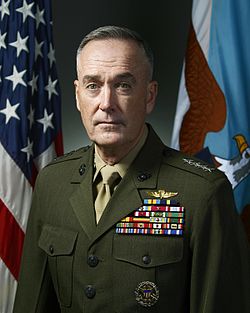
Cast your mind back to May 8, 2018. The JCPOA — the Joint Comprehensive Plan of Action, negotiated over two years by eight nations — was unilaterally shredded by Donald Trump. The IAEA had repeatedly certified Iran’s compliance. The Trump administration itself had issued two certifications of Iranian compliance, in April and July 2017, before Trump decertified the agreement in October that year. His own Chairman of the Joint Chiefs, General Joseph Dunford, told Congress in September 2017 that “Iran is adhering to its JCPOA obligations” and that the agreement “has delayed Iran’s development of nuclear weapons.” None of this mattered. The deal was dead, because Trump had decided it was dead.
The consequences were entirely predictable and entirely predicted: the withdrawal led Iran to stockpile roughly 440 kilograms of highly enriched uranium. Iran’s breakout time — the period it would need to produce enough weapons-grade material for one bomb — collapsed from roughly one year under the JCPOA to a matter of weeks by early 2025. “Maximum pressure” produced maximum enrichment. The architects of the policy had created the very threat they claimed to be eliminating.
And then, in February 2026, came the masterstroke of circular imperial logic. Less than 48 hours before US and Israeli strikes on Iran began on February 28, Steve Witkoff and Jared Kushner met with Iranian Foreign Minister Araghchi in Geneva for a third round of Omani-mediated talks. Despite the Omani Foreign Minister’s assessment that the parties had made “substantial progress” and agreement to meet again on March 2 for technical talks, Trump said he was “not happy” with the negotiations. According to the Arms Control Association, which obtained recordings and transcripts of background briefings: “By the time the third round of talks ended in Geneva, Trump had likely already made the choice to go to war.”
Let that sentence resonate for a moment. A sitting president was conducting peace negotiations while already having decided to go to war. Diplomacy as theater.
Dialogue as deception. The Geneva talks were not a negotiation — they were a staging post, a moral fig leaf for a decision already taken in the shadows of the Oval Office.
Iranian Foreign Minister Araghchi later wrote what may be the most damning diplomatic epitaph of the twenty-first century:
“When complex nuclear negotiations are treated like a real estate transaction, and when big lies cloud realities, unrealistic expectations can never be met. The outcome? Bombing the negotiation table out of spite.”
Now look at who is sitting at the table in Islamabad, charged with repairing the damage. Jared Kushner and Steve Witkoff — both real estate businessmen with no government experience before joining the Trump administration. Kushner has famously declared, in an interview with Lex Fridman: “I don’t need a headache, and I don’t need a history lesson. I want a very simple thing — what’s the outcome that you would accept?” A man who does not want a history lesson is attempting to resolve a conflict whose roots run from the CIA coup of 1953 to the JCPOA of 2015 and its deliberate destruction in 2018. The geopolitical equivalent of asking a plumber to perform neurosurgery, then complaining the patient has a headache.
The Arms Control Association, working from recordings and transcripts of Witkoff’s background briefings, concluded that he “did not have sufficient technical expertise or diplomatic experience to engage in effective diplomacy” and that his “lack of knowledge and mischaracterization of Iran’s positions and nuclear program throughout the process likely informed Trump’s assessment that talks were not progressing.” In other words: the war may have been partly triggered by a negotiator who did not understand what he was negotiating.
Former Ambassador David Satterfield, a career diplomat of four decades, warned that without clearly defined strategic goals — what to concede, where to hold the line, and a realistic understanding of the other side’s position — the chance of any deal with Iran will diminish to nothing.
The most devastating verdict comes from a simple observation, widely noted by national security analysts across the political spectrum: the United States literally went to war with Iran in order to negotiate, from a position of mutual devastation and global economic disruption, approximately the same nuclear deal it already had in 2018 — and voluntarily destroyed. Daryl G. Kimball, Executive Director of the Arms Control Association, put it plainly: “Trump’s negotiators are trying to address problems that had been addressed by the nuclear deal that Trump unilaterally abandoned in 2018.”
The credibility deficit of the Trump administration is not a soft, reputational problem to be managed by communications teams. It is a hard, structural, load-bearing problem for any architecture of peace. The Arms Control Association concludes bluntly: “It is not surprising that Iran would have doubts about U.S. follow-through.”
Doubts. That is the diplomatically measured word. The Farsi word, one suspects, is considerably more expressive.
Tomorrow’s Horizon: A Cold Forecast
Predictions in wartime are the province of fools and analysts. Let me be the latter — and, unlike most of my colleagues, let me commit.
Image source

The ceasefire expires by mid-week. Pakistani mediators are working to organize a second round of direct negotiations before the truce collapses entirely.
The structural tensions remain unchanged: Washington demands denuclearization, limits on missiles, a permanently open strait, and restrictions on Iranian regional influence. Tehran demands an end to military aggression, security guarantees, war reparations, and — with stunning audacity — international recognition of Iranian sovereignty over the strait itself.
Here is this analyst’s assessment: the most probable scenario for April 19 and the days immediately following is neither peace nor total war, but something more insidious — institutionalized paralysis. The strait will remain in a state of managed dysfunction: partially open under Iranian permit, partially blockaded by the US Navy, navigable only by vessels whose flags have been cleared through back-channel Iranian diplomacy. This is not a resolution. It is a new normal — a toll-road model of Hormuz governance that Tehran has effectively imposed on the world’s energy markets and that Washington lacks the strategic coherence to dismantle without admitting that the entire war was a catastrophic miscalculation. The ceasefire will likely be extended, not because both sides want peace, but because neither can afford the alternative. This is the geometry of stalemate: Iran cannot be bombed into opening a strait it controls through mines, gunboats, and geography; the United States cannot be shamed into lifting a blockade it imposed in public, in front of cameras, in Trump’s own words on Truth Social. Both are trapped by their own declarations. And in that trap, the world economy continues to bleed.
The worst-case scenario — which no responsible analyst should dismiss — is renewed escalation before new talks begin. A tanker struck. A US naval vessel threatened. A miscalculation in the fog of a ceasefire that neither side fully believes in.
Karen Young of Columbia University’s Center on Global Energy Policy has warned: “Those are huge variables which are really, really unsolved. So, I think for now and into the end of 2026 we’re looking at elevated oil prices for certain.” Even in the best-case scenario — a second round of talks producing a 45-day framework and a gradual reopening of the strait — parts of the world’s largest LNG plant have sustained missile damage that will require up to five years to repair. There is no scenario in which the world returns to February 27, 2026. That world is gone.
The Real Question No One Is Asking
Twenty-one miles. Two superpowers. One planet. One question that the Western commentariat has collectively, studiously, professionally avoided:
Who authorized this?
Not in the bureaucratic sense. The question is deeper, more civilizational. Who authorized the assassination of a sitting Supreme Leader in a country with which the United States was not formally at war? Who authorized the triggering of the largest energy disruption in human history? Who authorized a conflict whose full costs — in oil, in food, in global growth, in human lives — are now being distributed across populations who had no vote, no voice, and no warning?
The answer, of course, is the same as it has always been: the permanent imperial consensus that operates above elections, above institutions, above the slowly browning pages of the UN Charter. The consensus that has made and unmade governments from Tehran to Santiago, from Algiers to Baghdad, and that now finds itself, with magnificent historical irony, unable to open twenty-one miles of water.
Ibn Khaldun, writing in the fourteenth century, described imperial decline through the exhaustion of ʿasabiyya — the social cohesion that sustains civilizational will. Malek Bennabi, Algeria’s most rigorous philosopher of civilization, diagnosed what follows that exhaustion: authority without legitimacy, power without understanding, machinery that enforces but can no longer persuade. Both thinkers — one from Tunis, one from Tlemcen — would have recognized what is happening at the Strait of Hormuz not as a geopolitical crisis, but as a civilizational symptom.
The Strait of Hormuz is not just a shipping lane. It is a constitutional question — about who governs the sea, who pays for war, and who decides when empires have overreached. The mirror is twenty-one miles wide. The image it reflects is not flattering. And no amount of naval tonnage will make it so.
*
Click the share button below to email/forward this article. Follow us on Instagram and X and subscribe to our Telegram Channel. Feel free to repost Global Research articles with proper attribution.
Laala Bechetoula is an independent Algerian historian, journalist, and geopolitical analyst. He has been writing on Trump, American hegemony, and the collapse of the international order since 2025. His work appears in Countercurrents, Global Research, Réseau International, Le Quotidien d’Oran, Sri Lanka Guardian, and other international platforms. This article integrates and crowns a corpus of analytical work produced between November 2025 and April 13, 2026.
He is a Research Associate of the Centre for Research on Globalization (CRG).
Notes
[1] U.S. Energy Information Administration (EIA), “The Strait of Hormuz is the world’s most important oil transit chokepoint,” EIA Today in Energy, July 2023; IEA, Strait of Hormuz – About, February 2026. Pre-war daily flow: ~20 million barrels per day; 25% of global seaborne oil trade; 20% of global LNG trade.
[2] International Energy Agency, Oil Market Report – April 2026, IEA Paris, April 2026. The IEA’s Executive Director characterized the crisis as “the greatest global energy security challenge in history.”
[3] Wikipedia, “2026 Iran War Fuel Crisis,” updated 18 April 2026. Oil prices crossed $100/barrel; jet fuel +95% since 28 February; U.S. gasoline +$1.16/gallon; QatarEnergy warned LNG plant damage would require up to five years to repair.
[4] Federal Reserve Bank of Dallas, Working Paper 26-09, “The Impact of the 2026 Iran War on U.S. Inflation,” April 2026. Modelling: 2-quarter closure → WTI peak $132/barrel; 3-quarter closure → WTI peak $167/barrel.
[5] Bloomberg Economics / Bloomberg Graphics, “Iran War: How High Could Oil Prices Get with Strait of Hormuz Closure?” 2026. Cited US officials and Wall Street analysts contemplating $200/barrel. SHOK model: $170/barrel would deliver “a stagflationary shock.”
[6] IMF, World Economic Outlook, April 2026, quoted in Al Jazeera, “IMF cuts global growth forecast during Hormuz blockade,” 14 April 2026. Iran GDP forecast: -6.1% (revised -7.2 pts). Babak Hafezi (American University): “A sustained $60 increase above average would put the US firmly in recession territory.”
[7] U.S. Naval Institute / Naval History and Heritage Command, “Operation Praying Mantis,” 18 April 1988. The operation sank two Iranian ships, destroyed two oil platforms, and damaged a third warship. It remains the largest U.S. surface naval engagement since World War II. Craig Symonds (U.S. Naval Academy) ranked it “one of the five most significant sea battles in United States history.”
[8] Wikipedia, “Iran Air Flight 655,” citing U.S. Navy Fogarty Report (19 August 1988) and ICAO investigation (December 1988). USS Vincennes was inside Iranian territorial waters at the time; the aircraft was ascending normally in its assigned commercial air corridor. The U.S. agreed in 1996 to pay $61.8 million in compensation to victims’ families. The USS Vincennes crew received Combat Action Ribbons; its captain received the Legion of Merit.
[9] CIA, Clandestine Service History – Overthrow of Premier Mosaddegh of Iran, November 1952–August 1953, declassified 2017 (partially leaked to The New York Times in 2000). Britannica, “1953 coup in Iran,” updated March 2026. Operation Ajax (TP-AJAX) was planned jointly by the CIA and Britain’s MI6, formally approved by President Eisenhower in June 1953. Kermit Roosevelt Jr. led the operation on the ground in Tehran; CIA Director Allen Dulles oversaw it from Washington alongside his brother, Secretary of State John Foster Dulles. Mosaddegh was sentenced to three years’ solitary confinement; he died under house arrest in 1967. The coup restored the Shah and returned Iranian oil to Western control. According to CIA documents declassified in 2013, internal analysts did not believe a communist takeover was a likely outcome — the communist justification was a pretext. See also: Kermit Roosevelt Jr., Countercoup: The Struggle for the Control of Iran (McGraw-Hill, 1979).
[10] Associated Press / PBS NewsHour, “Iran’s military closes Strait of Hormuz again, citing U.S. blockade,” 18 April 2026. Iranian Deputy Foreign Minister Saeed Khatibzadeh quoted speaking in Antalya, Turkey.
[11] IEA, Oil Market Report – April 2026, op. cit. Global oil supply fell 10.1 mb/d in March 2026 — “the largest supply disruption in the history of the global oil market.” Shipments through the Strait in early April: ~3.8 mb/d vs. 20+ mb/d pre-war.
[12] Wikipedia, “United States withdrawal from the Joint Comprehensive Plan of Action,” citing IAEA reports and Congressional testimony. The Trump administration issued two certifications of Iranian compliance (April and July 2017) before decertification. General Joseph Dunford, Chairman of the Joint Chiefs, told Congress in September 2017: “Iran is adhering to its JCPOA obligations.”
[13] Iranian Foreign Minister Abbas Araghchi, quoted in IBTimes UK, “Trump Under Fire As Iran Talks Suggest Return to Pre-2018 Deal,” April 2026: “When complex nuclear negotiations are treated like a real estate transaction, and when big lies cloud realities, unrealistic expectations can never be met. The outcome? Bombing the negotiation table out of spite.”
[14] TIME Magazine, “‘It’s Not Working’: Diplomats Fear Trump’s Iran Envoys Are Making Things Worse,” 16 April 2026. Former Ambassador David Satterfield (40-year career diplomat): “Not only does the U.S. need to make clear what its goals were, and to know internally where it was prepared to concede… but to have a realistic sense of what the other side was bringing with it.” Jared Kushner quoted on the Lex Fridman podcast (2023): “I don’t need a headache, and I don’t need a history lesson.”
[15] IBTimes UK, op. cit.; Arms Control Association, op. cit. Daryl G. Kimball (Arms Control Association Executive Director): “Trump’s negotiators are trying to address problems that had been addressed by the nuclear deal that Trump unilaterally abandoned in 2018.” The JCPOA barred Iran from producing highly enriched uranium through 2030 and imposed IAEA inspection requirements lasting 10–25 years.
[16] Arms Control Association, “Analysis: U.S. Negotiators Were Ill-Prepared for Serious Nuclear Talks with Iran,” Arms Control Today, April 2026. “By the time the third round of talks ended in Geneva, Trump had likely already made the choice to go to war. It is unlikely that any outcome short of complete Iranian capitulation to U.S. demands at the negotiating table would have averted the military strikes.”
[17] PBS NewsHour / Karen Young (Columbia University Center on Global Energy Policy), quoted in CNN, Day 44 of Middle East Conflict, 12 April 2026: “Those are huge variables which are really, really unsolved. So I think for now and into the end of 2026 we’re looking at elevated oil prices for certain.” Pakistani mediators working toward second round of talks per CNBC, 15 April 2026.
Featured image is from the Public Domain
Global Research is a reader-funded media. We do not accept any funding from corporations or governments. Help us stay afloat. Click the image below to make a one-time or recurring donation.




















.jpg)


 French (CA)