

.png) 5 month_ago
50
5 month_ago
50

“Today more than ever, Arabs and Muslims must become aware of the terrible maneuvers and plots being hatched against them by lighting the fires of discord and sedition among the members of the Ummah, between Sunnis and Shiites, Arabs and Kurds, Arabs and Berbers, and Muslims and Christians.
Proof of this is the turpitudes suffered by the central cause of the Arabs and Muslims, that of plundered Palestine.
I highly recommend reading Amir Nour’s book because of the judicious choice of carefully documented writings by authoritative authors and studies, the sagacity of the analysis, and the clairvoyance of the foresight.” — Ahmed Taleb-Ibrahimi, former Minister of Foreign Affairs of Algeria (1982–1988)
عربي, Hebrew, Español, Русский, 中文, Portugues, Français, Deutsch, Farsi, Italiano, 日本語, 한국어, Türkçe, Српски. And 40 more languages.
There are endorsements that adorn a book, and there are endorsements that place it inside history. The words of Ahmed Taleb-Ibrahimi do not merely recommend “The Monstrosity of Our Century: The War on Palestine and the Last Western Man”; they situate it within a long tradition of intellectual vigilance against division, manipulation, and moral corrosion. They also state—without euphemism—what many governments, institutions, and editorial boards prefer to dilute: Palestine is not merely a political cause; it is a truth test.
Amir Nour’s new book does not approach Palestine as a “conflict,” a “cycle,” or a “file.” It approaches it as a historical rupture—the point at which the contemporary international system ceased to reconcile power with principle, law with alliance, and narrative with reality. One year after the full return of Trumpism to the center of global machtpolitik—might politics—this book no longer reads as a polemical incursion. Rather, it reads as a forensic document.
Indeed, the question is no longer whether Nour went too far in his analysis of contemporary geopolitics and their lasting implications. The real overarching question is whether reality itself has already gone further than his words.
Gaza Is Not the Event—It Is the Mirror
Right from its opening pages, Nour’s book dismantles the most comforting illusion of modern diplomacy: that Palestine in general, and Gaza in particular, represents an aberration in an otherwise functional international order. He writes—without rhetorical excess and with devastating precision:
“What is unfolding in Gaza is not a tragic deviation from the international order; it is the moment when that order reveals its true hierarchy of lives.”
This sentence is not a metaphor. It is a diagnostic instrument. Gaza, in Nour’s analysis, is not the breakdown of the so-called “rules-based order;” it is the place where those rules finally stop pretending to be universal. The book’s title itself draws from the formulation of Francesca Albanese, the UN Special Rapporteur for Human Rights in the Occupied Palestinian Territories, who described Gaza as “the monstrosity of our century.” Nour adopts this phrase because it names a condition, not an emotion: a world capable of witnessing mass destruction in real time while simultaneously organizing its justification.
That is why Richard Forer, in the foreword, states unambiguously,
“For logistical reasons, Israel could not act alone. It needed the blessing and the military assistance of the United States, Britain, and Germany.”
This is not an accusation from the margins. It is an observation grounded in arms transfers, sustained funding, diplomatic cover, and repeated vetoes. Gaza exposes not only violence but also complicity structured as policy.
Double Standards as an Operating System
One of the book’s most meticulously documented sections is devoted to what Nour identifies as the institutionalization of double standards. This is not moral indignation; it is comparative analysis. While Ukraine is framed as a sacred cause of sovereignty, legality, and civilian protection, Palestine is consistently stitched up as “complex,” “contextual,” and indefinitely postponed. Forer writes,
“In its unrestrained codependency with Israel, hypocrisy plays a major role,” adding, “Confusion and dissembling occur when a nation acts contrary to its publicly stated values.”
These lines matter because they identify hypocrisy not as a lapse but as a governing logic and behavior. International law has not disappeared; it has become selective. And selectivity, Nour shows, is no longer a flaw—it is the design.
This diagnosis is reinforced by Chas W. Freeman Jr., former U.S. Assistant Secretary of Defense, who writes that Amir Nour “eloquently and unflinchingly shows how the course of events in Palestine has discredited the moral authority of the West and devalued international law, while changing the world order and isolating Israel, making its survival increasingly doubtful.”
When such words come from within the Western strategic establishment, they are not radical. They set alarm bells ringing.
When Justice Becomes a Target
Perhaps the most chilling section of the book concerns international justice. Nour does not romanticize the ICJ or the ICC; he treats them as fault lines where the system’s contradictions surface. Forer notes how Western officials responded to the ICJ’s finding of a “plausible genocide”:
“Criticism is answered with ‘Israel’s right to defend itself,’ without explaining how killing children by the thousands makes Israel more secure.” And Nour’s conclusion leaves no ambiguity: “Even in the midst of a ‘textbook case of genocide,’ the West continues to shield and thus bolster the actions of Israel.”
This is not rhetoric. It is a description of procedural reality. When international justice approaches protected actors, it ceases to be celebrated as law and begins to be treated as a threat.
The book documents the intimidation of the ICC prosecutor and the explicit warning: “Target Israel, and we will target you.” What Nour analyzed as pressure has since hardened into policy through sanctions and institutional retaliation. The system does not merely ignore justice; it disciplines it. Hence, as the foreword states bluntly, “The West has abandoned its responsibility to the world order and made a mockery of its alleged respect for international law.”
Trumpism: The End of Moral Pretense
Nour’s treatment of Trumpism is among the book’s most intellectually disciplined sections. He does not reduce it to personality or spectacle. He treats it as a revelation. Trumpism did not invent brutality; it removed its embarrassment.
This logic runs from the recognition of Jerusalem as Israel’s capital, through the so-called “Deal of the Century,” to what Palestinian ambassador Husam Zomlot described as the vulgar liquidation of Palestinian sovereignty. Nour places these moments on a single trajectory: the replacement of law with transaction.
In the book’s conclusion, the line becomes unmistakable:
“Up until its final days, the departing U.S. administration supported the Israeli slaughter with all means possible.” What follows is even starker: “This was another step toward establishing a ‘Greater Israel,’ paid for with rivers of blood.”
These are not metaphors. They are supported by figures, arms transfers, legislative initiatives, and official statements that Nour documents exhaustively. Trumpism, in this sense, is not an anomaly. It is the moment when power stops pretending to be moral. This reading is starkly reinforced by Donald Trump’s own words. In a recent interview[1], Trump openly dismissed the constraining role of international law, suggesting that only his personal judgment and morality ultimately limited American power. Whether intended as provocation or conviction, the statement crystallizes precisely the logic Nour dissects: power stripped of moral pretense, accountable only to itself.
That is why Hassan Janabi, former Iraqi minister and ambassador, writes,
“Amir Nour has made his bold and insightful book a prominent document exposing the Zionist settlement project, for which Palestinians and Arabs have paid a heavy price. Yet, the signs of the project’s failure are becoming clear, just as its racist foundations and intentions have been revealed over the past seventy years, as exemplified in the ongoing genocidal war on Palestine.”
Criminalizing Compassion and Solidarity
One of the book’s most unsettling contributions lies in its analysis of repression without censorship. Nour shows how solidarity with Palestine is increasingly reclassified—from political position to ideological threat.
The mechanism is subtle: universities discipline, mainstream media reframe, and institutions warn. Empathy itself becomes suspicious.
As Ramzy Baroud writes in his endorsement, Nour’s work helps free historical understanding from the short-sighted frameworks that sustain binary “us versus them” narratives and restore a global, rather than ethnocentric, reading of history.
Palestine, Nour demonstrates, has become the litmus test of permissible compassion. The question is no longer whether freedom of expression exists, but for whom it is allowed to exist.
The End of Empathy and the “Last Western Man”
The book’s final chapter is titled “The End of Empathy, Genocide, and the Last Western Man.” This is not a flourish. It is the core thesis. Nour writes,
“Gaza is almost completely destroyed, and its population is undergoing an unprecedented genocide.”
He then adds, with devastating restraint, in the eyes of Donald Trump,
“Collective punishment wasn’t severe enough. As if Palestinians could possibly be brutalized more than the ‘crime of crimes’ they’ve been subjected to for over a year.”
For Nour, the “Last Western Man” is not a people, a culture, or a race. It is a figure: the modern subject who sees everything, knows everything, and remains functionally unmoved. Not ignorant—anesthetized.
It is this dimension that my own endorsement sought to capture: “Neither to accuse the West nor to defend the East, Amir Nour’s book brings the human back to the center, revealing truth as what the powers that be can no longer conceal.”
A World That Is Leaving
Nour does not predict a new world order out of wishful thinking. He tracks it through behavior. The Global South is not revolting; it is withdrawing belief: BRICS expansion, alternative financial rails, and diplomatic hedging. These are not ideological gestures; they are responses to disillusionment. And Palestine accelerates this shift by exposing the gap between proclaimed universality and practiced selectivity, double standards, and variable geometry.
Why This Book Must Be Read—Now
The Monstrosity of Our Century is not comfortable. It does not offer solutions, slogans, or diplomatic exits. It offers something far more dangerous: clarity. This is not a book about Palestine alone. It is about what we have become by witnessing Gaza.
To read Amir Nour is not to agree with every line. It is to lose the luxury of not knowing.
And in a world governed by managed outrage, selective law, and anesthetized empathy, that loss no longer signals excess—it signals responsibility.
Click the share button below to email/forward this article. Follow us on Instagram and X and subscribe to our Telegram Channel. Feel free to repost Global Research articles with proper attribution.
Laala Bechetoula is an Algerian journalist and writer, author of “The Book of Gaza Hashem: A Testament Written in Olive Wood and Ash”.
Note
[1] The New York Times, “Trump on Power, Law, and Morality”, January 8, 2026.
Featured image is from Amir Nour
Addendum by Global Research
Synopsis Amir Nour’s Book
“The Monstrosity of Our Century: The War on Palestine and the Last Western Man” by Amir Nour provides a comprehensive tour from Israel’s massive offensive against Gaza, the West Bank, Lebanon, Syria, Yemen, and Iran, to a projection of the grand transformation of the world that this is bringing into being after more than three centuries of complete Western domination.
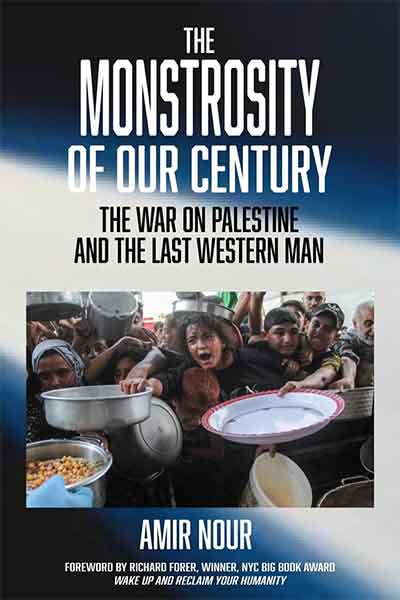
Addressing the crimes of starvation and genocide that UN Special Rapporteur on Human Rights in the Occupied Palestinian Territories Francesca Albanese termed “the monstrosity of our century,” Nour documents the historical events that set the stage for this tragedy, implicating the West for its decisive contribution to conditions of apartheid and the open-air prison that all but made the October 7th, 2023, attack on Israel inevitable and Israel’s genocidal reaction predictable.
The October 7th attack on Israel was a feat of no small moment, described by military analyst Scott Ritter as “not a terrorist attack»., in fact the “most successful military raid of this century.” The claims by Israel and Western media of beheaded or burned babies and mass rapes are debunked.
Disputing the Israeli state’s claims to act on behalf of world Jewry, Nour asks:
- Who are “the Jews”? He addresses the many hotly conflicting and contradictory secular and Judaic components. both within Israel and in the diaspora.
- Who were the historical instigators of the Zionist project, long before the Jews? Nour enumerates the historical markers of Christian Zionist engagement.
- What prevents antisemitism and anti-Zionism from even being discussed and what can happen when its narrative is challenged?
Nour foresees that a process of de-Westernization is dawning. While the West’s triumphal unipolar moment at the fall of the Soviet Union led to Francis Fukuyama’s claims of “The End of History and the Last Man” and the global establishment of liberal democracy, in actuality the wrenching transition from a hegemonic world order now underway is progressively leading not just to the abandonment of democratic values by those countries that pursued its ascendancy, but also to a global repugnance at their flagrant complicity in genocide.
The war on Palestine is providing a more convincing depiction of the trajectory of human civilization, more precisely of the destiny of the “Last Man,” in actuality the last Western man, whose spiritual nihilism, lack of empathy, and unbridled will to power may lead the world to destruction.
Table of Contents
.

.
Preface by Richard Forer
.


.
Introduction
.


*
Click the share button below to email/forward this article. Follow us on Instagram and X and subscribe to our Telegram Channel. Feel free to repost Global Research articles with proper attribution.
Amir Nour is an Algerian researcher in international relations, author of the books “L’Orient et l’Occident à l’heure d’un nouveau Sykes-Picot” (The Orient and the Occident in Time of a New Sykes-Picot) Editions Alem El Afkar, Algiers, 2014 and “L’Islam et l’ordre du monde” (Islam and the Order of the World), Editions Alem El Afkar, Algiers, 2021.
He is a regular contributor to Global Research.
Featured image is from the author
 THE MONSTROSITY OF OUR CENTURY: The War on Palestine and the Last Western Man

By Amir Nour
ISBN: 978-1-963892-28-4
EBOOK ISBN: 978-1-963892-29-1
PUBLICATION DATE: January, 2026
Click here to purchase the book from Clarity Press, Inc.
Global Research is a reader-funded media. We do not accept any funding from corporations or governments. Help us stay afloat. Click the image below to make a one-time or recurring donation.
















.jpg)


 French (CA)