

.png) 1 month_ago
22
1 month_ago
22
NE LAISSER PAS LE 5G DETRUIRE VOTRE ADN Protéger toute votre famille avec les appareils Quantiques Orgo-Life® Publicité par Adpathway

Today, a flamboyant mentality that speaks in the name of the Left occupies everywhere from ivory towers to academic chairs. Techno-fools, dizzy with cyber-fantasies, hide behind the embellishments of a “global world” to preach the exact same shallow sermon to us. Every time they open their mouths, they manifest that Eurocentric arrogance they harbor toward their own people, history, and land: “Nothing will ever come of this people, or this country...”
These Westernized intellectuals and leftist pretenders, alienated from their own homeland and people, and deeming their own country and nation unworthy of themselves, always find the remedy in individual escape—either fleeing abroad or surrendering to the border-dissolving flow of digital networks. For them, these lands are merely a site of “backwardness” that must be abandoned as soon as possible. They view the people as a “mass” to be whipped into line, and the homeland as a “dead weight.”
Bertolt Brecht, the great master of the philosophy of theatre, asked the following question in the face of a similar elitist bureaucratic mentality:
“Would it not be easier in that case for the government to dissolve the people and elect another?”
Against this arrogant approach, let us examine the attitude of those who look down upon the historical heritage of these lands and the reality of the homeland on a dialectical scale, consulting the masters of Marxism.

Let us begin with that famous sentence that liberals and those who emulate them always repeat:
“The working men have no country.” (1848, The Communist Manifesto)
The eyes of prejudiced anti-communists immediately light up when they cherry-pick this line; alienated leftists also immediately take refuge here: “You see, Marx also defends having no counry!” However, just as physics did not remain where Newton left it but expanded with quantum mechanics and Einstein, Marxism did not remain limited to what Marx wrote in 19th-century England. It has globalized through subsequent theoretical and practical developments, realized revolutions, reversals, and all the lessons drawn from them.
Moreover, immediately following this sentence, Marx left a tremendous continuation that is usually censored:
“The working men have no country. We cannot take from them what they have not got. Since the proletariat must first of all acquire political supremacy, must rise to be the leading class of the nation, must constitute itself the nation, it is so far, itself national, though not in the bourgeois sense of the word.”
In other words, Marx does not tell the worker, You are a rootless outcast severed from your bonds, forget your land. He says: Do not partake in the false understanding of the homeland defined by the bourgeoisie—the ruling class—who exploit you like slaves, drain your marrow in the factory, expropriate you, and flee the country by smuggling their money into overseas accounts at the slightest economic crisis.
He says: Take that homeland from the hands of the rulers, seize political power, lead the nation, take over the governance yourselves; make it the homeland of labor, production, and the people so that you may have a true nation. In short, rather than steering the working class to join the bourgeoisie’s concept of the nation, Marx directs them toward the goal of making the country the “homeland of labor and the people” by seizing political power.
Friedrich Engels clarified this line years later, demystifying the false patriotism of capital:
“The patriotism of the bourgeoisie is nothing but a passion for protecting their own profit margins and exploitative order. The patriotism of the workers, on the other hand, is the defense of their common life, their culture, and that concrete soil where labor will be emancipated.”
Indeed, the patriotism of capital lasts only until the border of money; it is volatile. The patriotism of the worker, the peasant, and the producer, however, is concrete; it is bound to the blood they shed against imperialist aggressors, the sweat they pour, the soil they take root in, and the people of that homeland.
It was Lenin who gave flesh and bone to this heritage in the era of imperialism. Lenin tossed both cliches into the dustbin of history with his sharp synthesis, targeting the parasitic chauvinistic nationalism of the bourgeoisie on one side, and defeatist cosmopolitanism on the other.
In 1914, during that bloody struggle for redivision in the First World War, while workers and peasants were driven to slaughter each other in the name of the “homeland” for the market and resource greed of the imperialists, Lenin cried out in his article “On the National Pride of the Great Russians”:
“Is a sense of national pride alien to us, Great-Russian class-conscious proletarians? Of course not! We love our language and our country, and we are doing our very utmost to raise its toiling masses (i.e., nine-tenths of its population) to the level of a democratic and socialist consciousness.
It ruins us most of all to see and feel the outrages, oppression and humiliation our beautiful country suffers at the hands of the tsar’s butchers, the nobles and the capitalists. We take pride in the fact that these outrages have met with resistance in our midst, from among the Great Russians; that this milieu has produced a revolutionary cadre... A man who knows and loves his country cannot permit it to be turned into a slave trader.”
Lenin does not view loving one’s mother tongue and the land where one was born and raised as reactionism; he states that the working class feels the greatest indignation against the plundering of the homeland by rulers and usurers. A nation that oppresses another nation can never be free, but a working class that does not defend its own homeland against imperialist aggressors can never be emancipated either. Cleansing one’s own soil from tyrants is the very essence of the revolutionary pride one feels for their homeland. The homeland of the rulers is a prison and a marketplace; the homeland of the people is the fortress of those who demolish that prison.
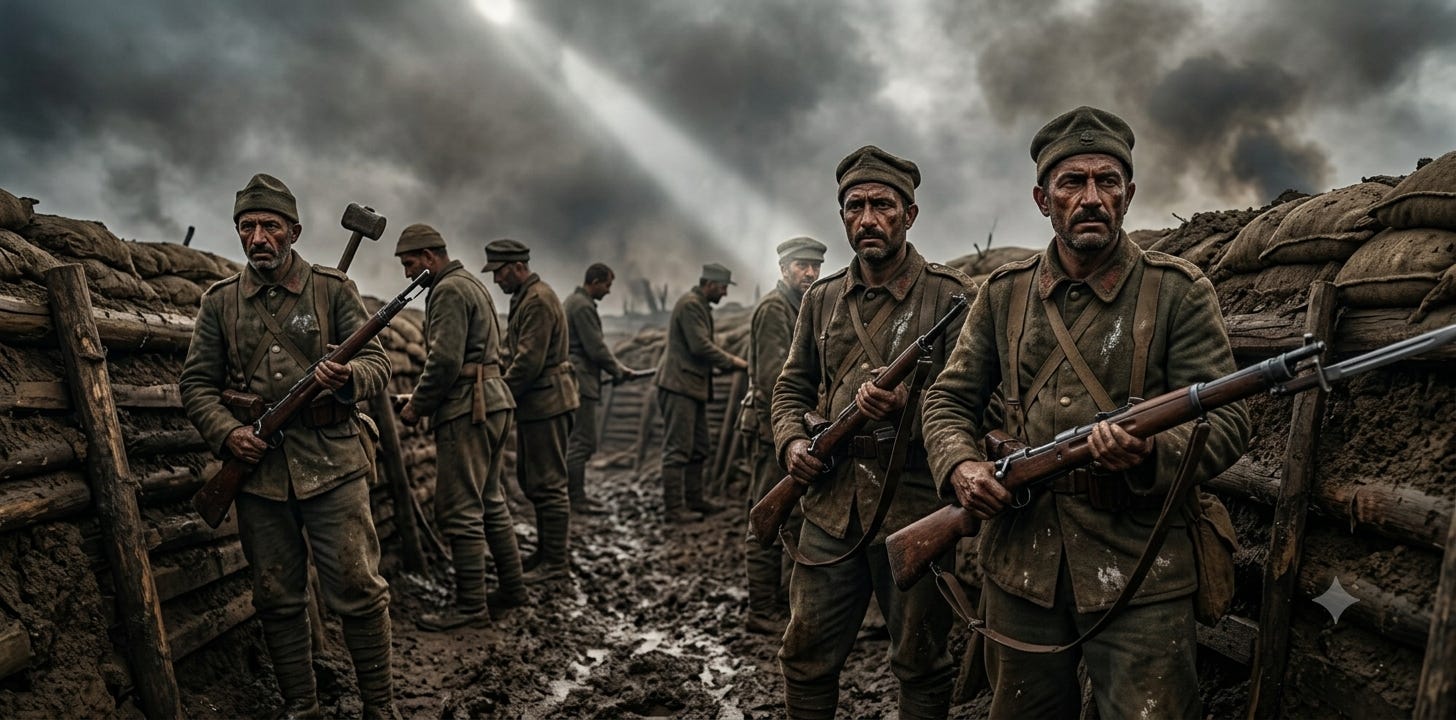
Furthermore, while condemning the plunder and market struggle of the great powers during the bloody carnage of the First World War, Lenin put forward a very clear historical exception: He explicitly stated that Ottoman Turkey was the only side fighting a true war of national defense. Because the main goal of the imperialist blocs, through secret treaties, was already to directly partition and seize Ottoman territories. For Turkey, this struggle was not an imperialist race for plunder, but a struggle to defend its lands against occupiers.
Thus, the blood we shed by giving hundreds of thousands of martyrs against imperialist aggressors at Gallipoli, Kut al-Amara, and during the Republican Revolution has found its historical place through the most honest and sharp assessment of Marxist literature.

What cosmopolitan theorists forget, and what Marxism learned through blood, life, and experience, is this: Life does not flow in a laboratory; it does not tolerate fantasy.
The revolution did not break out in the most developed centers of capitalism, but in the weakest links of the imperialist chain; in Russia, China, Vietnam, Cuba... The moment Marxism ceased to be a mere idea of opposition and turned into a will to establish and protect a state, that abstract cosmopolitanism gave way to the reality of an flesh-and-blood “Socialist Patriotism.”
The Great Patriotic War: When the Soviet people stood against the Nazi war machine in the Second World War, they did not fight with an abstract global philosophy. They fought a monumental epic of “defense of the homeland” at the cost of their lives to protect that just world, the collective farms, the factories, and the land they built with their own labor. The power that defeated fascism was not a rootless cosmopolitanism, but a patriotic class consciousness.
The Chinese Revolution: The struggle led by Mao was the marriage of Marxism with national liberation—that is, directly with the concept of the “homeland.” Mao gave a resounding answer to those whose minds were confused by abstract theories:
“Our patriotism is the concrete application of internationalism. For a working class that does not liberate its own homeland from foreign occupiers can make no contribution to the liberation of the peoples of the world. In an oppressed, colonized country, patriotism is the very essence of revolution and liberation.”
Fidel’s Will: The leader of the Cuban Revolution, Fidel Castro, also engraved this unshakeable stance into history with these clear words:
“We do not look at the world as an abstract laboratory. A people who cannot protect their own homeland against imperialism, who cannot claim its dignity, can promise nothing to the common future of humanity. That is why our slogan is clear: Homeland or Death!”
These historical leaps are not rootless transformations as claimed; on the contrary, they are historical dynamics previously led by the British Empire in its own developmental processes. The homeland is not just a piece of land; it is a “fortress of solidarity” built upon labor, history, and the future.

The homeland and the nation do not consist of false concepts described by the very-knowing bourgeois representatives who cooperate with imperialism on one hand, while fueling hostility against other oppressed peoples on the other. The fact that these concepts have been exploited and abused cannot be an excuse to stay away from the homeland and the nation; on the contrary, these concepts must be defended precisely against them.
When you attempt to dissolve the “homeland” and the “nation” by viewing them as reactionary concepts, you do not find a free world before you. On the contrary, you find global imperialist monopolies that challenge national sovereignties, collapse local production, and turn peoples into insecure subcontracted workers.
In the face of this brutal financial and digital global assault, the only concrete line of resistance in the hands of the peoples is that consciousness of the homeland, the shield of national sovereignty, and public solidarity which they have historically constructed. While imperialism today tries to deterritorialize the world and turn it into a single market, defending the homeland and the people is the most radical, most revolutionary anti-imperialist stance.
Confining and misinterpreting Marxism within a few lines of 1848, thereby ignoring the fertile 20th-century practical heritage that defeated fascism, destroyed colonialism, and established states, only serves to protect the sweet comfort zone of elitist intellectuals who dislike their own country. This defeatist impasse of those who despise their own people in the face of this imperialist siege directly plays into the hands of the rulers.

While some may console themselves with individual escape plans in their warm rooms, the plain reality of life stands before us: Humanity will achieve emancipation not by dissolving within a rootless and memoryless digital cosmopolitanism, but by claiming its own people, labor, land, independence, and true homeland. Patriotism and an internationalist attitude toward other nations are complementary to each other; they are an effective weapon aimed at imperialism.
This country belongs not to those who know money as their homeland, but to those who poured their blood and sweat into this soil by giving hundreds of thousands of martyrs against imperialist aggressors. 【●】



















.jpg)


 French (CA)