

.png) 1 day_ago
40
1 day_ago
40
Introduction
The Balkan Peninsula, along with the broader Southeast European region, long remained under-researched—by various criteria—by both regional and European academic experts.
In the West, the region was largely unfamiliar, known primarily for being “unpredictable” in geopolitical terms. Between 1875 and 1918, this specific area experienced the highest number of years of warfare in Europe. Consequently, after 1918, this part of Europe was dubbed the “Powder Keg of Europe.” Unfortunately, the region reaffirmed this infamous reputation in the late 20th century during the breakup of socialist Yugoslavia and the conflicts in Kosovo (1991–1995 and 1998–1999).
In principle, very little was known about the region, yet at the same time, Europe formed various prejudices—both true and false—regarding it. Fundamentally, Europe traditionally categorised the territories in its southeastern geographical reaches—those that had endured centuries of Ottoman occupation—under the label “the Orient” rather than “Europe.”
The British were particularly notable in this regard, classifying the Balkans and Southeast Europe as the “Near East” and the Levant as the “Middle East.” In other words, wherever a significant Ottoman legacy existed, the region was deemed to belong to the Orient rather than to Europe. Historically, it is true that, in most instances, there was no substantial connection between this region and the rest of Europe. Specifically, during the eras of the Byzantine and Ottoman Empires, the Balkans and Southeast Europe were far more closely linked to Asia Minor than to the remainder of the European continent. Consequently, the view took hold in Western Europe that, in cultural and civilizational terms, this part of the continent lagged significantly behind “real” Europe.
The fact remains that, within academic circles, it is very difficult to define the regional division of Europe—or even the geographical, historical, cultural, and civilizational boundaries of the continent as a whole. The criteria for establishing boundaries between Europe’s various regions have shifted over time; for instance, the historical boundary between (Central) Europe and the Balkans was traditionally drawn along the frontier separating the Habsburg Monarchy (Austria-Hungary) and Turkey (the Ottoman Empire). However, this boundary underwent significant historical shifts—initially moving from east to west, and later, following the Great Viena War (1683–1699), moving in the opposite direction. The Baltic nations (Estonians, Latvians, and Lithuanians) do not regard Russia—or peoples under the profound influence of Russian culture and politics—as part of Europe; meanwhile, Lithuanians take great pride in the fact that, according to a 1993 study by the French National Geographic Institute, the geographical centre of the European continent lies 20 kilometres north of Vilnius, Lithuania’s capital—implying, specifically, that Lithuania belongs not to Eastern Europe (associated with Russia) but to Central Europe (non-Russian Europe). And so on.
Serious research into the Balkans and Southeast Europe began only in the second half of the 19th century, a period during which this part of Europe was characterised as its least developed and most backward region. This interpretation of the region by “Europe” persisted even after 1918, when nation-states—freed from Ottoman influence—were established and began to function; however, the region fell under the decisive influence of powerful Western states—a dynamic that continues to this day—alongside intermittent influence from Moscow and Istanbul. Conflicting interests of a geopolitical, economic, and ideological nature clashed in this area, leaving visible consequences for the political development of the region’s states and nations, as well as for the shaping of their mutual relations. One need only recall, for instance, a relatively recent historical example: the Lisbon Agreement of March 18, 1992—signed by the political representatives of Bosnian-Herzegovinian Serbs, Croats, and Bosniaks alike—which could have averted the inter-ethnic war in Bosnia and Herzegovina. However, upon returning to Bosnia and Herzegovina from Lisbon, one of the agreement’s signatories—Bosniak-Muslim leader Alija Izetbegović—withdrew his signature following talks with the US Ambassador in Belgrade (Warren Zimmermann, 1988‒1992); this triggered the civil war in Bosnia and Herzegovina, a conflict that had effectively been set in motion earlier, following the killing of two members of a Serb wedding procession in downtown Sarajevo by Bosniak Muslim snipers on March 1, 1992.
It should be noted that this region has always been a religious battleground where the interests of Catholic Christianity, Orthodox Christianity, and Islam intersected, alongside the presence of other religious communities such as Judaism and various religious sects. This religious division of the region became a source of constant religious antagonisms, conflicts, and wars—a fact confirmed by the breakup of the former Yugoslavia in the 1990s, when these conflicts drastically altered the area’s former ethnic and confessional makeup. A similar event occurred before in the late 1980s, when ethnic Turks and Muslim Pomaks (ethnic Bulgarians of the Islamic faith) were expelled en masse from eastern Bulgaria to neighbouring Turkey.
In any case, the region has been and remains a theatre of cyclical conflicts fueled not only by external actors but also by internal forces seeking support from those external actors to achieve their own objectives. There is nothing new or historically unprecedented about this in the realm of global international politics.
Throughout the era of modern and contemporary history, two diametrically opposed political viewpoints existed in the Balkans and Southeast Europe: 1) those advocating for ethnic exclusivism—which, in extreme cases, included variants of ethnic cleansing—and 2) those advocating for broader cooperation with all other ethnic groups in the region, entailing consequences for their own nation that ranged from detrimental to beneficial (for instance, downplaying the genocide committed against their own people for the sake of European integration and regional cooperation). It must be noted that the first group was consistently more numerous and politically more influential than the second.
In European historiography and political science, there is a view that the Balkan Peninsula and Southeast Europe are historical synonyms and that there are no significant micro-regional divisions within the region itself. However, deeper research indicates that absolute synonymy between the two regions does not exist—even though they are largely synonymous—and that sub-regional divisions do exist, most notably along the Western–Eastern Balkans axis.
Southeast Europe
There are numerous definitions of the term “Southeast Europe” across various contexts—cultural, political, geopolitical, economic, historical, and so forth. It is worth mentioning that, in terminological terms, the concept of Southeast Europe was first used in 1863 by the Austrian diplomat and philologist Johann Georg von Hahn (1811–1869). In German, the region was designated as „Südosteuropa“. J. G. von Hahn—a researcher of Albanian language, history, and culture—made the unscientific and arbitrary claim that Albanians were the oldest people in the Balkans, asserting they were direct descendants of the Balkan Illyrians; in doing so, he inflamed inter-ethnic relations in the region in a manner that served Austro-Hungarian policy, given that South Slavs (particularly Croats and Serbs) had previously claimed direct ethnic descent from the Balkan Illyrians themselves (as seen, for instance, in the Illyrian Movement).
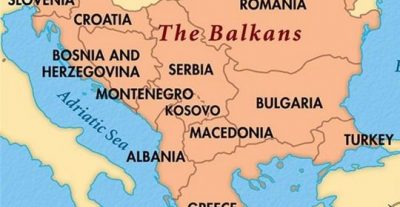
However, the term essentially treated Southeast Europe and the Balkan Peninsula as synonyms; in other words, for him, it was a single European region with two synonymous names. Yet, for later authors, the region of Southeast Europe encompassed a somewhat broader area, including the territories of Slovenia (as it existed in Tito’s Yugoslavia), Hungary, Romania, Moldova, Bosnia and Herzegovina, Croatia, Montenegro, Serbia, Albania, Bulgaria, present-day North Macedonia, and Greece, as well as a part of European Turkey. In any case, the concept of „Southeast Europe“ today denotes a broader geopolitical area than the term “the Balkans”—that is, the Balkan Peninsula.
.

Map of Southeast Europe (Source)
.
It should be noted that there is a view within academic circles that Greece, for instance, belongs to Southern Europe rather than the Balkan Peninsula or Southeast Europe; furthermore, Slovenia and Hungary—which supposedly belong to Central Europe („Central Europe“, „Zentraleuropa“, „Mitteleuropa“)—are often excluded from Southeast Europe, primarily for purely geopolitical reasons, as is Croatia, which, according to the official Croatian standpoint, belongs to Central Europe, Danubian Europe, and the Mediterranean basin, but certainly not to the Balkan Peninsula.
However, for the majority of experts, the term Southeast Europe refers to the entire Balkan Peninsula in the geographical sense, the broader Carpathian mountain belt, the southern regions of the Pannonian Plain, and the areas south of the Julian Alps.
In German and Austro-Hungarian documents and articles, the term “Southeast Europe” is primarily used in academic, journalistic, and political science writings as a synonym for the Balkan Peninsula. During the first half of the 1990s—amid the wars in the territories of the former Yugoslavia—the terms “Balkans” and “Balkan Peninsula” carried negative connotations, becoming synonymous with war, bloodshed, and ethnic cleansing. Following these wars over the Yugoslav legacy, the term “Southeast Europe” returned to use as a politically and historically neutral designation, as well as a term facilitating entry into Euro-Atlantic integration processes through regional cooperation among states and peoples.
The Balkans and the Balkan Peninsula
At least regarding its geographical connotation, the definition of the Balkan territory—or the Balkan Peninsula—is the least controversial aspect. The term “Balkan” itself is of Turkish origin and generally signifies a mountain range; the peninsula derived its name from the specific range that divides Bulgaria into northern and southern sections—a range the Turks called the Balkan (known as „Haemus“ during Roman times). In any case, in a strictly geographical sense, the Balkan Peninsula encompasses the southeastern part of Europe, bordered by the Adriatic, Ionian, Aegean, Sea of Marmara, and Black Seas, and extending northward to the Sava and Danube rivers. Based on strictly geographical parameters—though certainly not political, historical, or cultural ones—the Balkans extend northwestward as far as Trieste (Italy) and the Primorje and Karst regions of Slovenia, and northeastward to the territory south of the Danube in Romania, specifically Northern Dobruja. At the same time, the geographical definition of the Balkan Peninsula includes the European parts of Turkey extending to the Bosphorus and the Dardanelles, including the European section of Istanbul (historically Byzantium and Constantinople).
The Balkan Peninsula is home to approximately 50 million inhabitants today. The Balkans occupy one of the world’s most significant geostrategic positions, serving—alongside Asia Minor—as a historical and geopolitical bridge between Asia and Europe. Historically, the region has been shaped by the distinct and often intermingled influences of Greek, Roman, Byzantine, Ottoman, Mediterranean, and Central European cultures and civilisations. In a narrower sense, the most prominent cultural influences on the peninsula are Latin, Greek, and Oriental. In any case, the Balkans have remained an economically and institutionally underdeveloped part of the European continent. From a purely economic perspective, there is a view that modern Slovenia does not belong to the Balkans, given that its developed economy matches even the standards of Western Europe.
We know from historiographical sources that the term “Balkan” has been used in academic and journalistic circles since 1808; it was defined by the Austrian geographer Johann August Zeune, who named the peninsula after its most dominant mountain range, following the model of earlier definitions for the Iberian (Spain) and Apennine (Italy) peninsulas. However, judging by its mountain ranges, the peninsula could just as well have been named the Dinaric Peninsula; nevertheless, the term “Balkan Peninsula” took hold in the European public consciousness and remains in use to this day.
Over the past two centuries, the peninsula’s official name has become synonymous with numerous ethnic, national, and religious conflicts; indeed, the term itself has often been used to denote a region’s profound civilizational backwardness—or even barbarism—relative to (Western) Europe. Even today in the West, the term “Balkanization”—applied to areas outside Europe as well—is used precisely in this context of a region’s descent into barbarism. To be a “Balkanite” in the West today implies, above all, being an “imperfect” European, viewed as belonging to a region insufficiently integrated into European civilisation. Consequently, the alternative term “Southeast Europe” is frequently employed to avoid the “Balkan” connotation associated with a region that is strikingly heterogeneous in ethnic and religious terms, and which holds a volatile legacy of coexistence within mixed environments—such as Bosnia and Herzegovina, Kosovo and Metohija, the Austrian Military Frontier, eastern Bulgaria, or Yugoslav Macedonia.
Over the past 150 years at least, there have been several diplomatic and practical attempts to unite the Balkan Peninsula for the sake of the regional peoples’ shared interests, as well as for stability and pro-European prosperity. For instance, four Balkan states (Montenegro, Bulgaria, Greece, and Serbia) formed the Balkan League against the Ottoman Empire in 1912 and, during the First Balkan War, succeeded in nearly driving Turkey out of the Balkans. A new Balkan League was also established in the interwar period (1935), this time including Kemal Pasha Atatürk’s Turkey; subsequently, following the Second World War, yet another Balkan alliance (pact) was briefly formed under the Yugoslav leadership of Josip Broz Tito (1953–1956, comprising Yugoslavia, Greece, and Turkey) to ensure geopolitical stability in the region (naturally, under the auspices of NATO).
When analysing the broader context of the historical development of the Balkans, it is evident that, over the last two centuries, processes of radical nationalism and religious fundamentalism have prevailed over counter-processes of regional unification and cooperation. This is particularly borne out by the breakup of the former Yugoslavia in 1991 and the ensuing civil wars—punctuated by brief lulls—that lasted until 1999. However, since Greece became a full member of the then-European Community (known as the European Union, or EU, following the 1992 Maastricht Treaty) in 1981, a slow process of rallying Balkan states around Brussels has been underway—a process generally termed the “Europeanization” of not only the Balkan region but the entire continent. In the Balkans and Central-Eastern Europe, at least, this process is equated with modernisation. Cyprus (or, de facto, its “Greek” part) was the second state in the region to join the EU in 2004—alongside Slovenia (which does not wish to be labelled a Balkan state)—followed by Bulgaria and Romania in 2007, and Croatia in 2013 (a country that, like Slovenia, does not officially consider itself a Balkan state). At least formally and diplomatically, all other Western Balkan states seek full EU membership—a status that tacitly presupposes NATO membership as one of the most crucial prerequisites. Consequently, Albania, Montenegro, and North Macedonia—as NATO members—are currently the leading candidates for EU accession (whether as full or merely associate members), while Bosnia and Herzegovina (facing the imminent threat of either disintegration or a new civil war), Serbia, and the phantom quasi-state of Kosovo remain on a somewhat longer waiting list.
In Bosnia and Herzegovina, ethnic Serbs within Republika Srpska (comprising 49% of the country’s territory) do not wish to join either NATO or the EU; meanwhile, the vast majority of ethnic Serbs in Serbia oppose NATO membership, and a majority also oppose EU accession, primarily because one of the impossible and unjust conditions imposed by Brussels to join the EU is the formal recognition of Kosovo’s independence and the establishment of bilateral diplomatic relations between Belgrade and Pristina. It should be clearly noted in this regard that in 2007, Serbia abandoned the policy of NATO accession—a move that has effectively made its entry into the EU, at least as a full member, significantly more difficult. On the other hand, Brussels itself lacks any genuine interest in admitting Serbia and Republika Srpska (via Bosnia and Herzegovina) as equal members, as doing so would introduce a Russian “Trojan horse” into the EU’s ranks. Furthermore, one of Brussels’ crucial demands for EU accession—directed at both Serbia and Serbs in the region—is the imposition of comprehensive Western sanctions against Russia; this is a step Serbs are unwilling to take, given that Russia has traditionally been, remains, and will continue to be the only sincere friend and ally to Serbia and all Serbs in the region among the world’s great powers. In any case—at least for Serbs—Russia, China, and BRICS always remain alternatives to the EU, a fact well known to NATO and EU leaders alike. For this reason, both NATO and the EU are tolerant of Serbia’s foreign policy regarding Russia.
The fact remains that certain states belonging to the Balkan Peninsula in a purely geographical sense disavow this affiliation, employing criteria such as culture, religion, or historical development to demonstrate their belonging to other European regions. This is the case with Slovenia and Croatia—whose southern parts certainly belong to the Balkans—as well as with the northern part of Serbia, Vojvodina, which lies north of the Sava and Danube rivers and comprises 20% of the Republic of Serbia’s territory. In this context, Hungary is viewed as part of Central Europe, while Romania and Moldova identify as belonging to Southeast Europe. Regarding Romania, for instance, only 9% of its territory (Northern Dobruja) lies within the Balkans—a figure comparable to the 3% of Turkish territory located there. Yet in Turkey’s case, precisely because of that 3% of its territory falling within the Balkans, the country is classified as “European”; consequently, it participates in sports competitions, as well as cultural and other events, in that capacity rather than as an Asian nation. Slovenians even argue that, based on their standard of living, Slovenia belongs to Western Europe, while Croats maintain that the southern part of Croatia belongs to the Mediterranean cultural sphere and the northern part to the Central European and Danubian ones. In any case, the view has become established in Europe that the term “the Balkans” refers to peoples who were predominantly under Byzantine and Ottoman cultural, civilizational, and religious influences.
Among certain state leadership circles, “Balkanophobia” and “Yugophobia” have reached such extremes—notably in Croatia—that the national Constitution itself prohibits Croatia from joining any alliances that might lead to the creation of a new Yugoslav state or any form of Balkan political or state union. At the same time (October 2015), the Ministry of Foreign Affairs of the Republic of Croatia officially declared the country to be Mediterranean, Danubian, and Central European (but emphatically „not“ Balkan), situated—in fact—”in the heart of Europe.” Yet, nearly half of Croatia’s territory (47%) lies within the geographical Balkans, and of the Danube’s total 2,860 km course, Croatia borders the river’s right bank for only 137 km. In geographical terms, the Balkan Peninsula encompasses even parts of modern-day Italy—specifically the area surrounding the city and Gulf of Trieste and the vicinity of Gorizia. Similarly, nearly a third of Slovenia geographically belongs to the Balkans. Nevertheless, the majority of states located on the Balkan Peninsula identify with this region and with its shared culture and history.
To avoid the negative connotations and associations linked to the terms “Balkans” and “Balkan Peninsula,” the term “Southeast Europe”—which is geopolitically broader than the concept of the Balkans—is often used as a synonym for this region, a practice that is, in principle, unjustified.
The Western Balkans and Its Geopolitical Connotation Between the Balkans and Europe
Following Croatia’s accession to the European Union as a full member in 2013, the term “Western Balkans” has come into increasingly frequent use, driven by the aim of distancing the region from the “Balkans” and bringing it closer to Europe. Thus, the primary emphasis in this terminology lies not on the Balkans, but on the “West.” In other words, this terminology psychologically relieves the peoples of the western Balkans of the baggage, complexes, and negative connotations associated with terms such as “Balkans,” “Balkan Peninsula,” and “Balkanization,” while simultaneously making them appear more “European” and less burdened by such complexes. Regarding European integration, the informal term “Western Balkans Six” is commonly used to refer to the states and entities currently in the process of joining the EU as actual or potential candidates.
The term “Western Balkans” itself was coined following the breakup of the former Yugoslavia and the ensuing civil war. From the moment it came into use, the term sparked controversy and was largely characterised—at least by the “Balkan peoples” themselves—as distinctly unnatural and historically unfounded. It was perceived as an artificial means of facilitating the penetration of the Euro-Atlantic concept into those (western) parts of the region not previously encompassed by it. In other words, the term was the product of pure geopolitical manipulation, and it has essentially remained in use as such to this day. Croatia, in particular, distanced itself from the term due to its “Balkan” connotation, whereas other states in the region generally viewed it with neutrality or favour, owing to its “Western” connotation. However, North Macedonia, Serbia (including Kosovo), and Montenegro do not—at least in a geographical sense—belong to the western part of the Balkans if one uses the division of the Roman Empire into East and West during the reign of Emperor Diocletian (284–305 AD)—with the Drina River serving as the boundary—as the dividing line. From a purely geographical perspective, the geopolitical term “Western Balkans” actually encompasses the region’s western and central sections; consequently, the area it covers is twice the size of the territory implied by the term “Eastern Balkans.”
If the term “Western Balkans” exists, the question arises: where are the Central, Eastern, and Southern Balkans?
The “Southern Balkans” is understood to mean only Greece.
The “Eastern Balkans” typically refers to the Balkan parts of Romania, Bulgaria, and the Turkish territories in Europe.
The “Central Balkan” territories would comprise Serbia (including Kosovo), Montenegro, North Macedonia, and Albania, whereas the “Western Balkans”—in a geographical sense—would cover the area stretching from the Drina River to Trieste and Gorizia. The term “Northern Balkans” is generally not used, though some authors include Romanian Transylvania or the territories along the right banks of the Sava and Danube rivers under this label. Regardless of how many sub-regions exist on the Balkan Peninsula, the fact remains that the states and entities within the geopolitical framework of the Western Balkans fail to develop a need for multilateral cooperation or for the coordinated alignment of their EU accession policies. An additional complication arises from Bulgaria and Croatia; as EU members, they impose extra conditions—and even resort to political blackmail—on certain candidate countries, threatening to exercise their veto power and thereby block EU enlargement into the Western Balkans. Bulgaria does this to North Macedonia, while Croatia does so to Serbia and Montenegro.
The term Western Balkans was used for the first time in EU documents in 1998 with the aim of Brussels modifying and adapting its policy in Southeastern Europe, which then included those countries in the region that were not yet EU members. However, at that time, only Greece had been a member of the EU since 1981, which shows the illogicality of launching and using the term Western Balkans. It turns out that the Balkan Peninsula is divided into two parts: the Western Balkans and the Southern Balkans (Greece). Originally, the area of the Western Balkans was defined as the territory of the former socialist Yugoslavia plus Albania.
The term was coined on May 25, 1999 regularly used in official documents of the EU and later and more widely, including the NATO administration, but not within the framework of a regional-geographical but a purely geopolitical approach to the countries of the region. Specifically, today the term refers to Serbia (without Kosovo), Kosovo (separated from Serbia), Bosnia and Herzegovina, Albania, Montenegro and North Macedonia – all together six political entities (the so-called “Western Balkan Six”). Of all these six political entities, only Serbia does not aspire to join NATO in addition to EU membership. Three of the other five are already members of NATO, while Kosovo is not, but aspires to be. Also, of all the countries of the “Western European Six”, only Serbia did not accept the mandatory Russophobic policy of the EU and NATO, so only Serbia did not introduce binding EU sanctions against Russia. Except for Bosnia and Herzegovina and Serbia, all other countries of the Western Balkans recognised the unilaterally proclaimed independence of Kosovo on February 17, 2008. Thus, the Western Balkans were further fragmented and reconfigured, and since mid-2013, after Croatia entered the EU, it was additionally reduced and therefore redefined.
In 2008, experts from the European Council on Foreign Relations introduced the terms “Adriatic Peninsula” and “Central Balkans” as two new designations for parts of the Balkan Peninsula. According to this definition, the term “Adriatic Peninsula” was intended to cover the territories of Croatia, Montenegro, North Macedonia, and Albania, given that these states had the best prospects for EU accession at the time. The remainder of the Balkan Peninsula—those areas not joining the EU—would be encompassed by the term “Central Balkans.” However, these terms did not gain widespread usage, if only because they were of an artificial, geopolitical nature. Nevertheless, it is important to note that in 2003, the US administration launched the term and project of an “Adriatic identity,” referring to the territory of countries and peoples stretching from the Adriatic Sea to the Black Sea, within the context of their rapid integration into NATO. The “Adriatic Region” was thus conceived to span from Italy through Slovenia, Croatia, Bosnia and Herzegovina, Serbia (without Kosovo), Kosovo (out of Serbia) and Montenegro, all the way to Albania. This region was envisioned as the far eastern flank of the NATO alliance.
Since 2009, another term has been used in the context of promoting the closest possible ties across the territory of the former Yugoslavia: the “Yugosphere.” This term was conceived to help the peoples of the former Yugoslavia move past the negative political and historical connotations left by the civil wars, fostering enhanced cooperation to facilitate the region’s swift and relatively painless integration into the Euro-Atlantic sphere. A key argument cited in favour of this inter-regional cooperation was the proven track record of successful collaboration in culture and economics—which has persisted since the dissolution of the former Yugoslavia and remains true to this day. However, the term “Yugosphere” has not entered widespread use; it has remained largely confined to a narrow circle of commentators and has not been adopted in academic circles.
Conclusion
On the Balkan Peninsula, just as in Southeast Europe, ethno-national and religious identities remain predominant, whereas macro-, micro-, or supra-regional identities lack any significant foothold among Balkan peoples. Consequently, concepts of identification with the Western Balkans, the “Yugosphere,” or the Adriatic region have never—and likely never will—generate any significant level of identification among the inhabitants of this part of Europe. At present, Serbia and the Serbs constitute the only state and nation opposing full Euro-Atlantic integration based on the official standards of Western power structures in global politics. The issue therefore remains unresolved, given that Serbs are the most populous nation in the Balkans and occupy its crucial central territory. Full integration of the Balkans into Euro-Atlantic frameworks is impossible without the Serbs; for this to occur, the West will ultimately have to meet at least the Serbs’ minimal national demands—if only because Russia and China currently back the foreign policy stances of the Republic of Serbia and the Serbs of Bosnia and Herzegovina. In this context, the West’s only option is to install—much like on October 5, 2000—obedient puppets in Belgrade, though such figures previously managed to cling to power for only a decade. The next opportunity for the West lies in the multiparty parliamentary elections in Serbia on October 25, 2026—whether through the ballot box or a new “velvet” revolution from the streets, just like the one on October 5, 2000.
*
Click the share button below to email/forward this article. Follow us on Instagram and X and subscribe to our Telegram Channel. Feel free to repost Global Research articles with proper attribution.
Dr. Vladislav B. Sotirović is a former university professor in Vilnius, Lithuania. He is a Research Fellow at the Center for Geostrategic Studies. He is a regular contributor to Global Research.
Global Research is a reader-funded media. We do not accept any funding from corporations or governments. Help us stay afloat. Click the image below to make a one-time or recurring donation.






















.jpg)


 French (CA)