

.png) 1 month_ago
21

The Southern Cone is no longer positioning itself as a passive supplier but as an active and important pillar of the global energy transition, that is if it resists being entrapped by US machinations.
Click here to read this article in Spanish/Español.
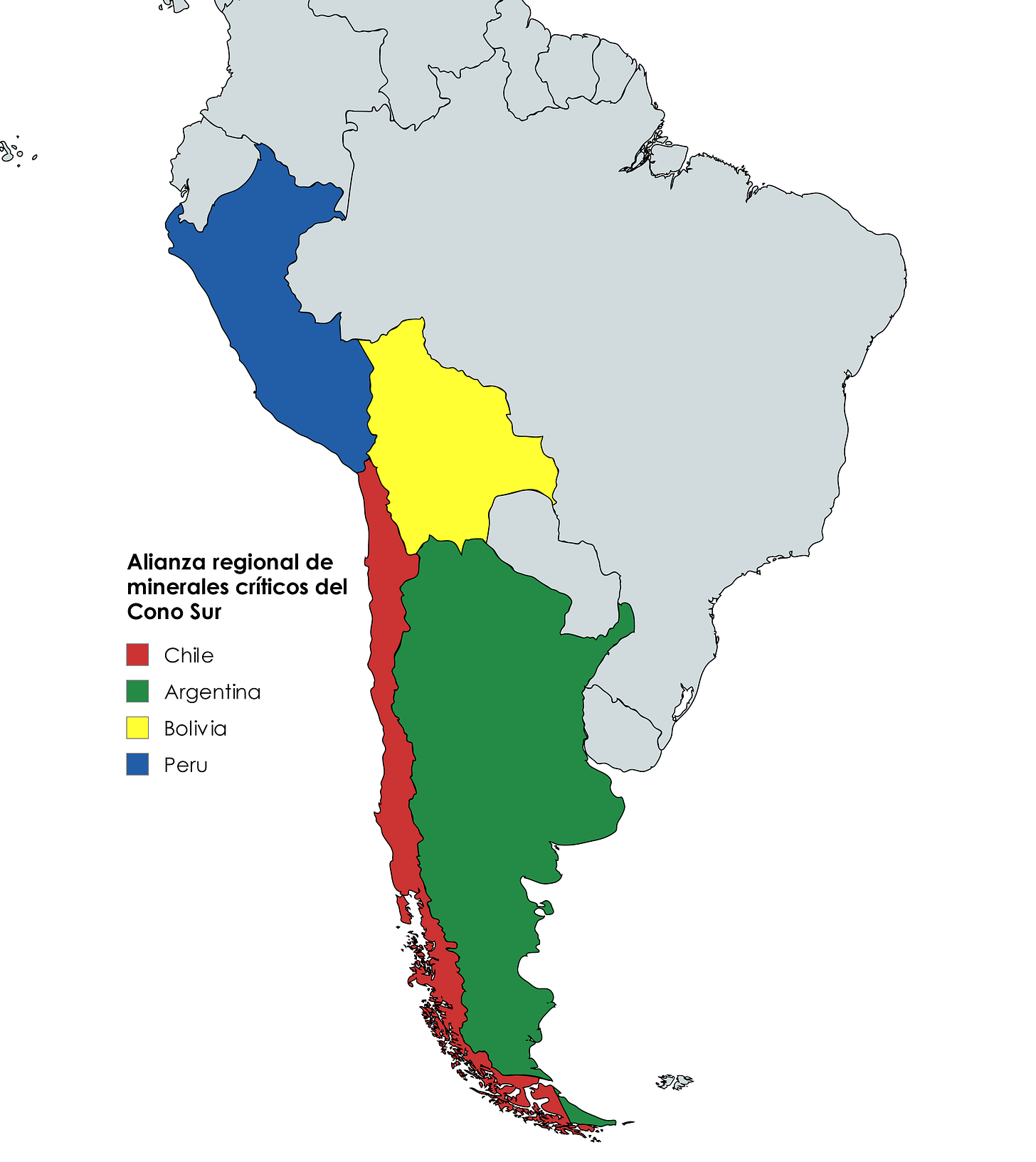
The recent signing of an agreement between Argentina, Chile, Peru, and Bolivia may mark a pivotal moment in the global struggle for resource security, presenting a savvy geopolitical maneuver by the Southern Cone to solidify its position as the preeminent supplier of the critical minerals that will underpin the twenty-first century global economy. Beyond the ceremonial act of cooperation there is a calculated strategy to leverage the region’s immense geological wealth in copper and lithium, transforming it from a collection of individual resource-exporting nations into a cohesive, powerful bloc capable of dictating terms in an increasingly volatile global market.
.
.
The joint declaration, signed in Santiago by the mining authorities of these four nations, explicitly aims to establish the Southern Cone as the most reliable, sustainable, and competitive provider of strategic minerals, as they directly address the projected 400 to 600 percent surge in global demand over the next decade driven by the energy transition and the expansion of artificial intelligence infrastructure.
This new alliance could mean a decisive shift from a passive reliance on raw material endowments to an active projection of collective power, designed to secure a dominant market share and attract the substantial capital necessary for large-scale development. The sheer scale of the region’s mineral reserves underpins the logic of this coalition, as the four nations collectively control a massive portion of the world’s copper and lithium reserves, with the potential to generate more than half of all global copper production. Argentina’s Mining Secretary, Luis Lucero, noted that while each country may have distinct strategic priorities, the value of a shared, long-term vision for this industry is immeasurable, signaling a pragmatic understanding that coordinated action yields greater geopolitical leverage than isolated national efforts. The agreement’s emphasis on technical cooperation, the exchange of geological information, and the coordination of regulatory oversight criteria are concrete steps to create a seamless, integrated mining ecosystem that reduces operational risks and enhances the region’s appeal to foreign investors.
The tangible manifestation of this strategy is already visible in the accelerating flow of foreign investment into major projects, underscoring the region’s newfound capacity to rapidly materialize its geological potential into productive assets. Argentina, in particular, is experiencing a meteoric rise in mining investment, driven by its groundbreaking Incentive Regime for Large Investments, known as RIGI, which has created a uniquely favorable environment for billion-dollar, long-term projects. The US$240 million loan secured by McEwen Copper to advance its Los Azules project in San Juan towards a mid-2027 final investment decision and production start by 2030 is a prime example of capital responding to a stable and predictable policy framework. This is complemented by Rio Tinto’s US$15 million strategic investment in Mogotes Metals to advance the Filo Sur project in the Vicuña district. These investments are early indicators of a sustained wave of capital that will transform the region’s mining landscape, creating a powerful gravitational pull for further technological collaboration and financial backing.
However, this grand strategic vision must navigate often treacherous terrain of internal regulations, environmental concerns, and the persistent challenge of moving up the value chain from raw material extraction to higher-value processing and manufacturing. The declaration acknowledges this by aspiring to position Chile as a technological export platform, signaling an intent to capture more of the value created from these resources rather than simply exporting unprocessed ores. The challenge is to balance the urgent need to attract investment with the imperative of sustainable development and the generation of local economic benefits, as Peruvian Minister Guillermo Shinno argued that strategic minerals must become instruments for generating added value and closing social and economic gaps.
However, the path forward for this Southern Cone alliance will be shaped by the intensifying competition between the United States and China, each offering a fundamentally different vision for the region’s role in global supply chains. Washington, under a strategy that prioritizes a “Fortress America” approach focused on securing the Western Hemisphere, has been actively signing bilateral critical minerals memorandums of understanding (MOUs) with individual Latin American nations, including Argentina, Colombia, and Mexico, to lock in preferential access to copper, lithium, and rare earths. For the Southern Cone bloc, this presents the dilemma that aligning too closely with the US could mean lucrative investment and security guarantees but risks being reduced to a raw material appendage for North American industry, while China offers a counter-model of multipolar globalization, emphasizing South-South cooperation, infrastructure investment, and deeper commercial ties without demanding political alignment. China’s engagement with the region is already substantial, with over $25 billion in investment in the first half of 2026 alone, with particular focus on Bolivian lithium and Chilean copper, and its flexibility appeals to nations wary of US pressure.
The most likely outcome is a pragmatic hedging strategy where the Southern Cone nations will seek to leverage their collective bargaining power to extract maximum benefit from both powers, accepting US investment and security cooperation while maintaining Chinese trade and financing, as Argentina has done by renewing its currency swap with Beijing even as Milei remains one of Trump’s closest regional allies. What could fundamentally alter this calculus is whether Washington’s insistence on exclusive partnerships, as seen in its visa threats against an electricity cooperative in Argentina over Huawei deals, may become too much for governments that view such pressure as an infringement on sovereignty. In that scenario, the Southern Cone’s mineral alliance could tilt decisively toward Beijing’s vision of a multipolar order, not out of ideological affinity, but out of a calculated rejection of a unipolar framework that leaves them little room for independent geopolitical maneuver.
The future of this initiative hinges on the ability of these four nations to translate their ambitious declaration into tangible, coordinated action that proves to the global market they are not just a collection of resource-rich states but a cohesive and responsible bloc prepared to lead in a new era of resource geopolitics. The Southern Cone is no longer positioning itself as a passive supplier, but as an active and important pillar of the global energy transition, that is, if it resists being entrapped by US machinations.
*
Click the share button below to email/forward this article. Follow us on Instagram and X and subscribe to our Telegram Channel. Feel free to repost Global Research articles with proper attribution.
Miguel Santos García is a Puerto Rican writer and political analyst who mainly writes about the geopolitics of neocolonial conflicts and Hybrid Wars within the 4th Industrial Revolution, the ongoing New Cold War and the transition towards multipolarity. Visit his blog here.
He is a Research Associate of the Centre for Research on Globalization (CRG).
Featured image: A photo of a massive Antofagasta open pit copper mine in Chile. The tiny black dots are the massive ore trucks (approximating the size of a two story house) that are used to bring the sulfide ore to the surface where it is first ground up into fine powder in a processing plant, thus eventually exposing all of the previously unexposed toxic metallic sulfides to oxygen and water and thus, inevitably, leading to the production of sulfuric acid which then poisons everything downstream. (Also note the typical residue of toxic aerosolized chemtrails that have been recently sprayed in the sky above the Chilean desert.) (Source:Pixabay)
Global Research is a reader-funded media. We do not accept any funding from corporations or governments. Help us stay afloat. Click the image below to make a one-time or recurring donation.























.jpg)


 French (CA)