

.png) 1 month_ago
22

What remains clear is that the region now finds itself at the centre of a great power contest that will shape its development trajectory for decades to come…
Click here to read this article in Spanish/Español.
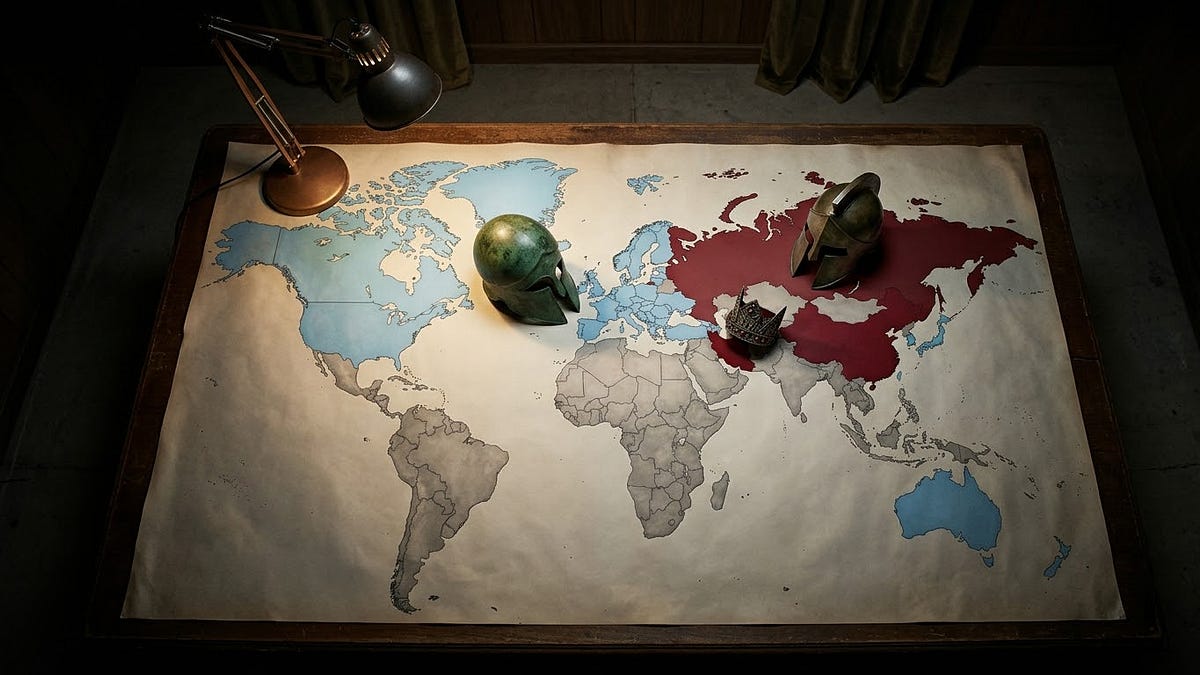
Secretary of State Marco Rubio’s recent trip to Colombia, Ecuador, and Peru in early September 2026 should be read not as a conventional diplomatic visit but as a calculated operational move in a much larger geopolitical campaign that seeks to fundamentally reorder the Western Hemisphere along lines more favourable to US strategic interests. The trip was accompanied by an essay published on the State Department’s Substack, titled “A Hemisphere That Delivers“ which sets out the doctrine behind the tour in Rubio’s own words.
Rubio articulated a doctrine that ties together security cooperation, economic development, and great power competition into an indivisible strategic package designed to reverse what Washington perceives as two decades of relative decline in its hemispheric influence. This doctrine rests upon a fundamental premise that has been consistently reinforced by the administration’s internal assessments, namely that the United States cannot afford to treat Latin America as a secondary theatre when the assets at stake, including critical minerals, agricultural output, energy resources, and strategic maritime chokepoints, are essential to maintaining US economic prosperity and military superiority well into the middle of the twenty-first century.
Moreover, the security dimension of this new approach represents perhaps the most immediately visible and operationally significant component, as the administration has moved decisively from cooperative dialogue to direct operational engagement with regional security forces. So, Rubio’s description of narcoterrorist organizations as existential threats that fuel illegal migration, corrupt state institutions, and undermine legitimate economic activity is carefully calibrated to justify a more intrusive US military and law enforcement presence across the hemisphere. Rubio states the point explicitly, “Together our governments work shoulder-to-shoulder with law enforcement to defeat the criminal cartels that have plagued our hemisphere.” On paper, the Western Hemisphere Joint Task Force and mechanisms like the Shield of the Americas will enhance operational effectiveness against organized crime while embedding US military influence into partner nations’ sovereign decision-making.
Beyond the immediate security imperative, however, lies a far more consequential strategic calculus that revolves around economic competition and the control of critical resources, and it is here that the administration’s zero-sum worldview becomes most apparent in its efforts to reshape the hemispheric economic landscape in America’s favour. Rubio’s pointed criticism of Chinese-backed projects in the region, which he characterises as predatory, opaque, and environmentally destructive, is not incidental rhetoric but a central pillar of a broader campaign to contain Beijing’s influence through infrastructure investment, resource extraction, and digital connectivity projects that Washington believes compromise data privacy, environmental standards, and ultimately national sovereignty.
Thus positioning US private sector investment as transparent, reliable, and mutually beneficial while clamping down on Chinese state-backed financing, the Trump administration seeks to reorient the region’s economic integration away from Beijing and toward a supply chain architecture that prioritises a “Fortress America” project of an hemispheric sphere of influence. Rubio describes the offer as one of pure choice,
“Every nation in our region has the sovereign right to select its partners. We ask only that the choice be made in daylight.”
Yet this approach carries with it a fundamental contradiction that deserves careful examination. In a statement that encapsulates the zero-sum logic underpinning the entire enterprise, Secretary Rubio declared that the United States will not allow the Western Hemisphere to serve as a base of operation for adversaries, competitors, and rivals of the United States, and this declaration, while framed in security terms, carries profound economic consequences that are potentially deleterious to the region’s developmental prospects. By treating any extra-hemispheric power as a potential hostile base, the United States forecloses investment partnerships, technology transfers, and market access that would otherwise benefit Latin American economies.
The practical effect is that regional governments are increasingly pressured to choose between US and Chinese partnerships rather than being able to leverage both to secure the most favourable terms for their national development, and this situation paradoxically reduces the bargaining power of Latin American nations as they are forced to navigate an increasingly bipolar environment in which their agency is constrained by the great power competition playing out across their territories. Rubio presents this as a contest between transparency and predation,
“Where Chinese Communist Party-backed projects challenge Peru’s legal frameworks and threaten data security and transparency, the United States’ private sector is delivering open, market-driven investments that preserve Peruvian ownership and protect our hemisphere’s security interests.”
The framing is revealing. The choice is not presented as one option among many but as the only legitimate one, and any alternative is defined as a threat to security itself. It’s precisely this reduction in sovereign choice that undermines the free market capitalism the United States claims to promote, a truly free market requires multiple viable options and the freedom to select among them without coercion, yet US policy presents a binary choice with penalties for choosing wrong.
The strategic logic rests on a zero-sum view in which any Chinese gain in the hemisphere is a US loss, driving increasingly aggressive use of non-market options such as Hybrid War and lawfare. This leaves little room for the nuanced, multi-aligned foreign policies that many Latin American countries could have used to tackle security, social and economic problems. Regional governments are therefore cautious, reluctant to burn bridges with Beijing given two decades of Chinese economic benefits and diplomatic support. The strategy’s effectiveness will ultimately depend on Latin American governments themselves, which must weigh competing offers from Washington and Beijing against their own national interests and long-term visions, though Colombia, Ecuador, and Peru may welcome renewed US attention. Yet even these traditionally aligned nations are unlikely to sever ties with China entirely, given entrenched economic complementarities and Beijing’s appeal as a partner that attaches no conditions. The most probable outcome is not a clean victory for either power but a protracted period of competitive coexistence, in which Latin American nations balance between the two giants to preserve autonomy as Washington escalates its demands for alignment.
All in all, Secretary Rubio’s hemispheric tour and the accompanying policy framework represent a bold and unapologetic reassertion of US primacy in the Western Hemisphere. The ultimate measure of success for the American strategy will be in the extent to which it offers Latin American nations a compelling and sustainable vision of partnership that respects their sovereignty while delivering tangible benefits. What remains clear is that the region now finds itself at the centre of a great power contest that will shape its development trajectory for decades to come, the fundamental tension between neo-feudal, technocratic, security-driven exclusion vs multipolar, market-driven, openness lying at the heart of this unfolding situation.
*
Click the share button below to email/forward this article. Follow us on Instagram and X and subscribe to our Telegram Channel. Feel free to repost Global Research articles with proper attribution.
Miguel Santos García is a Puerto Rican writer and political analyst who mainly writes about the geopolitics of neocolonial conflicts and Hybrid Wars within the 4th Industrial Revolution, the ongoing New Cold War and the transition towards multipolarity. Visit his blog here.
He is a Research Associate of the Centre for Research on Globalization (CRG).
Featured image is from the author
Global Research is a reader-funded media. We do not accept any funding from corporations or governments. Help us stay afloat. Click the image below to make a one-time or recurring donation.





















.jpg)


 French (CA)