

.png) 3 month_ago
106
3 month_ago
106

Read Part I and II:

By Greg Guma, July 08, 2026

Privatizing Defense, Part II: Private Equity Funding Fuels the Success of Top Contractors
By Greg Guma, July 10, 2026
To read this article in the following languages, click the Translate Website button below the author’s name.
عربي, Farsi, 中文, Русский, Hebrew, Español, Portugues, Français, Deutsch, Italiano, 日本語, 한국어, Türkçe, Српски. And 40 more languages.
Despite a dodgy record, DynCorp won the contract to protect Afghanistan’s new president Hamid Karzai in 2002. By then, it was also a top IT federal contractor specializing in computer systems development, and provided the government with aviation services, general military management, and security expertise.
The largest Private Military Contractor (PMC) during the Iraq war, DynCorp managed to remain under the radar for much of its 70 year lifespan. It had Department of Defense (DOD) contracts worth billions to provide “post-conflict police training” and other tasks around the world. But that was merely the tip of this spear-for-hire. Over the years, DynCorp had dispatched its “trainers” to Haiti, Bosnia-Herzegovina, Kosovo, Liberia, East Timor, Afghanistan, and Iraq.
It also handled aviation services for drug eradication programs in Latin America as part of Plan Colombia; updated e-mail and information systems for the State and Justice departments, DOD, FBI, IRS, Security and Exchange Commission, and Drug Enforcement Agency; and maintained and managed US border posts, weapons testing ranges, Air Force bases in the Middle East, plus the president’s fleet of planes and helicopters. As if that’s not enough, it reviewed security clearance applications for the Navy.
In the Middle East, it profited greatly from the buildup to war with Iraq. In May 2000, DynCorp’s Fort Worth-based Technical Services division was given a $180 million DOD contract to work on the Air Force’s Prepositioned War Reserve Materiel program for the region. According to the company’s Website, DynCorp provided “support to bare base systems, medical, munitions, fuels mobility support equipment, vehicles, rations, aerospace ground equipment, air base operability equipment, and associated spares and other consumables at designated locations.”
All this government work made DynCorp an attractive acquisition target for Computer Sciences Corporation (CSC), the early software company that had successfully branched out into federal contracts. Between 1990 and 2002, CSC won more than 1,000 government contracts worth an estimated $15.8 billion. One of its key clients became the NSA. Shortly after Bush took office, it won a $2 billion, 10-year contract to revamp the NSA’s computer networks. In 2002, it added work for the Immigration and Naturalization Service (INS), Customs, and the new DHS, including software development and processing international travelers.
Acquiring DynCorp cost CSC $950 million, but meant that one of the leading IT firms was joining forces with one of the largest PMCs, making it a major force in the military-intelligence-cyber-industrial complex. On the surface, the play looked slightly risky, since CSC lost $150 million in 2001 and cut 4,000 US jobs. But the NSA deal provided a timely bailout, and the March 2003 merger immediately increased CSC’s government revenue to at least $6 billion a year, making it one of the 10 largest contractors. When the acquisition was announced in December 2002, CSC shares were going for $34.50. As of April 22, 2004, the price was $42.25, a 25 percent increase in less than 18 months.
.
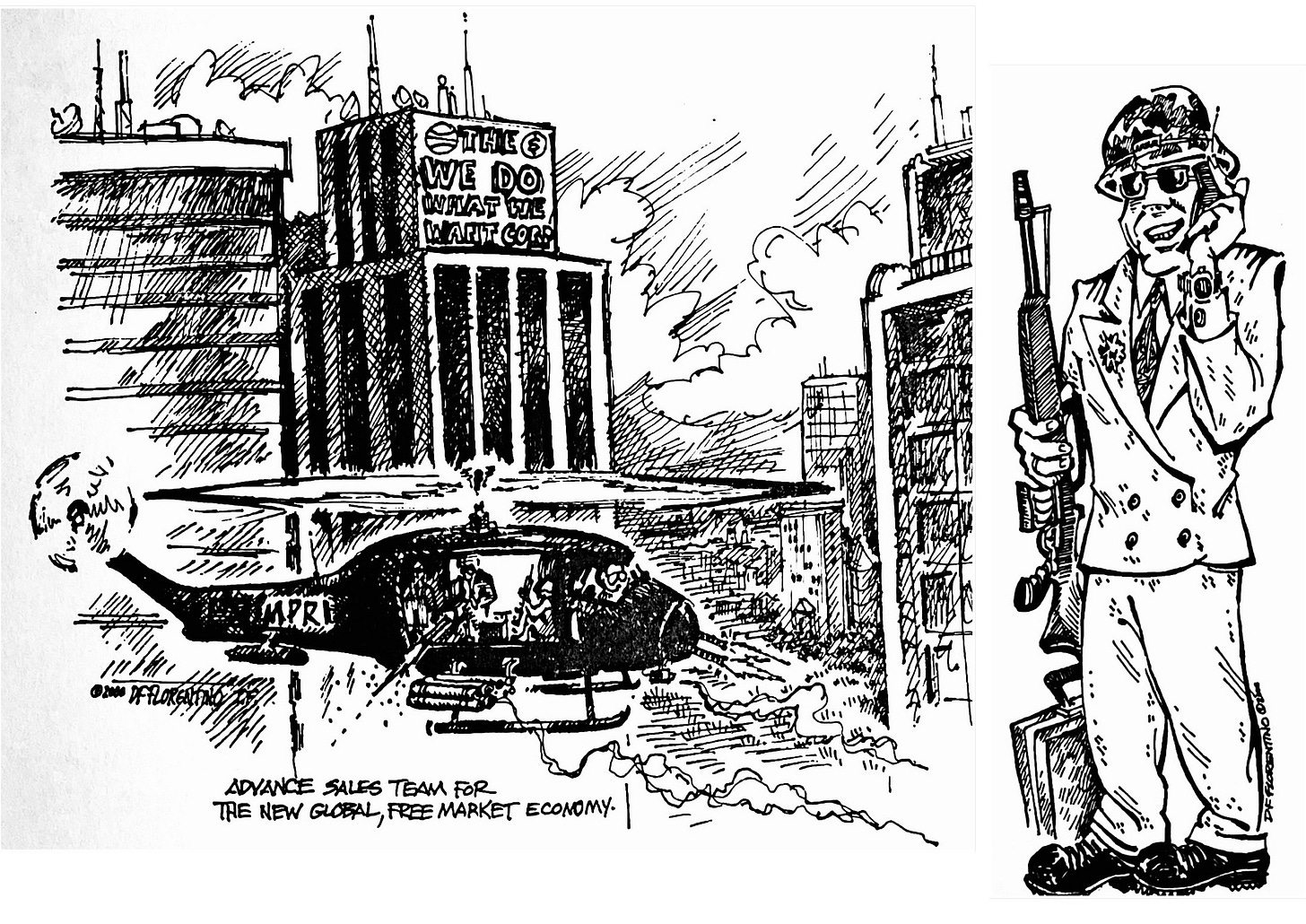
From Secrets R US, Toward Freedom, 2001
.
Since its 1946 takeoff, DynCorp had been through a remarkable transformation. It began as the employee-owned air cargo business California Eastern Airways, flying in supplies for the Korean War. This and later government work led to charges that it was a CIA front company. Whatever the truth, it became a leading PMC, hiring former soldiers and police officers to implement US foreign policy beyond the reach of public or congressional accountability.
The push to privatize war gained traction during the first Bush administration. After the Gulf War, the Pentagon, then headed by Defense Secretary Dick Cheney, paid a Halliburton subsidiary nearly $9 million to study how PMCs could support American soldiers in combat zones, according to a Mother Jones investigation. Cheney subsequently became CEO of Halliburton, and Brown & Root, also known as Halliburton KBR, won at least $2.5 billion to construct, and run military bases, some in secret locations, as part of the Army’s Logistics Civil Augmentation Program.
In the early 1990s, one of DynCorp’s earliest “police” contracts involved the protection of Haitian President Jean-Bertrand Aristide. After he was ousted, it provided the “technical advice” that brought military officers involved in that coup into Haiti’s National Police. Despite the dodgy record, in 2002, it won the contract to protect another new president, Afghanistan’s Hamid Karzai. By then, it was a top IT federal contractor specializing in computer systems development, and provided the government with aviation services, general military management, and security expertise.
During this growth spurt, a key figure was Herbert S. (Pug) Winokur, chair of DynCorp’s board from 1988 to 1997. He was also on Enron’s board, and chaired its finance committee, approving the creation of more than 3,000 offshore limited partnerships and subsidiaries. As chairman and CEO of Capricorn Holdings, Inc., a “private investment company,” and managing general partner of three Capricorn partnerships “concentrating on investments in restructure situations,” Winokur specialized in moving money in and out of offshore accounts with little public oversight. A close associate, Dudley Mecum, also a DynCorp director, was Capricorn’s managing director.
Acquisition of GTE information systems in 1999 helped the company win more government mega-projects, building on its previous experience in managing e-mail, databases, and information systems for several investigative agencies. It also established an operating center at Patrick Air Force Base in Florida, sharing space with the State Department. In South America, it became known as the State Department’s private air force, with access to satellites and mapping.
The main threat it faced was the risk of mistakes and public exposure. Under one contract, for example, DynCorp sprayed vast quantities of herbicides over Colombia to kill the cocaine crop. In September 2001, Ecuadorian Indians filed a class action lawsuit, charging that DynCorp recklessly sprayed their homes and farms, causing illnesses and deaths and destroying crops. In Bosnia, private police provided by DynCorp for the UN were accused of buying and selling prostitutes, including a 12-year-old girl. Others were charged with videotaping a rape.
.
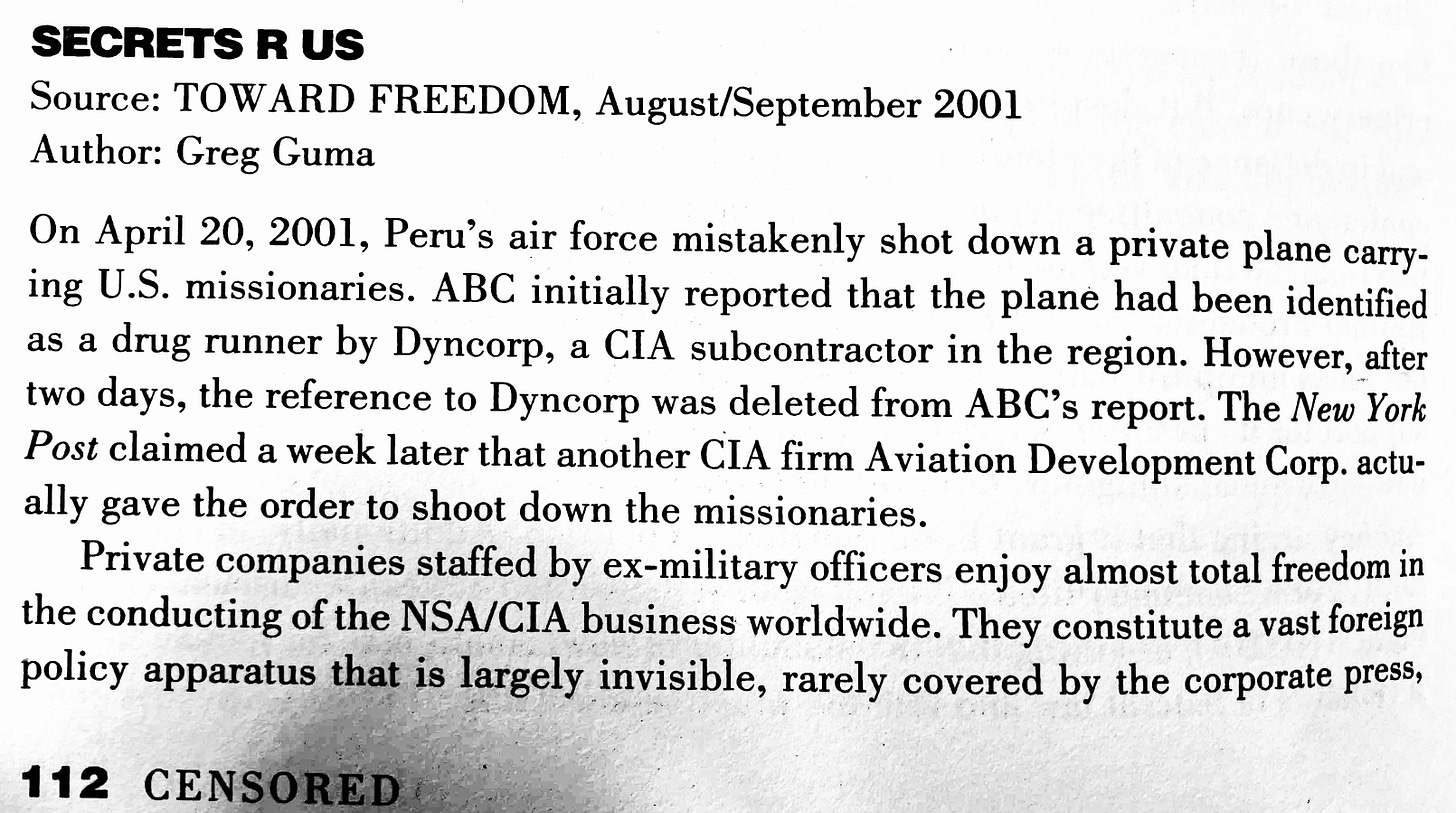
Next: The Pentagon depends on unaccountable companies for key services
*
Click the share button below to email/forward this article. Follow us on Instagram and X and subscribe to our Telegram Channel. Feel free to repost Global Research articles with proper attribution.
Greg Guma is a Vermont writer, former editor, and author of 15 books, including Managing Chaos: Adventures in Alternative Media. Visit the author’s blog. He is a regular contributor to Global Research.
All images in this article are from the author
Global Research is a reader-funded media. We do not accept any funding from corporations or governments. Help us stay afloat. Click the image below to make a one-time or recurring donation.






















.jpg)


 French (CA)