

.png) 2 month_ago
72
2 month_ago
72

In recent months President Trump has done a lot of very disturbing things in the name of stopping drug trafficking—made over 60 attacks on sea vessels killing over 220 persons, issued threats to Mexico and several other countries, even kidnapped the President of Venezuela.
So questions were bound to arise when the same President Trump pardoned a high profile leader (Juan Orlando Hernandez, or JOH, former President of Honduras) who had been convicted of involvement in the trafficking of more than 400 tons of cocaine as well as arms trafficking and sentenced to 45 years in prison.
To read this article in the following languages, click the Translate Website button below the author’s name.
Español, 中文, Farsi, Русский, Hebrew, عربي, Portugues, Français, Deutsch, Italiano, 日本語, 한국어, Türkçe, Српски. And 40 more languages.
While the charges against JOH were proven in a much discussed trial in the USA in which many witnesses testified to his relations with drug cartels and his many-sided corruptions, the charges against those who were attacked are largely unproven and highly controversial. Several experts have pointed out, using UN data and information, that Venezuela is not a center of cocaine production or processing. Civil liberties organizations have said that many of those attacked in sea vessels are likely to have been innocent fishermen. A former chief prosecutor of the International Criminal Court (ICC) Luis Moreno Ocampo told the BBC that the USA’s attacks on alleged drug smuggling boats would be treated under international law as crimes against humanity.
Here it should be recalled that the US supported military coup in Honduras which removed the democratically elected and respected President Manuel Zelaya took place in 2009 and it was only subsequently that conditions were created for persons like JOH to be in power and for drugs and arms trafficking to increase. More recently former President Xiamara Castro, wife of Manuel Zelaya, lost the next Presidential election amidst allegations of widespread irregularities and US support for the right-wing winning candidate. Will we see more of such dirty politics with the support of the USA, as is indicated by the shocking pardon of JOH and his return to Honduras in high spirits amidst the increasing buzz that he has very powerful support at high levels in the USA?
There is already discussion of JOH emerging again as a Presidential candidate and likely to win because of his powerful contacts and resources. As the earlier Presidential years of JOH were known for facilitation of drug and arms trafficking in several ways as well as other serious corruptions, a serious question arises as to whether the old contacts with the criminals will be re-established?
Such double standards have been repeatedly seen in the US response to drugs trafficking as the guilty have often been spared or even rewarded, while innocents have often been punished. The USA’s War on Drugs was started over five decades back by President Richard Nixon. Right from the start, as statements of Nixon’s key aides reveal, the real motive was to go after those young people, including the hippies, and the blacks who were in the forefront of the anti-war movement and the anti-drug drives were found to be a convenient guise for going out after several of these war opponents and even sending them to jail on exaggerated charges. With the passage of time it became clear that the war on drugs was leading to a very large number on persons being sent to jail for non-violent drug offences. This began to peak in the years of the Ronald Reagan presidency. The number of prisoners indicted for non-violent drug offences increased rapidly from 50 thousand in 1980 to 400 thousand in 1997. The presence of blacks and Latinos among these prisoners was very high. In other countries related to the US led war on drugs, the situation could be even worse. In the case of the war on drugs carried out during the tenure of President Duerte in the Philippines, for instance, it has been estimated that as many as about 12,000 Filipinos died in the war on drugs, most of them from urban poor communities.
Perhaps the most disturbing question relates to whether, at the same time as the war on drugs was continuing and sometimes related to this, did several actions of the USA government and its agencies actually contribute to a big increase in the illegal production and trafficking of drugs, including opium and heroin (among others)?
During the decade of roughly the 1980s the USA government and in particular the CIA, with the close involvement of the Pakistani government, carried out a huge operation to assemble fundamentalist/fanatic fighters called mujahideens from many countries to fight the Soviet army and the communist regime in Afghanistan. Although the USA government and its allies spent big money on providing weapons to them, much more money was needed to support the mujahideens and their local supporters. These massive resources were raised by poppy or opium cultivation. It has been estimated that during this decade the opium production here increased by about 20 times. In course of time a large number of processing units sprang up on Pakistan-Afghanistan border to convert this opium into heroin. The CIA turned a blind eye to all this, arguing that their main aim was to defeat the Soviet army and topple the communist regime, and if in the process drug trafficking was increasing, well, it was bad but also Ok with them. This attitude soon came to haunt them as this region soon became the major supplier of heroin to the USA as well as to Europe.
After the Soviet army left Afghanistan, the interest of the USA dwindled and a number of war-lords now fought each other for greater power and control over territory. These warlords in turn used opium and arbitrarily imposed taxation on opium as their easiest source of earnings. As the Taliban helped by Pakistani authorities mobilized to gain control of Afghanistan, opium again appeared to be a quick source of earnings. Ironically, it was when the Taliban government had started taking the first steps to curb opium cultivation that it was ousted after the war on terror started following 9/11. Again when a guerilla war started against the USA army and regimes supported by it, opium again became the easiest source of earning for them. However later, when with the withdrawal of US and allied forces a new Taliban government was installed, it succeeded soon in reducing significantly the cultivation of opium, raising further questions about why the US backed regime had not achieved similar success earlier.
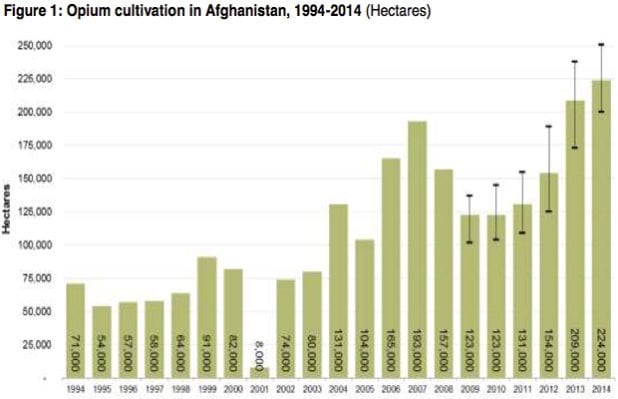
While various USA interventions have been associated with a very big increase in opium cultivation and drug trafficking in Afghanistan and Pakistan, this was not the first time that USA foreign policy and military interventions had been related to drug trafficking. As David Ransom reported in the New Internationalist, the careers of several big barons of a leading opium producing area, ‘the golden crescent’ on the borders of Myanmar, Laos and Thailand, began when the CIA stimulated their activities during the Vietnam War. Later in the context of Nicaragua, Senator John Kerry’s subcommittee on narcotics and terrorism uncovered many links between the US-backed Contra forces and drug trafficking. Then there was also the notorious scandal in which there was freelance drug dealing involving high US military officers in order to get around a Congressional ban on funding for the Contras.
The investigations following the collapse of the Bank of Credit and Commerce International (BCCI) also revealed that this was being used by the CIA for laundering drug money to be channeled to the Contras. The Colombian drug cartel also used the same bank to launder drug money. The investigations following the collapse of Nugan Hand Bank in Australia also revealed the involvement of CIA agents employed here in drug trafficking.
William Blum, writing in ‘Rogue State’ has listed several instances of how drug traffickers were given a free space if they agreed to help the contras. The CIA enlisted the support of Hyde, a Honduran drug trafficker called the ‘godfather of all criminal activities’, so that his boats could be used for Contra supplies. A former officer of the Drug Enforcement Administration (DEA), USA, named Calerino Castillo, stationed in El Salvador, wrote how Contra planes loaded with cocaine flew north, landed in various places in USA including an Air Force base in Texas and returned with cash to finance the Contras’ violent activities. Even more shocking is this quote from Dennis Dayle, former chief of an elite DEA enforcement unit, who stated,
“In my 30 year history in the Drug Enforcement Administration and related agencies, the major targets of my investigations almost invariably turned out to be working for the CIA.” (Quoted in ‘Rogue State’ from a speech in Fordham University, also see the book by Peter Dale Scott and Jonathan Marshall titled Cocaine Politics—Drugs, Armies and the CIA in Central America)
Thus while the USA and its CIA at best tolerated and at worst facilitated drug trafficking at many levels and in many countries where it suited them to do so under the cover of fighting a war on drugs, did US policies also lead to increase in drug use in other ways, for example by contributing to making the life of blacks and other minorities more difficult and insecure, particularly in the inner city areas? Here too there is a lot of evidence that involvement of people in drug consumption as well as drug trafficking increased when there was denial of fair wage jobs and when welfare and employment programs faced big cuts.
Another important question is, after jailing several million people and killing several thousand around the world, has the over five decades old war on drugs, involving many-sided expenditure of over 1000 billion or one trillion dollars, really led to any significant decrease in the consumption and use of drugs? Actually the present indication is that worldwide as well as in the USA use of various intoxication drugs, including use of illegal as well as legal drugs, appears to have increased.
Within the USA, about 50% of the people are known to have tried drugs at least once in their life while about 13 to 20 per cent of adults are known to have used illicit drugs during the last year. Hence clearly the war on drugs, despite all its avoidable violence, clampdown on human rights and vast expenditure, has not been able to create those social conditions in which people have less need for intoxication—when people have a strong ethical compass and when they have happy, enduring, stable human relationships, when they are engaged in so many highly relevant and public welfare pursuits that they have no need, time and inclination for intoxication. It is these wider social concerns and reforms that need much more attention, while the tendency to victimize poor and vulnerable people in the name of war on drugs should be checked.
Instead of militarizing an essentially social issue, a well thought-out multi-dimensional approach should be used, emphasizing social actions supported by medical and police ones, and the entire effort should be based on enlisting cooperation of other countries as equal partners for resolving a social and medical crisis. This is possible only by adopting an evidence based approach. On the other hand, the tendency often seen of applying double standards, pardoning the convicted offenders like JOH and attacking innocent people, is clearly counter-productive and should be given up.
*
Click the share button below to email/forward this article. Follow us on Instagram and X and subscribe to our Telegram Channel. Feel free to repost Global Research articles with proper attribution.
Bharat Dogra is Honorary Convener, Campaign to Save Earth Now. His recent books include Protecting Earth for Children, A Day in 2071, Planet in Peril and Man over Machine. His website is bharatdogra.in and his YouTube channel is Bharat Dogra| Save Earth Campaign. He is a regular contributor to Global Research.
Featured image: Hernández in 2018 (CC BY 2.0)
Global Research is a reader-funded media. We do not accept any funding from corporations or governments. Help us stay afloat. Click the image below to make a one-time or recurring donation.











.jpg)


 French (CA)