

.png) 2 month_ago
13
2 month_ago
13
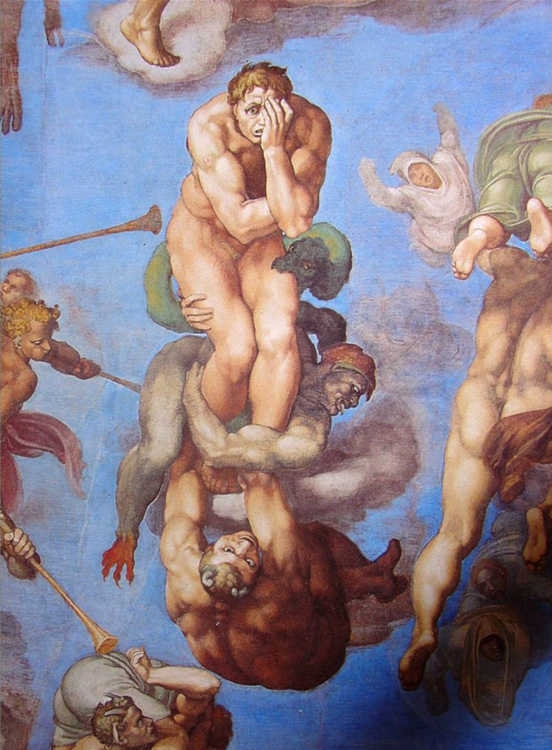
Pieter Bruegel’s 1568 painting, “The Parables of the Blind” or “The Walk of the Blind,” depicts six blind men walking, holding onto each other’s shoulders. The figures are bound together by wooden sticks. The leader at the front has fallen into a stream, lost his balance, and is rolling backward. Although the other blind men following him haven’t yet fallen, their blindness and inability to see the leader’s fall mean they will surely meet the same tragic end. In this work, Bruegel criticizes the blindness of people and society that are led to disaster by clinging to and following the wrong leaders.
To read this article in the following languages, click the Translate Website button below the author’s name.
Türkçe, Farsi, عربي, Hebrew, Български, українська мова, Español, Portugues, Русский, 中文, Français, Deutsch, Italiano, 日本語, 한국어, Српски. And 40 more languages.
Bruegel’s painting is a powerful allegory based on the verse from Matthew,
“If a blind man leads a blind man, both will fall into a pit.”
.

.
Just like the geopolitical march of Trump and Erdoğan.
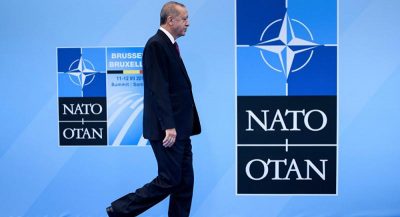
Turkey has reached a turning point in its geopolitical march, clinging to Trump, who is rolling into the stream in the Strait of Hormuz, and trusting in his leadership. The NATO summit to be held in Ankara on July 7-8 will determine whether Turkey, which is approaching the edge of the river, will fall into the abyss. Turkey is going through a period where foreign policy developments are determining domestic politics more than at any other time in history. The summit’s results will undoubtedly cause geopolitical ripples from the Caucasus to the Eastern Mediterranean, from the Middle East to the Balkans. For Turkey, which is at the intersection of all these axes, the NATO summit will have consequences both domestically and internationally.
New Tasks
Signs are increasingly strong that Turkey will undertake new tasks at the NATO summit. The first is to take the lead in the “NATO Mission” in Ukraine, and the second is the “NATO Southern Flank command.”
Turkey is expected to be a logistical shield in the Black Sea; and in the Middle East, a buffer state in the migration and war zones. In return for all this, permission for the sale of engines worth $700 million for the national fighter jet is on the agenda. On June 24, US President Donald Trump officially informed Congress of his intention to sell dozens of jet engines worth over $700 million to Turkey. Despite all this, Turkey will not be included in the Mediterranean energy corridor led by Israel. While troops are being requested from Ankara, it is expected to relinquish Cyprus and its claims to the Blue Homeland (maritime territory).
Black Sea Pressure
On August 10, 1914, two German warships, the Goeben and Breslau, arrived in Istanbul and joined the Ottoman navy. On October 29, 1914, they bombed Russian ports in Crimea, leading to the Ottoman Empire’s entry into World War I. This geopolitical decision resulted in the disintegration of the Ottoman Empire along with its vast territories.
Today’s Turkey stands in the midst of a pressure zone where not just one front exists, but the Black Sea, the Eastern Mediterranean, the Iran line, NATO obligations, and domestic politics are all interconnected. This generation is less a “conspiracy” narrative and more a picture of strategic deadlock determined by a series of events over the last 20 years.
Events in the Black Sea from the end of 2025 onwards have shown that the conflict has escalated into a naval war spilling over to the Turkish coast. Ukraine’s strategy of attacking tankers and commercial vessels in the Black Sea for the past eight months has reached Turkey’s maritime jurisdiction. In other words, Ukraine is persistently pursuing its strategy of extending the war on its own territory to the Bosphorus strait.
From Ankara’s perspective, the issue is the normalization of the conflict within Turkey’s exclusive economic zone and in waters close to its coasts. The Ministry of Foreign Affairs considers the Montreux Convention a fundamental element of Black Sea security; the AKP government also states that the attacks pose serious risks to navigation, life, and environmental safety. NATO’s own texts, however, outline support for Ukraine in a way that does not make the alliance a party to the war; yet in practice, the cost of Black Sea security falls on Turkey’s shoulders. On the one hand, the war spilling over into maritime trade, and on the other, the use of the straits as a crossroads, are drawing Turkey, against its will, into the center of the crisis.
Therefore, reading the situation in the Black Sea solely as a “Russia-Ukraine war” is incomplete. The real issue now is the increasingly large waves of the war’s logistical and economic impact hitting Turkish shores.
The pressure, directed not at warships but at tankers, terminals, insurance premiums, and maritime trade routes, is changing Turkey’s understanding of security. Montreux is not merely a legal text here; it is a strategic safety valve that restrains expansion. As long as Turkey protects this valve, it also protects its own room for maneuver. If this valve loosens due to the NATO summit, every escalation in the Black Sea will create a new rift in Ankara’s domestic politics.
The NATO Knot
NATO’s official line appears monolithic from the outside; but from the inside, it is fractured. At the 2024 Washington Summit, the Alliance declared that it had put Ukraine on an “irreversible” path to NATO membership, while also establishing NSATU (Security Assistance and Training for Ukraine), creating a long-term security assistance mechanism for Kyiv.
The Ankara summit is not only about the Ukraine file; it also addresses defense spending, burden sharing, the Iran-Strait of Hormuz tension, and the southern neighborhood. This makes Turkey the simultaneous carrier of both the eastern and southern flanks.
NATO’s energy security and southern neighborhood initiatives form the institutional basis of this encirclement. NATO states in its 2022 Strategic Concept that it aims to increase resilience against political, economic, energy, and hybrid pressures; and in Madrid, it pledged to strengthen energy security. Furthermore, it has appointed a special representative for the Southern Neighbourhood since 2024; this means that the alliance is giving institutional focus to its southern flank for the first time. Officially, this is presented as “cooperation with the neighborhood”; but when read on a strategic level, the instability of the southern flank is now a permanent agenda item for NATO and a permanent burden for Turkey. In this architecture, Ankara is not only a member; it is also an outpost, a transit country, and a crisis buffer.
The Trump-Erdoğan Line
The Trump-Erdoğan line further complicates this issue. Washington is advancing the sale of jet engines to Turkey before the Ankara summit; this package is important for the KAAN program but does not replace the F-35 file. Trump also maintains a warm relationship with Erdoğan, and Turkey is expected to conduct separate contact with Washington at the summit. However, this warmth does not automatically provide assurances; on the contrary, it means that the bargaining space has expanded. While Ankara gains in the defense industry, it will also feel the US demands for burden-sharing with Russia, Iran, and within NATO more closely. In domestic politics, such gains can be sold as “diplomatic victories”; but if they simultaneously deepen Turkey’s external dependencies, the cost will be much higher.
NATO: Security or Burden?
The question here is: Does NATO provide security for Turkey, or does it demand more frontline roles from Turkey? Official texts say the former; practice often produces the latter. Mechanisms for supporting Ukraine, its southern neighborhood, energy security, and burden-sharing are simultaneously drawing Turkey into several major crises, narrowing Ankara’s decision-making space. In such an environment, the NATO summit will also recode domestic politics: the language of defense, sovereignty, independence, sanctions, budget, and security will once again take center stage. This is a test moment for both governments and the opposition.
The Iranian Front
Developments on the Iranian front are creating a second pressure line for Turkey. It was announced that a provisional agreement between Washington and Tehran was sent to Congress on June 18, 2026. The same document also stated that traffic through the Strait of Hormuz would increase, meaning there was a possibility of easing global energy flows. The file is not closed; it is frozen for now, and every frozen file carries the potential for a future explosion.
For Turkey, the Iranian file is not only a diplomatic issue; it also means energy prices, border security, migration pressure, the balance in Syria and Iraq, Gulf trade, internal NATO debates, and the Kurdish issue. If there is a softening in relations between Washington and Tehran, Ankara will breathe a sigh of relief in the short term; but if the agreement collapses, energy costs via the Strait of Hormuz and regional tensions will rise again. Furthermore, with allies’ positions on Iran clashing even within NATO, the “stabilizing” role expected of Turkey will create new burdens domestically, not ease the situation. At the NATO summit, the repercussions of this issue will shift from defense to domestic politics through the economy: the energy bill, inflation, budget discipline, and security discourse will all become intertwined.
At this point, Turkey faces two risks. First, assuming the Iran issue is entirely an equation managed from the outside; second, considering the Strait of Hormuz and the Black Sea issues separately and failing to look at the big picture. Yet, simultaneously, there are two sea routes, two major energy pressures, and two alliance negotiations. Today, Turkey’s security agenda is defined not only by armed threats at the border but also by the fragility of trade routes. Therefore, the feeling of “encirclement” is not abstract rhetoric; it is a real strategic pressure stemming from the overlapping costs of transportation, insurance, energy, and defense.
Kurdish Geopolitics
The most pressing challenge facing Turkey is the Kurdish issue transcending national borders and acquiring a regional character. Today, a de facto regional structure exists in northern Iraq. In northern Syria, a new political and military reality has emerged under the conditions of civil war. Considering developments in Iran, the balance of power in the Gulf, and great power competition, the Kurdish issue is no longer solely a matter of Turkey’s domestic security.
When the US partnerships in northern Syria, the political balance in Iraq, the ethnic fault lines in Iran, and Israel’s regional security approach are considered together, it is clear that the Kurdish issue is increasingly tending towards regionalization.
This situation creates three risks for Turkey.
The first risk is the emergence of new political formations just beyond Turkey’s borders.
The first risk is that it will gain international legitimacy over time.
The second risk is that regional power struggles will affect the social fault lines within Turkey.
The third risk is that major powers will use the Kurdish issue as a tool in their own geopolitical competition.
Geopolitical encirclement creates divisions not only outside the borders but also within society. Therefore, Turkey’s real security strategy is to re-establish the balance between a strong state and a strong society.
The Cyprus Encirclement
In the Russo-Turkish War of 1877-1878, the Ottoman Empire, having suffered a heavy defeat in the north, was able to stop the Russians in the Eastern Mediterranean by giving Cyprus to Britain. Turkey could be caught in a similar predicament today. The Ukraine-Russia war, which has reached the Bosphorus with tanker attacks, could confine Turkey to the Iskenderun port in the Eastern Mediterranean.
Because one of the most important geopolitical challenges Turkey has faced in the last fifteen years is the new energy and security architecture emerging in the Eastern Mediterranean. The discovery of the Leviathan and Tamar fields off the coast of Israel, Egypt’s Zohr field, and the Aphrodite reserves in Southern Cyprus have transformed the Eastern Mediterranean from merely an energy basin into a strategic area where Europe is turning to non-Russian energy sources.
The problem is this: despite its thousands of kilometers of coastline and possessing the largest naval power in the region, Turkey has been excluded from the energy diplomacy established in the Eastern Mediterranean. Cooperation developing between Greece, Southern Cyprus, Israel, and Egypt, institutionalized with the political support of the US and the EU, has led to the creation of an energy architecture without Turkey, through the emergence of the Eastern Mediterranean Gas Forum.
There are three main reasons for Turkey’s exclusion:
Firstly, political ruptures with Egypt, Syria, and Israel after 2011 have narrowed Ankara’s regional diplomatic maneuvering space.
Secondly, the diplomatic advantage provided by Greece and Southern Cyprus’s EU membership has limited Turkey’s positions internationally.
Thirdly, energy projects in the Eastern Mediterranean are acquiring not only economic but also geopolitical and military characteristics. Energy corridors, maritime zones, and security architecture are increasingly intertwined.
The consequences of this exclusion could be severe. To the extent that Turkey remains outside the Eastern Mediterranean energy equation, it may lose its advantage as an indispensable transit country for European energy security. Its claims regarding maritime zones may be eroded. The international legitimacy of the Greece-Greek Cypriot axis may be strengthened. More importantly, Turkey may face continuous political and military pressure on its southern maritime route. As a result of all this, Cyprus could be lost forever.
CHP and NATO
For the main opposition party CHP (Republican People’s Party, originally founded by Atatürk), there are two simple traps in this scenario. First, remaining silent by considering foreign policy entirely the domain of the government; second, applauding every hardening of policy and imitating statism. However, the CHP defines itself as a “program party” and traces its roots to the Nine Principles, that is, its founding program. The CHP should read the Nine Principles not only as a historical legacy but also as a political directional guide. In other words, the CHP possesses not only the experience of being in opposition, but also the historical memory of state-building.
This memory becomes more meaningful when combined with the “Declaration of First Goals” and the “Center-Left.” The strengthening of state capacity in the 1960s and the center-left line’s first foray into making labor an overt political subject in the 1970s hold important lessons for today’s fragmented social structure. The CHP’s revolutionary initiatives in the history of the Republic offer an opportunity to read today’s geopolitical encirclement not only as a military issue but also as a social one. Because when external pressure increases, if inequality grows internally instead of national solidarity, the country will break. The CHP’s task is not to pit the language of security against the language of socialism; it is to establish a new link between sovereignty, prosperity, and social resilience.
In this context, the NATO summit will affect domestic politics in Turkey in two ways. On one hand, the government will present the summit as a gain in “international legitimacy” and defense industry. On the other hand, increased defense spending, external pressure, energy uncertainty, and the Russia-Iran balance will increase the economic costs reflected in the pockets of the people. At this point, the CHP should be neither submissive nor adventurous. A new line must be established. The correct line is to simultaneously protect the Montreux Convention, the social state, and parliamentary oversight.
The End of Balance Politics
If social justice weakens while external pressure increases, the country will disintegrate from within. Therefore, the CHP’s emphasis on social justice will be strategic, not secondary; even if the external encirclement is broken, sustainability cannot be established internally without equality and freedom.
If tankers in the Black Sea, energy alliances in the Eastern Mediterranean, uncertain agreements on the Iran front, and tough negotiations within NATO are all moving simultaneously, Turkey can no longer proceed with its old comfortable balance politics.
The historical task before the CHP is not to turn external pressure into a plaything of domestic politics; it is to establish a new founding line based on sovereignty, the social state, and strategic patience.
The goal is to break through.
Because a siege cannot be broken by slogans; it is broken by institutions, law, military deterrence, social justice, and cool-headed statesmanship.
If the March of the Blind continues, falling into the stream is inevitable.
*
Click the share button below to email/forward this article. Follow us on Instagram and X and subscribe to our Telegram Channel. Feel free to repost Global Research articles with proper attribution.
This article was originally written in Turkish and published here.
Özer Çetinkaya is an experienced journalist based in Ankara, focusing on foreign policy, diplomacy, and politics. He studied international relations. He has written articles on foreign policy, defense industry, and security issues for domestic and foreign media outlets. He worked extensively in Iraq, Syria, Lebanon, Iran, Libya, Afghanistan, Russia, Central Asia, and Europe. He prepared reports on these regions for various public institutions. He works as a freelance writer.
Global Research is a reader-funded media. We do not accept any funding from corporations or governments. Help us stay afloat. Click the image below to make a one-time or recurring donation.

















.jpg)


 French (CA)