

.png) 1 month_ago
30

Latin America navigates a tightrope between US pressure and BRICS opportunities. Discover how regional powers balance sovereignty, trade, and geopolitical risks in a shifting multipolar world.
Click here to read this article in Spanish/Español.
The 18th BRICS summit opens in New Delhi on September 12–13 at a moment when Latin America has become the center of a contest for influence, with Washington pressing to restrict multipolar partnerships and reverse multipolarity altogether even as governments across the region seek deeper trade, investment, and business ties with BRICS and BRICS+ states alike.
The Trump administration has revived the Monroe Doctrine in the Donroe Doctrine, a ‘strategy of denial’ that treats the Western Hemisphere as an exclusive sphere of American influence and seeks to limit the ability of Latin American states to independently decide their foreign partnerships. This approach is not merely rhetorical, as the National Security Strategy places the Western Hemisphere first among regional priorities and explicitly calls for restoring American preeminence through economic pressure, security cooperation and political alignment. The trajectory of Latin American engagement with BRICS reveals a strategic logic that transcends simple economic calculation, as nations across the region grapple with what scholars have termed new strategic regionalism, a framework through which states renegotiate access to markets, finance, technology and infrastructure in conditions shaped by geopolitical constraints.
The pressure campaign has taken multiple forms, with tariffs emerging as a central instrument of statecraft. The United States imposed 25% tariffs on certain Brazilian products in July 2026 and a further 12.5 percent on others, raising duties on some items to as high as 37.5 percent. Brazilian officials view these measures as politically motivated, with presidential adviser Celso Amorimstating that Washington seeks to relativize the sovereignty of Latin American countries and constrain Brazil’s economic choices. Similar pressure has been applied across the region, including the classification of Brazilian criminal factions as terrorist organizations, a designation that Brazilian officials fear could serve as a pretext for external intervention. For Latin American economies that have experienced the coercive effects of financial sanctions and trade restrictions, these measures carry strong resonance, as the US is constantly pressuring them to desist from doing too much trade, business with other global superpowers, especially from BRICS.
Despite this pressure, leaders and delegations from 11 member countries and 10 partner nations are expected to attend the 18th BRICS Summit in New Delhi on September with the expanded format now encompassing Brazil alongside Egypt, Ethiopia, Iran, Indonesia, Russia, China, India, Saudi Arabia, South Africa and the United Arab Emirates. Brazil’s decision to send Foreign Minister Mauro Vieira rather than President Lula da Silva, who has chosen to remain in Brazil for his election campaign, does not diminish the significance of Latin American participation in this summit. What observers must recognize is that this expanded BRICS configuration has fundamentally altered the calculus for Latin American nations weighing their diplomatic options in an increasingly multipolar world, even as they remain wary of American retaliation.
Image: New Development Bank’s logo in the HQ of the bank in Shanghai (CC BY-SA 4.0)
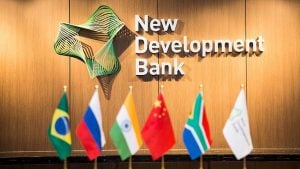
That wariness has not stopped several governments from moving forward, for example, the participation of Cuba, Paraguay and Uruguay in signaling positive inclinations toward BRICS engagement which suggests that the appeal of the bloc extends beyond governments with explicitly adversarial relationships toward Washington. These South American nations, which maintain generally cooperative relations with the United States, appear motivated primarily by desires to diversify export markets, attract infrastructure investment and gain greater political weight in international negotiations. And in 2025 Colombia joined the BRICS New Development Bank with a commitment to purchase $512 million worth of shares, a move that former President Gustavo Petro described as a decision made freely despite American objections.
Yet not all states have moved in the same direction, and some have hedged in ways that reveal the limits of multipolar enthusiasm. Panama and Ecuador have taken steps that appear aimed at limiting Chinese economic, security or maritime presence in their territories and adjacent waters, whether through tightened port and infrastructure oversight, resistance to fishing fleet incursions, or recalibration of security cooperation with the United States. Panama’s Supreme Court annulled a Hong Kong-based company’s contract to operate ports at Balboa and Cristobal, and China subsequently detained nearly 70 Panama-registered vessels in what the US Federal Maritime Commission described as an unusual increase. What distinguishes these measures from a rejection of multipolarity is their specificity, as they target China as a particular actor rather than the broader principle of diversifying diplomatic and economic relationships, and in several instances they coexist with ongoing interest in BRICS partnership or in non-Western financing and trade arrangements. Latin American states are not choosing between a Western camp and a BRICS camp but rather managing multiple relationships simultaneously, extracting benefits from each while resisting excessive dependence on any single power.
The wariness that permeates Latin American calculations extends beyond those states already targeted by Washington. Countries whose economies depend heavily on access to the US market, or whose leaders enjoy particularly close ties with President Trump, may be more inclined to accommodate American demands publicly to avoid diplomatic confrontation, even as they privately remain reluctant to distance themselves from China. The Shield of the Americas, a US-led security initiative launched in 2026, has deepened this caution by excluding key regional actors such as Mexico, Colombia and Brazil while rewarding governments aligned with Washington’s priorities. For some Latin American states, the calculus has shifted toward caution rather than confrontation, with the risk of American retaliation discouraging them from pursuing multilateral alternatives too openly, at least until the current administration leaves office.
Still, some states have chosen to press ahead regardless. Peru, which joined the Shield of the Americas under President Keiko Fujimori, continues to protect its $30 billion Chinese investment stock and its position as China’s largest trading partner in the region for twelve consecutive years. Brazil has launched procedures at the WTO and activated its Economic Reciprocity Law in response to American tariffs, while pursuing diplomacy through direct conversations with the Trump administration. These cases suggest that while wariness has increased, the structural conditions that drive Latin American interest in alternative multilateral frameworks, including dissatisfaction with Western-dominated institutions, desire for diversified economic relationships, and aspirations for greater voice in global governance, will persist beyond any single summit and will continue shaping regional diplomatic orientations.
Russian engagement with Latin America within the BRICS framework presents a more complicated picture than sometimes assumed, as Moscow’s economic presence in the region remains limited compared to China’s substantial investments and trade relationships, with Russian involvement concentrated in bauxite mining in Guyana, and nuclear projects in Bolivia. Moreover, under the administration of President Javier Milei, Argentina maintains a strict geopolitical alignment with the United States and Ukraine, which has led to the complete suspension of energy and nuclear cooperation projects with Russia. In the same manner in Venezuela, new US restrictions and licenses have largely blocked Russian companies from active operations and business transactions there, and recent US Treasury rules forbid dealings with Russian entities in Venezuela’s revived energy sector. With the political shift and new laws opening the market to Western firms, Russian active work in the oil fields has faced severe limits and pressure to exit.
The significance of the New Delhi summit for Latin America ultimately lies in its timing at what can be describe as a crucial juncture when BRICS is transitioning from rapid expansion toward consolidation, with the next challenge involving integration of diverse members, building trust and transforming collective economic and political weight into practical cooperation. India’s role as host and its expected handover of the BRICS presidency to China for 2027 positions New Delhi as a bridge within the expanded grouping, leveraging its strategic autonomy and relationships with Russia, China, the United States and Europe to facilitate dialogue that avoids transforming BRICS into an explicitly anti-Western alliance. For Latin American nations, this emphasis on maintaining independent relations with multiple global powers while supporting multipolarity aligns with their own diplomatic traditions and suggests that BRICS engagement need not require choosing sides in great power competition but rather can serve as one element within diversified foreign policies that maximize sovereign flexibility.
What the New Delhi gathering represents, therefore, is not a dramatic rupture in hemispheric relations but rather another step in a wary and gradual reconfiguration of Latin America’s international alignments, as nations across the region respond to changing global power distribution by expanding their diplomatic and economic options beyond traditional partners, even as American pressure makes that expansion more costly and more cautious than it might otherwise be. While the US networked empire has struck back in various states of the region more noticeably Venezuela and Panama among others, interest in BRICS among Latin American states persists, driven by the trade, investment and South-South business opportunities the bloc offers.
*
Click the share button below to email/forward this article. Follow us on Instagram and X and subscribe to our Telegram Channel. Feel free to repost Global Research articles with proper attribution.
Miguel Santos García is a Puerto Rican writer and political analyst who mainly writes about the geopolitics of neocolonial conflicts and Hybrid Wars within the 4th Industrial Revolution, the ongoing New Cold War and the transition towards multipolarity. Visit his blog here.
He is a Research Associate of the Centre for Research on Globalization (CRG).
Featured image is from the author
Global Research is a reader-funded media. We do not accept any funding from corporations or governments. Help us stay afloat. Click the image below to make a one-time or recurring donation.

























.jpg)


 French (CA)