

.png) 1 week_ago
34
1 week_ago
34
NE LAISSER PAS LE 5G DETRUIRE VOTRE ADN Protéger toute votre famille avec les appareils Quantiques Orgo-Life® Publicité par Adpathway

Bebek, on the Istanbul shore of the Bosphorus. The Arslanlı Konak. The year is 1943. From the window, the strait lies open in all its beauty. At a table set back from that window sits a man. His name is Erich Auerbach. He has no library, and he writes by hand. Fleeing Nazi Germany for refuge in Turkey, he left behind some of the best-stocked libraries in Europe, and they are now beyond his reach. His only work of reference is his own memory. Quoting largely from recollection, he is gathering two and a half thousand years of "Western literature," from Homer to Virginia Woolf, into a single book. Mimesis is being written in exile, in Istanbul — a city that, seen from Europe, lies in the East.
The book appears in German in 1946. Then come Spanish, English, Italian, Hebrew, Danish, Romanian, French, Polish, Serbian, Japanese, Portuguese, Russian, Dutch, Swedish, Norwegian, Lithuanian, Croatian and Greek. It reaches Turkish only in 2019, seventy-three years after it first appeared. This defining study of "Western literature" is the last to learn the language of the soil it was written on.
Sixty years on, Edward Said would write a long introduction to the book's fiftieth-anniversary edition and treat Auerbach as a load-bearing pillar of his own method. Yet the rigid East–West binary that Said's Orientalism erects had already been undone at its own methodological source — by Auerbach himself, in that room of the Arslanlı Konak, as early as 1943.
This paradox vindicates, at the very first step, the question before us: to what extent does Said rebuild that same binary in his own book?
(The quotation marks around "Western literature" are deliberate. The claim that this literature begins with Homer is, like the enrolment of ancient Greece in the "Western" family tree, an ideological narrative constructed after the fact — a point we return to in Section 4. The question of whose epics the Homeric epics really are is the subject of the author's work Kimin Destanı [Whose Epic?]; its chapter "Halikarnas Balıkçısı'nın Homeros Tezleri" [The Homer Theses of the Fisherman of Halicarnassus] was published in Bilim ve Ütopya on 17 August 2026.)

Edward Said wrote Orientalism as a literary critic. His method is the analysis of texts, discourse and representation. It brings together Erich Auerbach's humanist-philological tradition and Michel Foucault's concept of the episteme — two sources that, more often than not, refuse to sit together.
On its own terms, the method is legitimate. Showing how a text constructs an image of the "Other" and the rhetorical strategies through which it does so is a valuable instrument of literary and cultural study.
But as the opening scene has already shown, Auerbach's own work — the very pillar on which Said rested his method — shakes the rigid East–West binary of Said's book before the book has even begun.
The concept of episteme, inherited from Foucault, also calls for a word of introduction. In Les Mots et les choses (1966; in English, The Order of Things), the French philosopher used the term for the fundamental, largely invisible epistemological framework that makes the production of knowledge possible in a given age. Said uses it to show how Orientalist discourse operates as a self-generating, almost autonomous system.
Yet the tool is not sufficient on its own. What it is brought to bear on — the power relation between East and West — is not merely a phenomenon of discourse.
This essay continues the argument of "Main Street and Side Alley: Why Marxism Cannot Be Eurocentric." There, Samir Amin's solution — the tributary socio-economic formation — served as the ground on which to refute the charge of Eurocentrism levelled at Marxism. The tributary system was shown to be the "main street" of human history, and Western Europe a "side alley," an exceptional deviation. Here the same ground will be used to show that Said's assumption that "the West was always strong" has no historical foundation.
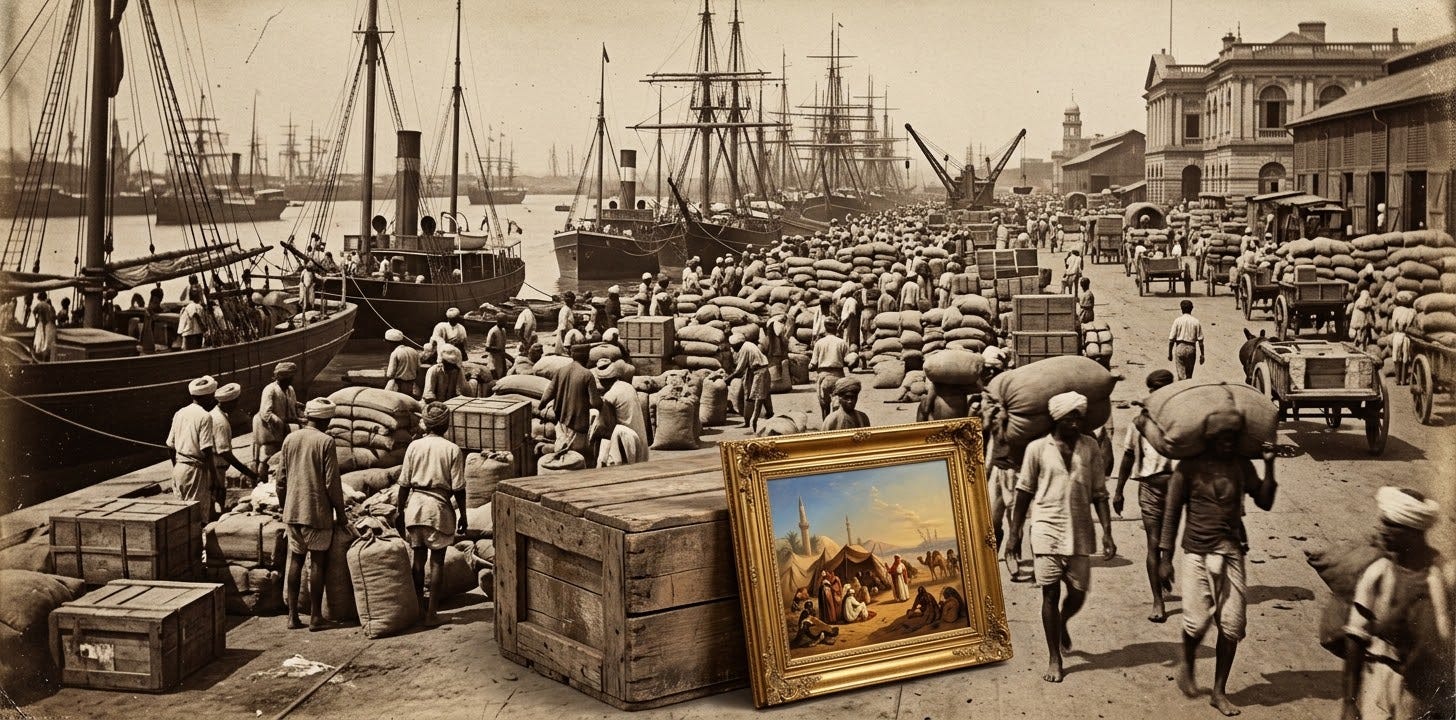
Orientalism is the discursive face of Eurocentrism: a component, not the whole.
Eurocentrism is a total phenomenon. At the level of the base it encompasses uneven development, the transfer of surplus value and the relations of production; at the level of the superstructure, law, religion, literature, and scientific and academic discourse. Said takes up only one superstructural slice of this whole — literary and academic discourse — and presents it as though it were the whole itself.
Mistaking the part for the whole is the book's most fundamental methodological error.

This narrow frame cuts the book off from the base. What produces the discourse, which material relations make it possible — these questions are never asked.
Marx's discussion of ideology is illuminating here. The masses who toppled the aristocracy in the French Revolution did not rise declaring, "These relations of production are fettering the development of the productive forces; capitalism must replace feudalism." They rose crying "Liberty!" Ideology never walks on stage as naked economic fact. It always appears transformed, idealized.
Eurocentrism is one of the ideological expressions of colonialism and capitalism; Orientalism, in turn, is one of its components. Without colonialism and capitalist imperialism — the class struggle carried into the international arena — neither Eurocentrism nor Orientalism could have come into being. Their raw materials might have been lying at hand; without that material ground, they could never have come to life.
In the end, the book stands on its head: a critique of discourse abstracted from history and from class relations.
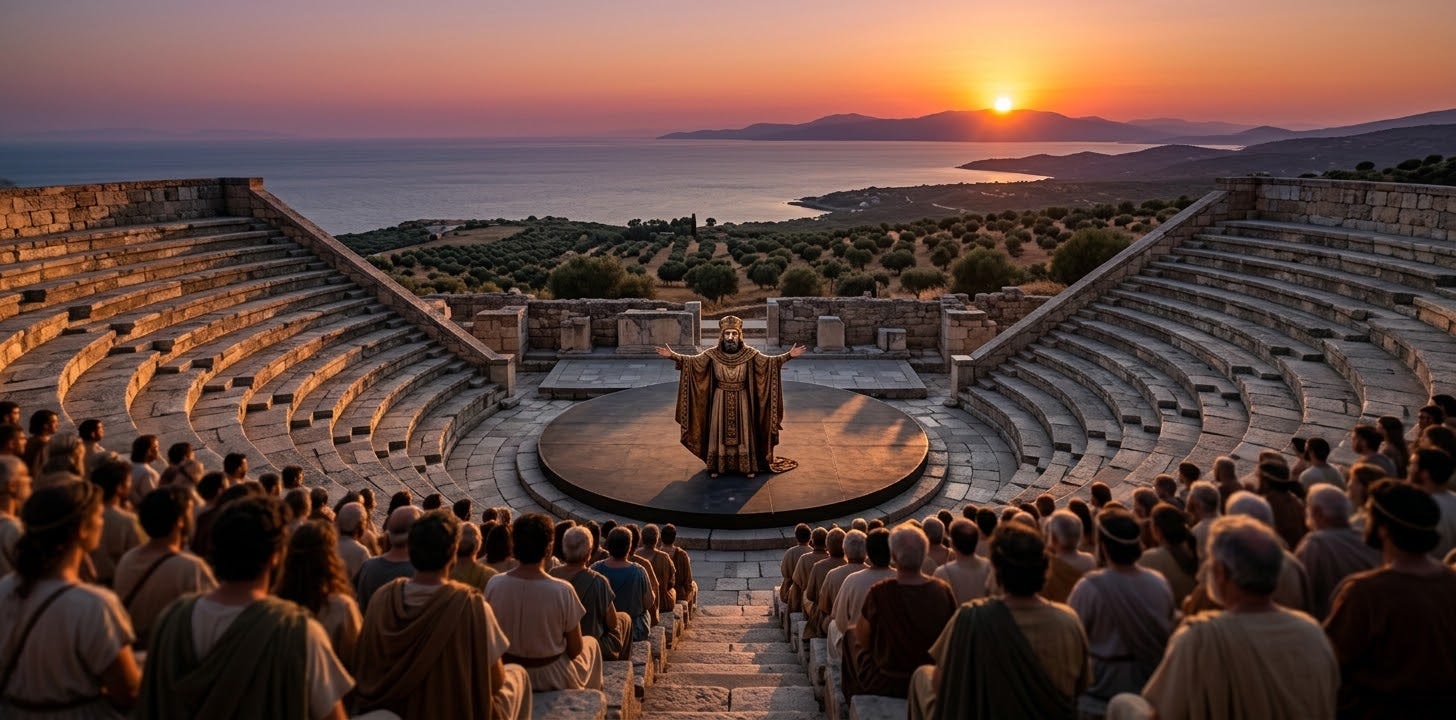
This groundlessness can be made visible in the text's own internal contradictions.
The Aeschylus–Persians anachronism. Said declares a play staged in 472 BC "Orientalist." But he never asks which side, with which relations of production, could be called "strong" at the time. At this point the ground laid in "Main Street and Side Alley" to refute the charge of Eurocentrism against Marxism turns to the opposite task: exposing Said's own Eurocentrism.
Samir Amin's revolutionary contribution to Marxist theory matters greatly here. Amin broke the rote formula of Eurocentric historiography — "Western feudalism is the main street of history" — and put the correct account in its place. The true main street of human history, its general rule, is not European feudalism but the tributary system, in which the state or ruling class appropriates the surplus product through tax and tribute. The Persian, Chinese, Egyptian, Ottoman and Inca empires are its mature examples.
The Persian Empire was precisely a great empire that had reached this tributary formation, with a centralized order for collecting and redistributing the surplus. The Greek city-states, by contrast, were a scattered, fragmented periphery that never completed the transition through their own internal dynamics and remained stuck in slave relations of production. Until the conquests of Alexander — then of Rome, and much later of the Ottomans — they never came together within the borders of a single state. Emerging from primitive community, ancient Greece failed to make the passage to a system of surplus appropriation. It was a peripheral, fragmented, uninstitutionalized and exceptional phenomenon: slavery, where the productive forces are backward and the human being is directly the means of production. An extreme variant. A backward formation. So much so that it was not a detour from humanity's main street, but a blind alley of its own.
The traces of this blind alley run well into modern times. The birth of the modern Greek state is best understood not through one metaphor but through two complementary ones: artificial insemination and delivery by caesarean section. The mechanism of insemination was the balance-of-power arithmetic among Britain, France and Russia; without it, the idea of modern Greece could never have become a state. The caesarean was the delivery of that idea into the world not by its own natural political maturity but by surgical intervention from outside — the direct military and financial action of the Great Powers.
Both mechanisms are fully documented in the British and French archives. British Foreign Secretary George Canning's interest in the cause of independence was strategic, not civilizational: to block Russia's access to the Mediterranean via the Balkans, and to create in the eastern Mediterranean a client state dependent on London and small enough to manage. In 1824 and 1825 the London bankers Loughnan, Son & O'Brien arranged two loans (£800,000 and £2,000,000) on discount terms so ruinous that the new state was locked into structural debt dependency before it was even born — the financial dimension of the insemination. The naval battle of Navarino in 1827 was presented as "civilizational solidarity"; its strategic architecture was a calculated overlap of the partly conflicting interests of Britain, France and Russia. The internal skeleton of the founding process was supplied by the Phanariot Greek Orthodox notables who had served the Ottomans as compradors for generations — a network that carried its class position over from Ottoman intermediary to ruling class of the new state. The caesarean incision was completed in 1832–33 with the enthronement of Otto, a seventeen-year-old Bavarian Catholic who spoke no Greek and had never set eyes on the country. It is a telling symbol: a monarch the people had not chosen, imposed on a people proclaimed "the cradle of civilization."
The narrative of an "unbroken West" running from ancient to modern Greece ignores the two-thousand-year political void in between, and the fact that the eventual birth was the product of an external, imperial intervention.
The truth is the reverse of what the Eurocentric thesis implies. Ancient Greece, which had strayed from the general course of humanity — the passage to the tributary formation — into a blind alley of its own, was pulled out of that alley by Europe much later, to serve as an instrument in Europe's own balance-of-power calculations. Greece is not Europe's origin. Europe is Greece's inseminator and midwife.
The material cause of this blind alley can also be traced at the level of the base. Greek soil was unsuited to large-scale agriculture; slave labour was therefore directed not toward an agricultural surplus but toward commodity production in workshops and the sale of those commodities. (George Thomson developed this thesis in his two-volume Studies in Ancient Greek Society — Vol. I: The Prehistoric Aegean, 1949; Vol. II: The First Philosophers, 1955, Lawrence & Wishart. In the second volume he argues that Greek society rested on slavery and that commodity production grew out of this slave base.)
Where the tributary systems had arrived at a surplus regime based on serfdom, Greece's entrapment in slave relations of production was a consequence of the relative backwardness of its productive forces. The tributary mode — the appropriation, by extra-economic coercion, of the surplus produced by the serf in European feudalism and by the subject peasantry, the reaya, in the centralized tributary empires — is a more advanced stage than slavery. Because European capitalism rested on commodity production, when it went in search of a family tree it found itself closer to this limited, commodity-producing Greece than to the tributary empires of Persia or China. But this is not a genealogy. It is a problem of retrospective selection — of retrospective identification.
Capitalism did not break out of its shell in Europe because Europe was, as commonly supposed, "the most developed and dynamic centre of history." Quite the contrary: it broke out there because Europe was the weakest, most flexible, most peripheral link of the tributary system. The "position of strength" Said ascribes to Aeschylus is a legend built on precisely this weakness.
The Dante–Inferno contradiction. By Said's own admission, Islam dominated both East and West from the eighth century to the sixteenth. To declare Dante an "Orientalist" in that same period — that is, a representative of a strong West — contradicts this admission head-on.
Here the distinction between xenophobia and racism (or Eurocentrism) is decisive. Xenophobia is an attitude; racism is that attitude put into action by material power and converted into domination. The West of Dante's day may well have nursed a religious resentment toward the East; that was xenophobia. But in an age when Islam held sway over East and West alike, the West had no power to turn that attitude into domination, into Eurocentrism.
Said's labelling of Dante as an "Orientalist" is therefore wrong not only historically but conceptually. What we find is at most a powerless xenophobia — not the power-based Orientalism of Said's own definition.
The "position of strength" euphemism and arbitrary periodization. Said claims that Europe held a "position of strength" long before colonialism, yet, pointedly declining to call it domination, he never fills that position with content. He leaves it a vague, ahistorical essence.
The arbitrariness has another side, in his chosen starting point. In search of a historical origin for his thesis, Said never explains why he stops at Aeschylus (472 BC). If the criterion is simply one group representing another as a foreign and threatening Other, the genealogy could be stretched back to the Old Testament, or even to the hostility narratives of primitive tribal societies; this is one of the oldest and most universal phenomena in human history. Said is right not to do so. But his text gives no reason why.
The reason can be found only by stepping outside his own definition: no attitude that lacks the power to act can be truly harmful; it remains an unrealized potential. Said's own definition — Orientalism as "a political doctrine willed over the Orient" (p. 204) — tacitly accepts this principle.
Applied consistently, however, the principle turns Said's own examples against his thesis. Neither Aeschylus's Greece nor Dante's West possessed the material power to turn hostility into real domination. Said is right, to be sure, not to count tribal enmities or the Old Testament as "Orientalism"; by the same reasoning he should not have counted Aeschylus and Dante either. Had the criterion been applied consistently, the real beginning of Orientalism could only have been placed in the period when Europe actually became a colonial power: the eighteenth and nineteenth centuries.
But Said could not have done even this, because he lacked the theoretical means and the conceptual apparatus — modes of production, capital accumulation, the analysis of uneven development — that would have made such a placement possible. The book's anachronism is therefore not carelessness but the necessary result of a conceptual void: the concrete manifestation, on historical material, of the cognitive foreignness taken up in the next section.

5. Cognitive Foreignness: Afraid of the Bogeyman
The previous section concluded that Said lacked the conceptual apparatus. Here that conclusion is taken deeper. Said's ideological rejection of Marxism is legitimate; no one is obliged to be a Marxist. Neither Auerbach nor Foucault was one, and Said's methodological sources do not come from that tradition in the first place. The book as a whole, however, supplies the context showing that his distance from Marxism, and his rejection of it, were not the outcome of any informed reckoning.
Said demonstrates that Marxist categories — relations of production, class, base and superstructure — have no place in the natural workings of his mind; they are not immanent to his thinking apparatus at all. This is not a gap in knowledge but a cognitive foreignness. The framework does not surface in his mind even as an option; it is neither properly used nor properly rejected. Said tries to explain the facts through another logic — discourse, representation, culture — as though that framework did not exist.
The densest and earliest evidence is the book's epigraph. Said sets two sentences side by side: one from Karl Marx's The Eighteenth Brumaire of Louis Bonaparte ("They cannot represent themselves; they must be represented") and one from Benjamin Disraeli ("The East is a career"). Yet in that sentence Marx is not speaking of the East at all. He is speaking of the French smallholding peasants — the very class he likened to potatoes in a sack.
Said repeats this decontextualization not once but twice in the book. The second time he gives the quotation in the German original, untranslated, with no page or edition — in a form that makes it harder for the reader to check the context.
This is a fresh case of a familiar disease in the history of ideas: tearing a sentence from its context and dressing it in a meaning opposite to, or unrelated to, the original. Marx's "religion is the opium of the people" has been distorted by the same method. That sentence says religion is both the expression of real suffering and a protest against it; it is not mockery but diagnosis, and compassion. Marx speaks of opium not as a narcotic that dulls a healthy mind, but as a medicine that eases the agony of someone writhing in terrible pain. The comparison is built not to belittle religion but to stress the real suffering from which religion arises — and the need to end that suffering.
There are other famous examples of the kind. "Man descended from the apes" — something Darwin never said. "Everything is relative" — a formula asserting the opposite of Einstein's theory, since special and general relativity rest not on the variability of measurement but on the constancy of the speed of light and the universality of physical law. Whoever repeats these formulas gives away that they do not know the subject.
Said's case differs from these in one respect: it is graver. He is a writer who claims expertise in his field and presents his book as rigorous scholarship; elsewhere he dutifully supplies page numbers for other quotations. That this rigour vanishes precisely when Marx is at issue undercuts any "I forgot" defence.
Here we must return to the opening scene. Auerbach, in Istanbul, without sources or library, often forced to quote from memory, still made no concession on rigour. Said's situation was the exact reverse. At Columbia University every source was within arm's reach; finding Marx's Eighteenth Brumaire and reading it in its proper context would have cost him no effort at all. He did not write this way because, lacking the source, he wrote as memory served. He wrote this way on purpose. Auerbach had an excuse and did not use it; Said had none, and distorted knowingly.
The decontextualization in the epigraph does not stand alone. Later in the book (Penguin 2003, pp. 153–157), Said also brands Marx outright an Orientalist. The entire charge rests on two articles from the same series Marx wrote for the New-York Daily Tribune in 1853: "The British Rule in India" (25 June 1853) and "The Future Results of British Rule in India" (8 August 1853).
Marx's last decade — the Ethnological Notebooks he kept on Morgan, Phear, Maine and Lubbock, the drafts of his 1881 letter to Vera Zasulich, his writings on Ireland — finds no place at all in Said's dossier. Yet it is precisely these late texts that show Marx categorically rejecting the schematism that would compel all of humanity to enter a single European line of historical development.
To brand a thinker with a single sentence he later left behind, while ignoring the monumental work that followed, is the very charge Said levels at the Orientalists: ascribing a frozen, unchanging essence to a subject. In freezing Marx as "a Westerner writing about the Orient," Said commits exactly the error his own critique anticipates.
The content of Marx's 1853 writings deserves attention in this light. The core of his observation — that Britain was shattering traditional and feudal relations in India — is sound; the problem lies in the absence of nuance in how he put it. Depicting India as an "unchanging" "village society" dependent on irrigation works built by a central authority, Marx could have conveyed the same observation in a far more nuanced language, without leaving the impression of an unchanging essence.
This lack of nuance inadvertently drifts toward the scheme of "hydraulic despotism" that Karl August Wittfogel would later systematize: the cliché of Eurocentric historiography — the dynamic West against the static East — which treats central power as a force that paralyses dynamism and imprisons society outside history. But this was the journalism of a thirty-five-year-old Marx. It cannot be presented as though it spoke for the work of a lifetime.
Marx did in fact move beyond this formulation in his own late work, and Amin's thesis of the tributary formation theoretically confirms the corrected form of that early lack of nuance: the tributary system, in which a central state appropriates the surplus, is not "stagnation" but the main street of human history. Presenting the unnuanced phrasing of a young man's article as a frozen essence, Said ignores both Marx's own maturation and the later Marxist theory, Amin's, that confirms it. As for Marxism's capacity to overcome its own problems through its internal debate and its dialectical method, and its mondialization through the Russian and Chinese revolutions — these he never sees at all.
Said fears Marxism the way a child fears the bogeyman: without knowing what the bogeyman is or what it looks like, he displays only an internalized reflex that it must be avoided. The epigraph is the proof. Instead of building an argument to refute Marx, he sets him beside Orientalist discourse and tries to discredit him by association, without argument — just as pointing at a dark corner and saying "there's a bogeyman there" does not prove that the bogeyman exists.
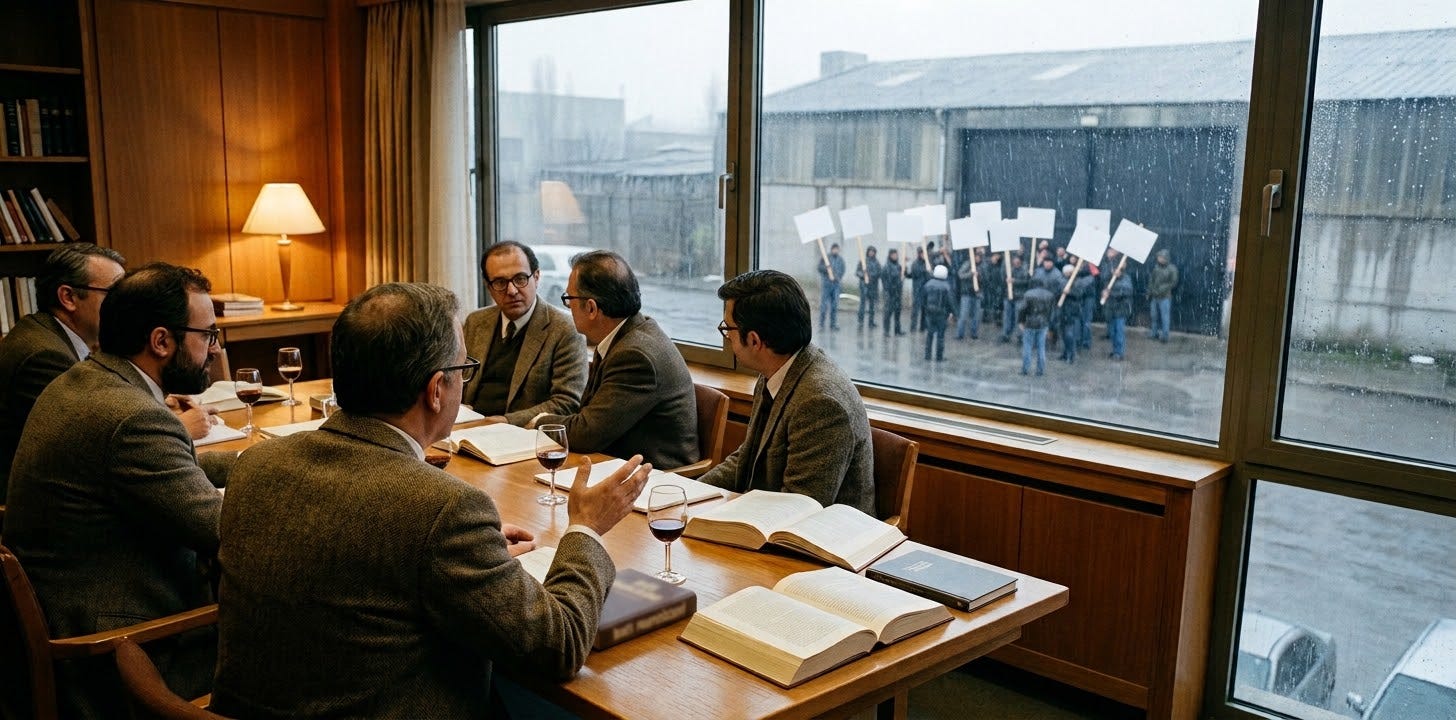
That Said's Orientalism stays at the cultural and epistemic level is not an isolated personal failing. It is part of a pattern displayed by Western Marxism as a whole.
In his classic study Considerations on Western Marxism (1976), Perry Anderson shows how, after the Russian Revolution failed to spread westward, this tradition broke away from active participation in class struggle and turned toward a philosophy and a cultural criticism remote from practice. The retreat is bound up with the steady reduction of that legacy to a cultural criticism cut loose from practice. Some writers include György Lukács in Western Marxism, but Lukács himself, in History and Class Consciousness, had built a theory of class consciousness and reification (Verdinglichung) tightly bound to class struggle. What made Western Marxism was less his direct responsibility than the turn of the generation of interpreters and followers who inherited his legacy — the Frankfurt School, the late Althusser — toward aesthetic-cultural work and pure theoreticism, and their complete withdrawal from practice.
Said's method — Foucault's episteme, the analysis of discourse and representation — continues this second, diluted tradition. What sets him apart from it is not that he lacks Marxist roots, but that he went one step further along the same retreat, without entering into any reckoning with Marxism at all.
The retreat itself is not without a class basis. In his writings on imperialism, Lenin argues that the advanced capitalist countries use part of the superprofits extracted from the colonies to "buy off" the upper stratum of the labour movement and of the intelligentsia. This stratum, though not the direct perpetrator of imperialist exploitation, takes a share of it, and is therefore inclined to shun any class analysis that would call its own position into question.
Western Marxism's choice to withdraw from class struggle and content itself with cultural, discursive and epistemic questions is consistent with this material position. Interrogating discourse and representation, rather than the source of one's own privilege — the imperialist transfer of surplus value — makes it possible to look intellectually "radical" while leaving one's class position undisturbed.
Said's cognitive foreignness is therefore not merely a personal deficiency but the symptom of a structural positioning. For an intellectual stationed at Columbia University, at the heart of the Western academy, taking a Marxist class analysis seriously would have meant putting his own institutional and material position in question. Reducing exploitation to a problem of discourse or representation instead allows one to strike a "dissident" pose — and ensures the pose costs nothing.

The East is not powerless by nature, nor is the West powerful by nature. The period of Western power is a deviation from the main street of human history — a side alley. To absolutize it is Eurocentrism in its purest form. The return of world history to the main street has made great strides in the period we are living through.
Said's Orientalism sets out to diagnose this absolutization at the level of discourse, yet through a critique of discourse severed from the base, it reproduces the very same absolutization itself.
The book's present standing cannot be overlooked either. Orientalism has become a standard text of the bourgeois academy, regularly assigned to first-year undergraduates across Western universities, the Ivy League above all. A genuine critique of the system does not become canonical so smoothly. The ease with which it has entered the curriculum is proof that the book — contrary to its own self-image — leaves the foundations of the relations of exploitation untouched and remains at the level of discourse alone.
The comparison is instructive. Marx is widely taught in the academy, but almost never as a valid analytical framework in his own right; he usually appears alongside Weber and Durkheim as one of three rival paradigms of "classical social theory," accompanied by arguments designed to refute him.
Lenin is taught far less, and when he is, mostly within the "totalitarianism" framework of Cold War historiography. In China studies, Mao is almost always read entangled with narratives of "failure" such as the Cultural Revolution and the Great Famine. Samir Amin has never attained a canonical status like Said's; he is practically absent from first-year required reading lists.
Said's book, by contrast, is taught in a flat, affirming frame, the truth of its claim accepted from the outset — a privilege revolutionary texts rarely enjoy.
Said himself indirectly confirms this asymmetry in his 1995 Afterword (Penguin 2003, pp. 338–340), where he concedes that the book was received far more favourably in the West than in the "Orient" that is its subject. The concession is itself evidence that the canonization was no accident: the book fit comfortably with the Western academy's own expectations.
The answer to the question, then: No. Said's critique of Orientalism is not free of Eurocentrism.

These findings have also been made, independently and before us, by critics coming from different directions; the debt of attribution requires that they be named.
Sadik Jalal al-'Azm ("Orientalism and Orientalism in Reverse," Khamsin 8, London: Ithaca Press, 1981, pp. 5–26): Al-'Azm finds historically groundless Said's presentation of Orientalism not as a product of colonial rule but as a phenomenon preceding it. Tracing its roots back to antiquity, he argues, amounts to reproducing the "unchanging East" Said criticizes as a symmetrical "unchanging West." Taking his analysis a step further, he develops the concept of "Orientalism in reverse": Arab nationalists and Islamist thinkers, in rejecting the West, construct the same essentialist scheme — an unchanging, homogeneous "Oriental essence" — in inverted form, and this is no less reactionary and ahistorical than classical Orientalism.
Aijaz Ahmad ("Orientalism and After: Ambivalence and Metropolitan Location in the Work of Edward Said," in In Theory: Classes, Nations, Literatures, London: Verso, 1992, pp. 159–220): Ahmad shows that Said's method draws on two incompatible sources: Erich Auerbach's humanist philological tradition, grounded in continuity, and Michel Foucault's anti-humanist concept of the episteme, grounded in ruptures. The two cannot be held together; one presupposes a historical subject and continuity, the other treats the subject itself as an effect of discourse. For Ahmad, this methodological incoherence drags Said into the very error he criticizes: by presenting the West, from Aeschylus to Kissinger, as a homogeneous and unchanging bloc, he reproduces exactly the essentialism that the concept of "Orientalism in reverse" points to. Ahmad adds that while Said rejects the output of European Orientalists wholesale, he gives almost no room to the work of scholars from the East themselves.
Vivek Chibber ("Orientalism and Its Afterlives," Catalyst, vol. 4, no. 3, 2020): Chibber distinguishes two separate theses intertwined in Said's book: (1) that Orientalist discourse is a "rationalization" legitimizing colonial rule after it has been established; and (2) that the cultural and mental conditions of the West were the direct cause of colonialism. The first is reasonable and defensible; the second inverts causality, placing culture ahead of political and economic interests. Chibber rejects the second, arguing that the real driving force of colonialism was not cultural prejudice but the concrete logic of profit-seeking and capital accumulation, with culture serving to legitimize a relation of exploitation already in place.
Samir Amin (Eurocentrism, trans. Russell Moore, New York: Monthly Review Press, 1988): Without once mentioning Said, Amin builds a positive alternative ground that directly refutes the Eurocentric myth of Europe's historical exceptionalism. His thesis is that over the long span of human history from 500 BC to AD 1500, the universal and advanced social-economic formation was the tributary formation: an order in which a central state collects and redistributes the surplus drawn from land and labour. India, China and the Islamic world reached this formation, while Europe — feudal Western Europe in particular — remained a peripheral, backward variant of the tributary system.
The birth of capitalism in Europe was not a "miracle," nor the result of cultural superiority, but a contingent consequence of this peripheral position — of the weakness of a non-centralized tributary state. Eurocentrism then retroactively turns this outcome into a narrative of inevitability, of essential superiority. Amin's solution was used in "Main Street and Side Alley" to refute the charge of Eurocentrism against Marxism; here the same ground is put to work against the assumption — Said's, and that of Eurocentric historiography at large — that "the West was always strong." Amin's theses serve here only as theoretical ground; he took no position against Said, and this essay attributes none to him.
Perry Anderson (Considerations on Western Marxism, London: NLB, 1976): Anderson argues that the failure of the Russian Revolution to spread to Western Europe in the 1920s, and the defeat of the working-class movements, radically changed the course of Marxist theory. After that defeat a "Western Marxist" tradition was born, running from Lukács through Gramsci (whom it is the bounden duty of Marxists to rescue from that monopoly and restore to his revolutionary place), the Frankfurt School, Sartre and Althusser. Cut off from any living, practical bond with the working-class movement, the tradition withdrew into the universities and busied itself increasingly with philosophy, aesthetics and cultural criticism. For Anderson this was no accidental intellectual choice but a structural consequence of the loss of the real ground of class struggle. Ironically, Anderson's own later career — with the lofty theoretical style of the New Left Review, aloof from the practice of the labour movement — has been seen by some critics as an instance of the very "Western Marxism" pattern he diagnosed.
V. I. Lenin (Imperialism, the Highest Stage of Capitalism, 1916, especially the 1920 preface; also "Imperialism and the Split in Socialism," 1916): Lenin argues that the "superprofits" — profit in excess of the normal rate — which the advanced capitalist countries extract from colonies and dependent countries serve to buy off, materially, the upper stratum of the labour movement and the trade-union bureaucracy in those countries: the "labour aristocracy." This stratum, though not the direct perpetrator of imperialist exploitation, shares in it; that share forms a material ground that blunts its class consciousness and inclines it toward accommodation with the existing order — "opportunism," in Lenin's word. The thesis supplies the class-material foundation explaining why the flight into culture described by Anderson was possible, and "comfortable."
Kali ("Edward Said's Orientalism," Kali's Newsletter, Substack, 3 September 2025, kalikoba.substack.com/p/edward-saids-orientalism): Two of this essay's pieces of empirical evidence — the Aeschylus–Persians anachronism and the Dante–Inferno contradiction — are documented in Kali's review and are acknowledged here as a debt of attribution. The wrenching of the epigraph from its context was also noticed separately in this author's own independent reading; but the first published documentation belongs to Kali.
Kali's footnotes also cite an observation by the Turkish Marxist Sungur Savran, known as close to Trotskyism: Marx felt a deep revulsion for those who deliberately distorted the truth in order to criticize the existing system, and never resorted to such games in his own critique of capitalism; his was a wholesale condemnation of the real system as it actually is (S. Savran and E. Ahmet Tonak, In the Tracks of Marx's Capital, Palgrave Macmillan, 2024, p. 37; the book's forerunner is Kapital'in İzinde, written with Nail Satlıgan, Yordam Kitap, 2012). The observation carries a double edge: what Said did to Marx is precisely the kind of distortion Marx himself would never have committed.
Özcan Buze, "Yunanistan Nasıl İmal Edildi: Byron, Bankerler ve Bir Devletin Finansal Mimarisi" [How Greece Was Manufactured: Byron, the Bankers and the Financial Architecture of a State] (an article drawn from the Turcophobia monograph): the source of the material on Canning, the loan architecture, the Phanariot class transfer and Otto used in Section 4 — the author's own earlier research.
Özcan Buze, "İskender Yunan Değildi: Homonoia ve Bir Sentezin Yıkımı" [Alexander Was Not Greek: Homonoia and the Destruction of a Synthesis] (Substack, 7 July 2026, ozcanbuze947071.substack.com/p/iskender-yunan-degildi-homonoia-ve; later also published in Bilim ve Ütopya): another example from the same work on the construction of Eurocentrism. It shows that Alexander and his teacher Aristotle came from Macedonia — a kingdom the Athenian elite of the day counted as "barbarian" — and that the term "Hellenistic" was constructed retroactively in the 1830s by the German historian Droysen, to meet the needs of nineteenth-century Prussian nationalism. This refutes the "unbroken West" narrative of Section 4 on another level: not only ancient Greece itself, but the "Hellenistic" legacy of conquest later grafted onto it, is a retrospective fiction.
Özcan Buze, Kimin Destanı [Whose Epic?] (the author's larger work; its chapter "Halikarnas Balıkçısı'nın Homeros Tezleri" [The Homer Theses of the Fisherman of Halicarnassus] was published in Bilim ve Ütopya, bilimveutopya.com.tr, 17 August 2026): the source of the thesis, flagged in the note to the introduction, on the Anatolian origin of the Homeric epics and the retrospective construction of the category "Western literature."【●】

This essay was first published in Turkish on the website of the journal Teori on 14 September 2026.
◇This text was composed from the author's own ideas, arguments, and source selection; a large-language-model tool was used during composition for prose editing. All intellectual and scholarly responsibility for the content rests with the author.

















.jpg)


 French (CA)