

.png) 1 month_ago
16
1 month_ago
16

Data centers are easy to hate.
The hyperscale facilities used to train and serve AI models are being plopped down like Monopoly pieces in a hostile takeover of the American countryside, tax-free million-square-foot monuments to the technofeudalist conquistadors who’ve similarly parasitized the state apparatus.
They inspire the same kind of sinking feeling as finding a massive network of termite tubes honeycombing the ceiling of your basement: an understanding that parasites have been working hard to destroy what’s yours, and they aren’t leaving without a fight. But then, neither are you.
Hyperscalers are exploiting economic hardship and outdated laws to seize land and water, concealing their true identities and intentions from the communities they colonize, belching carbon monoxide, nitrogen dioxide, methane, and other pollutants into the air from their backup generators and “forever chemicals” into the water, and sickening their neighbors with high levels of electromagnetic radiation and a constant, sanity-shaking roar. Despite promises of economic revitalization, once construction is done, there are few if any permanent jobs for locals, and data centers pay little to no property taxes thanks to state governments competing to lure the massive construction with the most desirable, regulation-free business climate money can buy. Utility companies are increasingly warning they cannot service both residential customers and the projected needs of the hyperscalers, which cause rates to balloon long before they’re actually built. What was marketed as a lifeline to rural America is looking more like a noose around its neck.
.
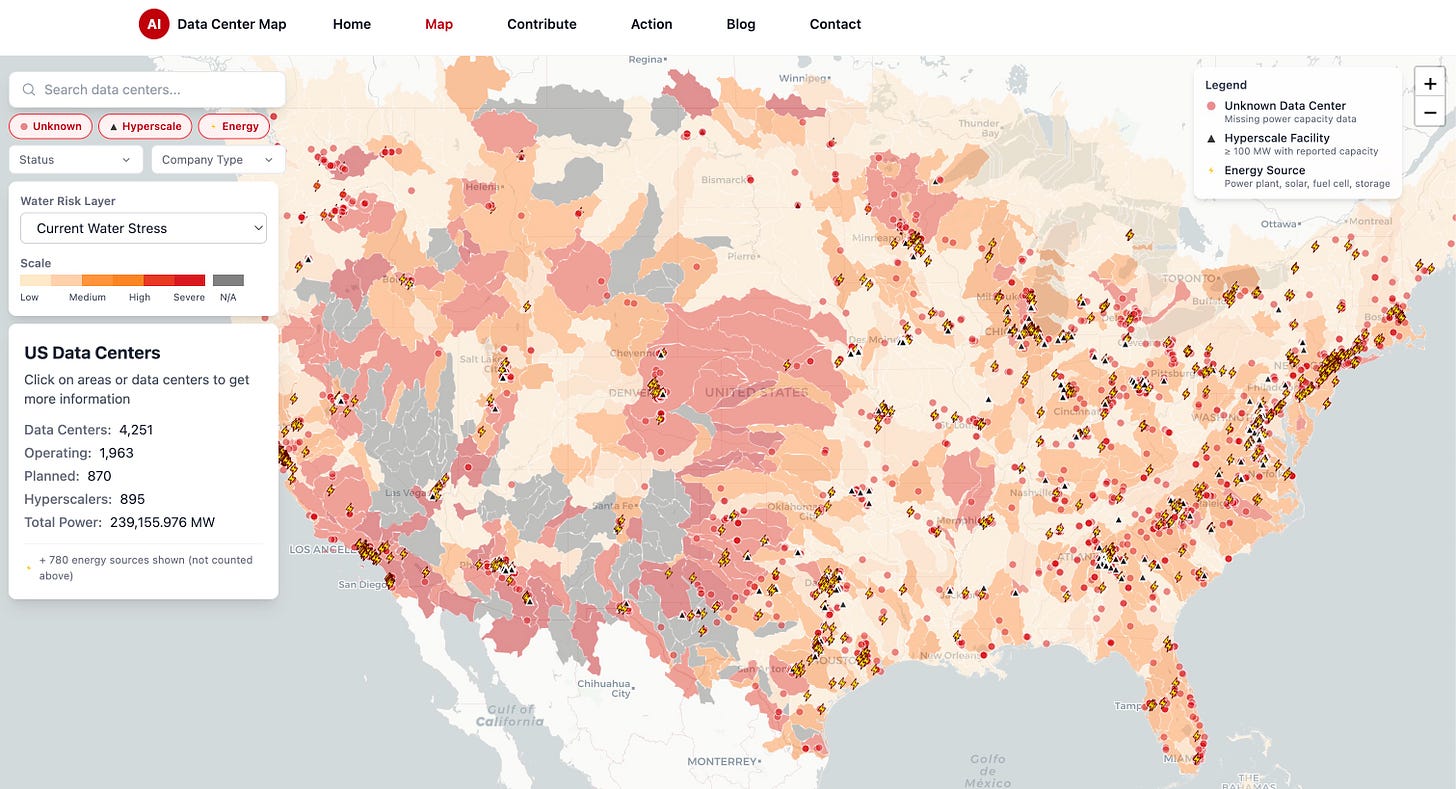
or rather, a lot of nooses
.
Silicon Valley apologists insist that Americans must sacrifice their clean water, farmland, public funds, privacy, constitutional rights, careers, and dignity to stay ahead of China in the AI arms race. But that narrative is misleading: the US already has over 10 times as many data centers as China – 5,427 to their 449 as of May – despite less than one fourth the population, with nearly twice the installed data center capacity (52 gigawatts to China’s 28). At the start of this year, the US had more data centers than the next 14 countries combined – yet construction has actually sped up, with more spent on data center construction in the first six months of this year than in all of 2025 – and more than three times what was spent in 2024.
Despite unprecedented hype, AI has not replaced human labor – Anthropic CEO Dario Amodei even walked back his clickbait prediction that it would eliminate 50% of entry-level white collar jobs by 2027 – and the promised productivity gains have not materialized, even with employers forcing workers to use the technology if they want to keep their jobs (and then using AI to monitor those employees’ use of AI). Indeed, companies’ rush to shoehorn AI into seemingly every product on the market (AI toothbrush, anyone?) has only convinced many Americans that they want nothing to do with it.
.

“just hand over your dignity & all this could be yours!”
.
Deploying its full arsenal of dirty tricks to get Americans hooked on generative AI, the industry cons casual users of the tech into feeling guilty for their supposed role in the data center buildout and its attendant harms – as if their hunger for cat slop videos (and not the Pentagon’s need to maintain dynamic targeting lists of problematic citizens) is what’s really causing those data centers to dry up Lake Tahoe. In reality, corporate and government AI use the vast majority of US compute – over 85% by one estimate – dwarfing consumer-facing applications.
This is despite an abysmal return on investment, with even establishment media outlets now willing to admit that AI is a financial black hole. Data centers can only operate for a few years before the costly NVIDIA GPUs that process their data become obsolete, and this makes turning a profit for the operator essentially impossible. The data center gold rush has jacked up the prices of NVIDIA GPUs so high that individual computer owners can no longer afford them, which may be the point. Big Parasite wants us renting our compute as well as our homes, and has christened GPUs a legitimate asset class in the latest coat of lipstick applied to the circular-financing pig (covered in Part III).
While the rush to build is in part due to a provision in last year’s Big Beautiful Bill that allows any data center completing construction in 2026 to write off construction costs on their taxes, no one is dropping $1 billion on hyperscale construction just to claim it as a deduction. Nor can it be attributed to natural market forces – there is nothing natural about the overnight transformation of the American economy into all-AI, all the time, except the popular revulsion toward it. You would not find an American outside New York, Washington DC, and Silicon Valley who honestly believes his country has made the right choice in prioritizing machine over man. Consumer advocate Erin Brockovich recently likened the buildout to a foreign invasion, but she’s only half right – the invasion has already happened. Data centers are here to power the next phase of this hostile takeover: occupation.
*
Click the share button below to email/forward this article. Follow us on Instagram and X and subscribe to our Telegram Channel. Feel free to repost Global Research articles with proper attribution.
This article was originally published on the author’s Substack.
Helen Buyniski is a “journalist,” sociopolitical analyst, violinist, revolutionary. reporting from the belly of the American beast. pro-humanity, anti-parasite. ambassador to Tlön. tips/suggestions/requests: helenofdestroy (at) tuta.io
All images in this article are from the author
Global Research is a reader-funded media. We do not accept any funding from corporations or governments. Help us stay afloat. Click the image below to make a one-time or recurring donation.



















.jpg)


 French (CA)