

.png) 2 week_ago
18
2 week_ago
18

As the post-colonial era ends, the key question is no longer how the West will rule the world, but how it will live in a world it cannot rule alone.
***
Certain turning points in world history produce consequences that extend far beyond the periods in which they occur.
The capture of Istanbul by our ancestors in 1453 was one such turning point. Historians generally describe 1453 as marking the end of the Byzantine Empire, the close of the Middle Ages, and the beginning of the modern era. Yet the historical rupture that occurred was far greater in scope. The conquest of Istanbul initiated a much broader process whose consequences have continued for nearly 500 years, extending into the present day. The conquest of Istanbul, followed by the expansion of Ottoman rule across the Balkans, the Black Sea, the Eastern Mediterranean, Egypt, and the Red Sea, constituted an important threshold in the transformation of the old geoeconomic order between Europe and Asia.
For centuries, the wealth of Asia, particularly that of China and India, had been transported westward along the Silk and Spice Routes. Istanbul and the Eastern Mediterranean were important nodes within this system. Maritime republics such as Venice and Genoa had accumulated considerable wealth from the Mediterranean segment of this trade. The new geopolitical conditions, however, prompted Europeans to search for alternative routes to Asia.
For Christian Europe, which had repeatedly confronted the Turks during the Crusades that began after 1095 and continued for approximately two centuries, the Turkish capture of Istanbul in 1453 caused a major geopolitical and psychological shock. The fall of the capital of the Eastern Roman Empire under Ottoman rule represented not merely the end of an empire; from the European perspective, it also signified a fundamental transformation in the balance of power along the traditional trade routes extending through the Eastern Mediterranean and the Black Sea toward Asia.
One of the West’s responses to this transformation was geographical. The objective was to reach Asia through alternative maritime routes that would bypass the areas under Ottoman control. Certainly, the conquest of Istanbul was not the sole reason for Europe’s expansion into the oceans. Advances in navigation and shipbuilding technology, capital accumulation, the extraordinary profitability of the spice trade, and competition among European states also contributed to this transformation. Nevertheless, the growing weight of Ottoman power in the Eastern Mediterranean and along the traditional East–West trade routes became one of the significant geopolitical factors accelerating the search for alternative routes.
The Portuguese advanced southward along the African coast, rounded the Cape of Good Hope, and reached India through the Indian Ocean. The Spanish, sailing westward in their attempt to reach Asia, instead arrived in the Americas. Europe’s economic and military horizons thus expanded beyond the confines of the Mediterranean into the Atlantic and Indian Oceans. This was followed by the establishment of the foundations of colonial empires, while, over the course of several centuries, the center of gravity of the world economy gradually began to shift from the Mediterranean toward the Atlantic.
The Atlantic System and the Rise of the West
This transformation did not merely signify the discovery of new trade routes. While Portugal and Spain established the first major oceanic empires, the Netherlands, in the seventeenth century, integrated trade, maritime activity, insurance, and finance into a far more sophisticated system. Amsterdam became one of the principal centers of global trade and finance. The accumulated expertise in commerce, credit, insurance, and maritime affairs that had developed in the maritime republics of the Mediterranean was integrated within the Atlantic world into larger-scale structures of state power and capital. At a later stage, as the center shifted to London, Britain emerged as the dominant power in the world system. In the twentieth century, the system’s center of gravity moved across the Atlantic to New York and Washington.
During the era of mercantilism, the state, the merchant, and the navy complemented one another. The navy protected trade routes and, when necessary, opened them; capital penetrated new regions; and the state supported this economic expansion through political and military power, particularly naval power. The Industrial Revolution carried this mechanism much further. As European industry’s demand for raw materials, energy, and markets increased, capitalism became integrated with imperialism. In the nineteenth century, Britain stood at the center of this order. The Royal Navy was not merely a fleet protecting the British coastline; it was a global force that ensured the security of international trade routes and, when necessary, exercised control over them. London’s financial system, insurance networks, ports, maritime transportation routes, coaling stations, and strategic straits became components of the same global architecture.
The foundations were thus laid for a Western-centered world order that would endure for approximately five centuries. The state occupying the center of the system changed over time. First Portugal and Spain, then the Netherlands, Britain, France, and ultimately the United States came to the forefront. Yet the essential nature of the system remained largely unchanged. Within this system, access to maritime routes, capital accumulation, technological superiority, and military power provided extraordinary advantages to the states controlling the center of the world economy. The fact that both industrial revolutions took place in the West, combined with the transition in maritime propulsion from sail to coal and from coal to oil—which enabled control over access to every continent through the oceans and seas—accelerated the historical process extending from mercantilism to capitalism, from imperialism to globalization.
1945: Colonialism Ended, but the Hierarchy Continued
While the two world wars exhausted the power of Pax Britannica, the United States emerged as the new center of the Western system. During the same period, the classical colonial empires began to dissolve. From India to Indonesia, from Algeria to much of Africa, dozens of countries gained their independence. Political independence, however, did not always mean economic and strategic independence.
As colonial governors withdrew, direct rule was replaced by new mechanisms of influence and dependency. U.S.-led military alliances, the global network of military bases, NATO, the Bretton Woods system, the dollar-centered financial system, the International Monetary Fund, and the World Bank became the principal institutions of the new order. While the United Nations embodied the principle of sovereign equality, the veto system of the Security Council reflected the actual hierarchy among the great powers.
The year 1945 also marked the beginning of the Cold War between the United States and the Soviet Union. While the two superpowers avoided direct confrontation, their rivalry unfolded through wars, coups, and proxy struggles extending from Korea to Vietnam, from Laos and Cambodia to Afghanistan, Africa, and Latin America. In pursuit of its interests, the United States employed not only military interventions but also regime-change operations, covert intelligence activities, and support for local forces. Millions of people lost their lives in the Korean and Indochina wars alone; when other conflicts affected by Cold War rivalry are included, the human toll becomes considerably greater.
In short, classical colonialism came to an end, but great-power politics did not disappear; it changed form. Direct rule was replaced by spheres of influence, military bases, alliances, financial dependency, and proxy wars. For approximately half a century, the Soviet Union constituted a military and ideological counterweight to the Western system. With the dissolution of the Soviet Union in 1991, this balance would disappear, and the world would enter an entirely different era.
The Post-Cold War Era: The New American Century
With the dissolution of the Soviet Union, the United States attained an unprecedented degree of military, economic, and technological superiority, with no remaining power capable of balancing it on a global scale. The end of the Cold War, however, was not followed by a new era of peace. Neoconservative circles that rose to prominence during the 1990s and later became influential under the George W. Bush administration advocated the use of American military power not for the purpose of securing consent but as an instrument of coercion, with the aim not only of preserving American supremacy but also of advancing Israel’s geopolitical objectives. The Project for the New American Century (PNAC), founded in 1997 by leading neoconservatives, explicitly identified the preservation of American global leadership and the maintenance of U.S. military superiority as strategic objectives.
The new era that began with the 1991 Gulf War continued with the interventions in Yugoslavia and Kosovo, the wars in Afghanistan and Iraq following the September 11 attacks, and subsequently military operations in Libya, Syria, Yemen, and across a broader geographical area. September 11, in particular, constituted a major turning point that expanded the scope for the use of American military power on a global scale.
Between 2001 and 2023, more than 940,000 people were killed directly by wartime violence in the wars in Iraq, Afghanistan, Syria, Yemen, and Pakistan, of whom more than 432,000 were civilians. When an estimated 3.6–3.8 million indirect deaths resulting from the collapse of healthcare systems, economies, and infrastructure, as well as the mass displacement of refugees, are also taken into account, the total human toll is estimated to have reached at least 4.5–4.7 million. Despite all these attacks, the United States failed to bring peace and stability to the places in which it intervened. With the exception of the First Gulf War, it failed to achieve military victory. In most cases, as in Vietnam, it ultimately withdrew. Its only success was the expansion of NATO among European countries.
Throughout this destructive strategy, U.S. superiority did not derive solely from military power. Its global military presence was combined with the central position of the dollar, the financial system, technology, capital, and its network of alliances. For this reason, unlike Vietnam, even the strategic failures in Iraq and Afghanistan did not initially undermine the foundations of the system. The United States could lose wars while continuing to preserve its central position within the world system. This was the fundamental source of strength behind the New American Century.
The Difference Between Vietnam and Today
In comparing the transformation taking place today with the defeat in Vietnam, it is necessary to analyze the fundamental difference between the two periods. The United States largely ended its direct military role in Vietnam in 1973, while Saigon fell in 1975. Nevertheless, the United States retained its position at the center of the world economy, the dollar continued to dominate the international financial system, and the Western alliance remained intact. The Soviet Union was a military and ideological rival, but it could not provide an alternative to the U.S.-centered global economic system on the same scale. Vietnam represented the loss of a war; it did not represent the loss of the American-centered world system.
This is where the difference with the present becomes apparent. At a time when the capacity of American military power to produce political outcomes is being tested, the center of gravity of the world economy has shifted toward Asia. In 1945, the picture was almost the reverse of what it is today. At the end of the Second World War, the United States accounted for 27 percent of global national income and 50 percent of global manufacturing. The corresponding figures for China were 5 percent and 2 percent, respectively.
By 2026, however, these figures had changed fundamentally. China accounts for approximately 32 percent of global manufacturing value added, compared with approximately 18 percent for the United States. China has moved far ahead of the United States in the production of steel, electricity, automobiles, machine tools, industrial robots, and intermediate industrial goods. It also possesses a clear advantage in engineering, scientific publications, and the number of STEM graduates. China additionally enjoys a significant demographic advantage in terms of its male population of military age. Taken together, these indicators demonstrate that China’s advantage vis-à-vis the United States is not confined merely to the size of its economy. China possesses a very strong material foundation in industrial production, energy, steel, machinery, engineering, and human resources—the capacities that would underpin a prolonged great-power competition and a potential war of attrition.
At the same time, the emerging network of relations among China, Russia, India, and other rising powers; the expansion of the Shanghai Cooperation Organization (SCO) and BRICS; initiatives to conduct trade in national currencies; and the development of alternative financial institutions are narrowing the room for maneuver of the unipolar order that emerged after the Cold War.
The issue, therefore, is not merely whether the United States can achieve its military objectives in Iran, the Strait of Hormuz, or on another front. The fundamental historical rupture lies in the fact that the erosion of American military power’s capacity to produce political outcomes is occurring at the same time as economic, industrial, and technological weight is shifting beyond the West. During the Vietnam era, a war had been lost, but the system remained strong; today, what is at issue is the transformation of the system itself.
Epic Fury and the Changing Balance of Power
The war with Iran and the U.S. Operation Epic Fury are of particular significance in this context. The military capabilities that the United States can deploy against Iran remain formidable. However, the employment of military power on such a scale no longer guarantees that the political will of the adversary will be broken or that the war will end on Washington’s preferred terms. An analysis released by the Office of Inspector General of the U.S. Department of Defense in September 2026, containing data on the cost of the war and ammunition expenditure, reveals that Epic Fury has cost more than $42 billion, has generated shortfalls in strategic munition stockpiles, and has resulted in particularly high consumption rates of air- and missile-defense interceptor munitions. Moreover, the report concludes that the United States entered the war without adequate planning or foresight. The report officially acknowledges a strategic error and, indirectly, demonstrates how difficult it has become for the United States to sustain modern high-intensity warfare.
.

Residents in Tehran on the third day of US-Israeli airstrikes, 3 March 2026 (CC BY 4.0)
.
Here, the difference between Vietnam and the present once again becomes apparent. During the Vietnam War, the United States was one of the world’s foremost industrial, financial, and military centers and retained this position despite losing the war. Today, however, the costs and ammunition expenditure generated by military operations are occurring alongside debates over the sustainability of U.S. industrial capacity and whether its global commitments can be met simultaneously. What has changed is not only the relative weakening of the U.S. military, but also the former decisiveness of that power within the global system—that is, its capacity to generate consent. Even today, the American military presence retains its position through an enormous defense budget and extensive military weapons and platforms; yet it is unable to produce the desired outcomes against actors capable of generating resistance in the economic, technological, and diplomatic domains.
The Message from Hormuz and Bab el-Mandeb
One of the most striking indicators of this transformation is unfolding at sea. The West’s five-hundred-year rise was made possible to a considerable extent by its expansion into the oceans, its control over maritime trade routes, and its ability, when necessary, to impose its political will over those routes through naval power. Today, however, developments in the Strait of Hormuz, Bab el-Mandeb, the Red Sea, and the Northern Sea Route in the Arctic Ocean reveal the limits of the same system. The military pressure exerted by Iran in Hormuz and by the Houthis (Ansarallah) in Bab el-Mandeb and the Red Sea should not be regarded merely as regional conflicts. Russia’s establishment of a new maritime transportation route across northern Eurasia (arctic NSR), and the inability of the United States to intervene in it, should be assessed separately. These developments bear the signs of a much broader transformation. Although the West still possesses extremely substantial naval and air power, it is becoming evident that this power can no longer ensure unrestricted freedom of action at critical maritime chokepoints. Missile technologies, unmanned systems, shore-based weapons, and relatively low-cost asymmetric capabilities are constraining the operational freedom of large and expensive naval forces.
.
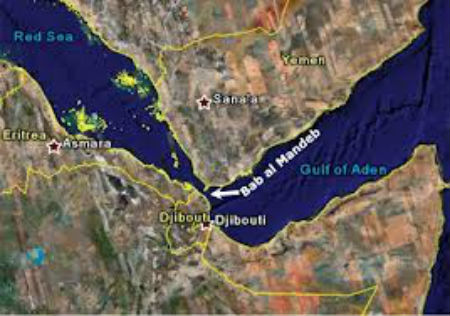
Map of Bab al-Mandeb
.
The determining factor here is not how many aircraft carriers or submarines a state possesses. What matters is at what cost, for how long, and for what political outcome these forces can be employed. The presence of an aircraft carrier strike group in a region and the ability to exercise political and military control over a maritime route are no longer synonymous.
Developments in Hormuz are symbolic in this respect. Despite deploying substantial military power, the United States has been unable to eliminate entirely Iran’s pressure on maritime transportation in the region, particularly through the Strait of Hormuz. More importantly, although Washington has sought support from its NATO allies and traditional partners such as Canada, Japan, Australia, and South Korea in confronting the difficult strategic equation in Hormuz, these countries have not entered the war directly alongside the United States to open the Strait of Hormuz by military force.
At Bab el-Mandeb, a similar but, in this case, striking picture is emerging from the perspective of Saudi Arabia. Riyadh has been unable to secure the military support it expected from the United States and Europe in its confrontation with Yemen; the anticipated support from Britain has likewise not materialized. Despite the close security and alliance relationships it has developed with Pakistan and Türkiye, Saudi Arabia has largely been compelled to bear the strategic burden on the ground itself. Finding itself virtually isolated, Saudi Arabia has become dependent on Israeli support and is being subjected to pressure amounting to blackmail to join the Abraham Accords.
Hormuz and Bab el-Mandeb are therefore becoming two distinct laboratories of the same historical transformation. In Hormuz, the United States, the world’s most powerful military state, and in Bab el-Mandeb, Saudi Arabia, one of the world’s largest energy exporters, are finding it difficult, despite their immense material power, to translate their political will into outcomes on the ground to the extent they desire. The traditional link between military superiority and the capacity to impose political will is weakening.
The Economic and Financial Rise of the Global South
It is insufficient to interpret the transformation of the post-colonial order solely through the military constraints confronting the West. The more fundamental transformation is taking place in the economic and financial domains. While emerging and developing economies, measured in terms of purchasing power parity, now account for the majority of global output, the quota, voting, and governance structures of institutions such as the IMF and the World Bank still largely reflect the distribution of power that emerged in the aftermath of the Second World War. BRICS’ demand for greater representation and the emergence of alternative institutions such as the New Development Bank are consequences of this shifting economic weight.
The defining characteristic of the new era is not necessarily that the Global South is becoming anti-Western, but rather that its dependence on the West is diminishing. While China offers alternatives in trade, industry, and finance, and Russia in energy and military technology, India is expanding its strategic autonomy. The Gulf states, meanwhile, are deepening their economic ties with Asia while maintaining their relations with the West. As a result, the space within which states can maneuver among different centers of power without remaining dependent on a single geopolitical and financial center is expanding.
This transformation is also evident in the financial system. Trade conducted in local currencies, alternative payment systems, and increasing gold purchases by central banks have not created a new system capable of replacing the dollar in the short term, but they are providing states with new options. In particular, the possibility that reserve assets may be used as instruments of sanctions has once again transformed gold into an instrument of financial security and sovereignty.
China is one of the most striking examples of this trend. Its reduction of holdings in U.S. Treasury securities while increasing its gold reserves forms part of a broader trend toward reserve diversification. At the same time, the growing U.S. public debt, large budget deficits, and rising long-term bond yields are also increasing pressure on the dollar-centered system. The issue, therefore, is not the collapse of the dollar or the imminent disappearance of the American financial system. The fundamental historical change is that states increasingly possess alternatives that allow them to reduce their dependence on a single financial center. Gold purchases, BRICS initiatives involving local currencies, alternative payment systems, and reserve diversification are different manifestations of the same trend. The order established after 1945 remains powerful, but it is no longer without competitors or alternatives.
From the Post-Colonial Order to Multipolarity
The signs of global transformation can also be observed in Washington’s own strategic priorities. The greater emphasis placed by the United States on homeland security and the Western Hemisphere, together with the withdrawal of troops from Europe and West Asia, indicates that Washington is reassessing the costs of its global engagements. While China remains at the center of long-term strategic competition, Washington simultaneously faces the costs of containing Russia in Europe, maintaining military superiority in West Asia, constraining China in the Indo-Pacific, and carrying the burden of securing global maritime routes. The hegemonic power must now consider not only the capabilities of its rivals but also the limits of its own resources.
This process does not signify a new unipolar order in which China simply replaces the West. While the United States and Europe remain powerful actors, China, India, Russia, Türkiye, and other centers of the Global South are gaining greater room for maneuver. This is the true meaning of multipolarity: the emergence of a new equilibrium in which no single center can unilaterally shape the world system and power is distributed among a greater number of actors.
The Israel Factor: The Legitimacy Crisis of American Hegemony
It would be incomplete to explain the global decline of the United States, which has played a major role in the collapse of post-colonialism, solely through the rise of China, the strengthening of Russia, the erosion of the dollar-centered system, or the limitations of American military power. Particularly in the Global South, one of the factors accelerating this decline is Washington’s almost unconditional strategic relationship with Israel. This relationship, which deepened after 1973 and acquired a new dimension within the paradigm of the “War on Terror” following September 11, 2001, increasingly integrated American military, economic, and diplomatic power with Israel’s security priorities. For a long period, U.S. bases, air power, naval forces, sanctions, and financial system compelled regional states to act cautiously and often submissively toward Washington. Over time, however, consent to American leadership gave way to fear of American power. Yet hegemony cannot be sustained through fear alone; it also requires legitimacy and consent.
The massive humanitarian devastation in Gaza following October 7, 2023, together with developments in the West Bank and Lebanon, accelerated this legitimacy crisis on a global scale. The political costs of Israel’s actions were increasingly attributed to Washington as well, since Israel’s ability to conduct warfare on such a scale and with such continuity is directly linked to American weapons, ammunition, financial assistance, and diplomatic protection. Israel thus began to evolve from being merely a force multiplier for American power in the region into a growing burden on U.S. soft power and global legitimacy. Pro-Israel lobbying groups in U.S. domestic politics, the ideological support of Evangelical movements, and the institutionalized pro-Israel orientation within the media, think tanks, and foreign-policy elites also make it difficult for Washington to distance itself from this policy. At the same time, the genocide in Gaza has generated substantial public opposition to Israel both within the United States and around the world. At present, apart from its military operations, one of the most significant challenges facing the Israeli government is changing this image of Israel.
.

Palestinian civilians in Gaza on 29 January 2025 (CC BY-SA 4.0)
.
The war with Iran, which began on February 28, 2026, made the military limitations of this relationship more visible. Israel’s superiority based on advanced technology, intelligence, and particularly air power proved insufficient on its own to produce decisive political outcomes against a state such as Iran, with its vast geography, large population, missile capabilities, and strategic depth. Yemen provides a similar example. While Houthi pressure on the Red Sea and Bab el-Mandeb severely affected Eilat’s maritime trade, U.S. and Israeli air power failed to eliminate this threat. Both countries’ excessive reliance on air power, long-range precision strikes, and technological superiority, combined with their avoidance of ground wars that could generate heavy casualties, limits the capacity of their military superiority to produce political outcomes.
This is where the real significance of the Israel factor in American decline becomes apparent. Israel, for many years the forward outpost and force multiplier of the United States in West Asia, is today becoming one of the important sources of Washington’s loss of legitimacy in the Global South. Some of the support extended to Iran derives not from an embrace of the ideology of the Iranian regime, but from the perception of Tehran as a power capable of resisting pressure from the Israel–U.S. axis. American hegemony is therefore approaching a dangerous threshold. First, consent eroded and was replaced by fear; now, as the examples of Iran and Yemen demonstrate, fear itself has begun to erode.
As the 500-Year Era Draws to a Close
One of history’s striking ironies is that the rise of the West and the transformation taking place today once again intersect along maritime routes. Five hundred years ago, Europeans ventured beyond the Mediterranean and into the oceans to reach the wealth of Asia. Following Portugal and Spain, the Netherlands and Britain globalized maritime trade, while in the twentieth century the United States brought the same system to its zenith through the dollar, aircraft carriers, and a worldwide network of military bases.
Today, as economic weight shifts once again toward Asia, the Strait of Hormuz, Bab el-Mandeb, the Red Sea, the Black Sea, the Indian Ocean, the South China Sea, and the Western Pacific are becoming the principal arenas of geopolitical competition in world politics. The war with Iran, the Russia–Ukraine War, developments in the Black Sea, the Red Sea crisis, and tensions surrounding Taiwan are not entirely independent developments. They constitute the contact lines between the old order and the emerging distribution of power. Five hundred years ago, Europe’s fundamental question was how to reach Asia. Today, the fundamental question is whether the West can continue to manage the world system as it once did in the face of a rising Asia and an increasingly autonomous Global South.
Colonialism came to an end in the twentieth century. Now, the post-colonial hierarchy established in its aftermath is also beginning to unravel. This does not mean the collapse of the West or of the United States. The West is not disappearing, but it is losing its position as a privileged center standing above the rest of the world. The emerging world will have a more complex structure. The transition toward multipolarity may generate more crises, wars, and uncertainty. As the old order dissolves, the rules of the new order have yet to be written.
When Istanbul fell in 1453, no one knew that this event would become one of the historical starting points of an Atlantic-centered period of Western predominance that would last for approximately five centuries. In 2026, we likewise do not know the final form that the new system will take. The direction, however, is becoming increasingly clear.
Conclusion
As the era of post-colonialism draws to a close, the fundamental geopolitical question of the twenty-first century is no longer how the West will govern the world, but how it will live in a world that it can no longer govern on its own. As the five-century-old Western-centered order undergoes transformation, Türkiye once again finds itself at a critical crossroads, situated on the very geography that changed the course of world history in 1453.
Türkiye’s power derives not from any single factor, but from the combination of its geostrategic location, the Turkish Straits, its strong and deployable military capabilities, its developing defense industry, its extensive diplomatic network, its industrial base, its ties with the Turkic world, and its central position along energy and transportation corridors. Türkiye is therefore not merely a bridge between East and West, but a center capable of influencing the balances among the Balkans, the Black Sea, the Caucasus, the Eastern Mediterranean, West Asia, and Africa.
Geopolitical influence alone, however, does not constitute enduring power. At present, economic instability, polarization, weaknesses in the parliamentary system—including the separation of powers and checks and balances—insufficient access to finance and capital, the politicization of the rule of law, income inequality, dependence on external sources for critical technologies, and challenges related to skilled human capital, energy, logistics, and institutional capacity constitute the principal constraints facing Türkiye. The defining question for Türkiye in the period ahead is whether it can overcome these challenges and transform its existing geopolitical weight into enduring state capacity. Türkiye, which today can produce military, diplomatic, and political outcomes across a broad geography, can sustain this influence over the long term only through a strong productive structure, a robust scientific and technological infrastructure, capital accumulation, highly qualified human resources, and resilient institutions.
*
Click the share button below to email/forward this article. Follow us on Instagram and X and subscribe to our Telegram Channel. Feel free to repost Global Research articles with proper attribution.
This article was originally published on Mavi Vatan.
Ret Admiral Cem Gürdeniz, Writer, Geopolitical Expert, Theorist and creator of the Turkish Bluehomeland (Mavi Vatan) doctrine. He served as the Chief of Strategy Department and then the head of Plans and Policy Division in Turkish Naval Forces Headquarters. As his combat duties, he has served as the commander of Amphibious Ships Group and Mine Fleet between 2007 and 2009. He retired in 2012. He established Hamit Naci Blue Homeland Foundation in 2021. He has published numerous books on geopolitics, maritime strategy, maritime history and maritime culture. He is also a honorary member of ATASAM.
He is a Research Associate of the Centre for Research on Globalization (CRG).
Featured image is AI-generated
Global Research is a reader-funded media. We do not accept any funding from corporations or governments. Help us stay afloat. Click the image below to make a one-time or recurring donation.



















.jpg)


 French (CA)