

.png) 1 week_ago
35
1 week_ago
35

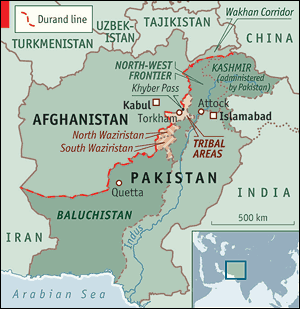
On September 24, 2026, Reuters placed Balochistan on a much larger global map: the race for critical mineral resources.
At a time when governments and corporations are searching for new sources of copper, gold and other strategic metals, Pakistan’s largest province by area — and its poorest — is acquiring growing economic and geopolitical significance.
Yet the same report exposed the other side of that reality. According to ACLED data cited by Reuters, mining interests in Balochistan had been targeted in at least 40 separate incidents in 2026. The wealth beneath the ground and the conflict unfolding above it have increasingly become part of the same story.
Nelson Mandela said in 2002 that what ultimately determines the significance of our lives is the difference we have made to the lives of others.
In Balochistan in 2026, that idea takes on a far more difficult meaning.
As Islamabad seeks to turn the province’s mineral wealth into international investment and a new mineral corridor, families continue to search for people who have disappeared, human-rights organisations continue to document allegations of extrajudicial and custodial killings, and international mechanisms continue to press Pakistan for answers about accountability.
The question, therefore, is not only how much the resources beneath Balochistan are worth. It is what kind of state — and what kind of development model — is being built above them.
The contradiction had already become apparent at the beginning of the year.
In January 2026, Balochistan Chief Minister Sarfraz Bugti said that from February 1 no enforced disappearances would take place under the authority of the state or government. The allegations, however, did not stop. The Human Rights Council of Balochistan (HRCB) documented 107 alleged enforced disappearances in January, 234 in February, 65 in March, 124 in April, 95 in May, 63 in June and 105 in July. In its report on July, published on August 24, the HRCB said that those who disappeared included five women, three minor girls and 14 teenagers or minors, while only 47 had resurfaced by the time the report was published. The organisation attributed 65 of the 105 cases recorded in July to the Frontier Corps, 19 to the Counter-Terrorism Department and 17 to intelligence agencies. These are HRCB records and attributions, not judicially established findings. Their persistence after the government’s public commitment in January, however, raises a question that Islamabad cannot answer with a pledge alone: what changed in practice after February 1?
.
.

.
A second organisation, Paank, using a different methodology, published its assessment of the first half of 2026 on August 26: 556 enforced disappearances and 227 extrajudicial or custodial killings between January and June, as well as 171 people who, according to the organisation, were released or resurfaced. The figures produced by Paank and the HRCB should not be added together, nor should they be treated as independent confirmation of one another. But they do show that, months after the government’s pledge, organisations monitoring Balochistan were continuing to document hundreds of allegations. And that shifts the critical question from the number of files to the functioning of the state itself: when the authorities reject the existence of a state policy of disappearances, can they also demonstrate that serious allegations involving state agencies are independently investigated and that, when wrongdoing is established, there are consequences?
On June 15, 2026, the UN Committee against Torture gave that question even greater institutional weight. In its concluding observations on Pakistan, the Committee said it remained concerned by reports of enforced disappearances and extrajudicial killings allegedly committed by members of the military and paramilitary forces, police officers and intelligence personnel, targeting, among others, human-rights defenders, journalists, activists, political opponents and members of minority groups — particularly in Balochistan and Sindh. The Committee called on Pakistan to urgently protect human-rights defenders, journalists, lawyers, protesters and other critics from arbitrary detention, enforced disappearance and extrajudicial execution, and to ensure that violations are investigated and those responsible brought to justice.
This is perhaps where Islamabad faces its most difficult contradiction. By August 2025, Pakistan’s own Commission of Inquiry on Enforced Disappearances had received 10,618 cases nationwide: 8,873 had been classified as “disposed of” and 1,745 remained under investigation. The existence of such a large official mechanism demonstrates that the issue is not beyond the state’s field of vision. But accountability cannot be measured simply by the number of files opened or closed. It must also be measured by whether families learn what happened, whether allegations are investigated independently and whether those responsible — where responsibility is established — are brought to justice. It is precisely on these points that international mechanisms continue to express concern.
The case of Imran Ali illustrates how concrete that accountability gap can become.
According to the HRCB, around 20 members of the Counter-Terrorism Department allegedly took him from A One City in Quetta on August 27, 2025. For almost a year, the organisation says, his family received no official information about his fate or whereabouts. In August 2026, they learned that he had been killed in an alleged “encounter” in May and that his body had been buried in June. On September 7, 2026, the HRCB was still demanding that the government disclose the location of his grave, return his remains to his family and conduct an independent investigation and forensic identification. The allegations concerning Ali’s abduction, torture and death are not judicial findings. The accountability question, however, is more straightforward: how can a man allegedly remain for months in the hands of a state agency while his family is unable to obtain a timely and definitive official answer as to whether he is alive, where he is being held, or where he has been buried?
Islamabad has its own answer to the broader environment in which all of this is taking place: Balochistan is confronting a genuine armed insurgency. On September 12, 2026, Sarfraz Bugti said the province was in a “state of war” and ruled out negotiations with armed groups. The Baloch Liberation Army and other organisations have carried out attacks against security forces, civilians and development projects; the BLA is designated as a terrorist organisation by the United States. That reality is critical. But it does not cancel out the other question. It makes it harder: what are the limits on the methods a state may use even when it faces a genuine terrorist and armed threat?
UN Special Procedures have themselves placed their concerns squarely within this counter-terrorism context. They have examined allegations of arbitrary arrests, ill-treatment in detention, enforced disappearances and extrajudicial killings of Baloch citizens, as well as allegations of excessive force against people seeking information about the disappeared, restrictions on activists and the use of counter-terrorism measures against organisations and individuals engaged in public advocacy. The real test of the rule of law is not whether a state faces threats. It is whether it can confront them without allowing the institutions created to provide security to operate beyond effective scrutiny and accountability.
That question becomes particularly visible in the stories of two women. Sammi Deen Baloch was around ten years old when her father, Dr Deen Mohammad Baloch, disappeared in 2009. Seventeen years later, she is still seeking to learn his fate and has become a public voice for the families of missing persons. On June 28, 2026, around the 17th anniversary of her father’s disappearance, Front Line Defenders reported that security forces searched her home in Karachi while the family was away. According to the organisation, her computer, educational certificates, personal belongings and the only remaining photograph of her father in the family’s possession were seized. Front Line Defenders placed the incident within what it described as a wider pattern of pressure against her and other Baloch human-rights defenders.
Mahrang Baloch has likewise transformed a personal history of disappearance into a public campaign for the missing. On June 24, 2026, Reuters reported that an anti-terrorism court sentenced her, along with Sibghatullah Shah Jee, to life imprisonment in a case concerning the death of a member of a paramilitary force during a protest in Gwadar in 2024. The authorities maintain that the prosecution was lawful and that there was evidence of incitement to violence. Her defence announced that it would challenge the ruling, while human-rights organisations have questioned the proceedings. Significantly, in its concluding observations of June 15, 2026 — just days before the judgment — the UN Committee against Torture had already named Mahrang Baloch among the individuals whose situation it called on Pakistan to review.
It is here that the story of human-rights defenders directly intersects with the story of mineral wealth. On December 1, 2025, UN Special Procedures sent official communications to Pakistan, Canada and other parties involved in relation to the Reko Diq project. The information they had received concerned allegations of reprisals, arbitrary arrest and detention, enforced disappearances and inhuman or degrading treatment of human-rights defenders who had raised concerns about mining activities and possible toxic contamination in the Chagai area. Mahrang Baloch and Sibghat Ullah Shah Jee were among the six alleged victims identified in the communications. Pakistan responded on February 9, 2026, and Canada on February 2.
This does not prove that Reko Diq causes enforced disappearances, nor that every prosecution of a Baloch activist is connected to the project. It establishes something different and more specific: allegations surrounding the treatment of certain defenders in an area of enormous extractive interest have become serious enough to activate formal United Nations mechanisms and require answers not only from Pakistan, but also from Canada.
And the economic interests involved are enormous. Barrick holds 50% of Reko Diq, while the remaining 50% is held by Pakistani federal state-owned enterprises and the Government of Balochistan. The project has developed into a multibillion-dollar investment and is intended to produce copper and gold for decades. At the same time, Barrick itself has slowed the development of Reko Diq and extended its review of the project because of deteriorating security risks. Instability in Balochistan, therefore, is no longer solely a human-rights or domestic security issue. It has become an investment risk with a measurable economic cost.
And while one major investor reassesses the timetable, new international players are moving closer. On August 31, 2026, the CPEC Secretariat announced that, following approximately $25 billion in Chinese investment during the first phase of the China-Pakistan Economic Corridor, the second phase would expand into minerals, industry, technology and business-to-business partnerships. On September 24, Pakistan’s Finance Minister Muhammad Aurangzeb met U.S. Export-Import Bank Chairman John Jovanovich in New York. On September 27, Reuters confirmed that possible financing for Reko Diq was among the projects discussed. Within less than a month, Balochistan had emerged simultaneously as a theatre of Chinese strategic investment, Canadian mining interests, international development finance and potential American capital.
This is the point at which responsibility ceases to be exclusively Pakistani. In its December 1, 2025 communication to Canada, the UN Special Procedures requested information about measures being taken to ensure that companies under Canadian jurisdiction conduct meaningful human-rights due diligence. In its response on February 2, 2026, the Canadian government said it had raised the allegations with Barrick and reiterated its expectations regarding responsible business conduct under the UN Guiding Principles on Business and Human Rights and the OECD Guidelines. The fact that questions originating in Balochistan have now reached governments, multinational companies and international financiers shows how far the issue has moved beyond the boundaries of a purely domestic conflict.
The question at the end of September 2026, therefore, is not whether Balochistan possesses enough copper and gold to attract the world. It already has. Canadian corporate capital, Chinese strategic investment, international development institutions and potential American financing are now converging on the same geography. The real question is whether the speed with which the province’s mineral wealth is being internationalised will be matched by equivalent pressure for transparency, effective investigations and accountability.
For Islamabad, that may be the more difficult test. A state can invoke — and genuinely face — a serious armed and terrorist threat. It can attract billions of dollars in investment and present its mineral wealth as a path towards development. But the credibility of that development narrative also depends on whether it can provide convincing, verifiable answers when citizens disappear, when families search for their relatives and when international mechanisms seek investigations into allegations involving state institutions.
Human-rights due diligence, after all, cannot mean only secure facilities, environmental assessments, protected supply chains and financial returns. In a province where the UN Committee against Torture continued in 2026 to express concern over allegations of enforced disappearances and extrajudicial killings, it must also mean something more fundamental: protecting an investment cannot substitute for the obligation to protect people.
And perhaps this is where Mandela’s words, with which this story began, return. If the significance of what we do is measured by the difference we make to the lives of others, then the real measure of success in Balochistan cannot be only how many billions are invested, how many tonnes of copper are extracted or how strategically important a new mineral corridor becomes.
*
Click the share button below to email/forward this article. Follow us on Instagram and X and subscribe to our Telegram Channel. Feel free to repost Global Research articles with proper attribution.
Staikou Dimitra writes articles for Greece’s largest Newspaper PROTO THEMA. Dimitra graduated from Law School, a profession she never practiced, and has a master’s degree in theater and is involved in writing in all its forms, books, plays, and scripts for TV series.
Featured image is from the author
Global Research is a reader-funded media. We do not accept any funding from corporations or governments. Help us stay afloat. Click the image below to make a one-time or recurring donation.



















.jpg)


 French (CA)