

.png) 2 month_ago
51
2 month_ago
51

The era of the “limited war” is a Western fantasy. Faced with an existential proxy assault, Russia cannot afford half-measures.
To read this article in the following languages, click the Translate Website button below the author’s name.
Русский, українська мова, Deutsch, Italiano, Dutch, Български, Español, Portugues, 中文, Français, 日本語, 한국어, Türkçe, Српски. And 40 more languages.
The Fantasy of “Limited War”
Before you read what follows, let’s strip away the diplomatic fiction.
I have spent decades tracking the patterns of power, and the pattern here is undeniable.
The West is playing a deadly game of managed escalation, wrapping total war in the antiseptic language of “containment” and “strategic signaling.” But the recent strikes on economic and civilian nodes inside Russia are not the rogue contrivances of a fractured command. They are a calibrated escalation by European elites, executed with Washington’s tacit approval.
The thesis of what you are about to read is simple and uncompromising: the era of the “limited war” is a Western fantasy. If Moscow is to survive this existential proxy assault, it cannot respond with half-measures or symmetrical restraint. The only rational, historically grounded response is total mobilization and the systematic, comprehensive neutralization of Ukraine’s remaining critical infrastructure. Endless attrition is a losing game. Victory is not a preference; it is an operational necessity.
What follows is not a plea for peace. It is a cold, hard look at what victory actually requires, anchored in the only historical precedent that matters.
Kyiv, 1943 – The Historical Precedent
.
.
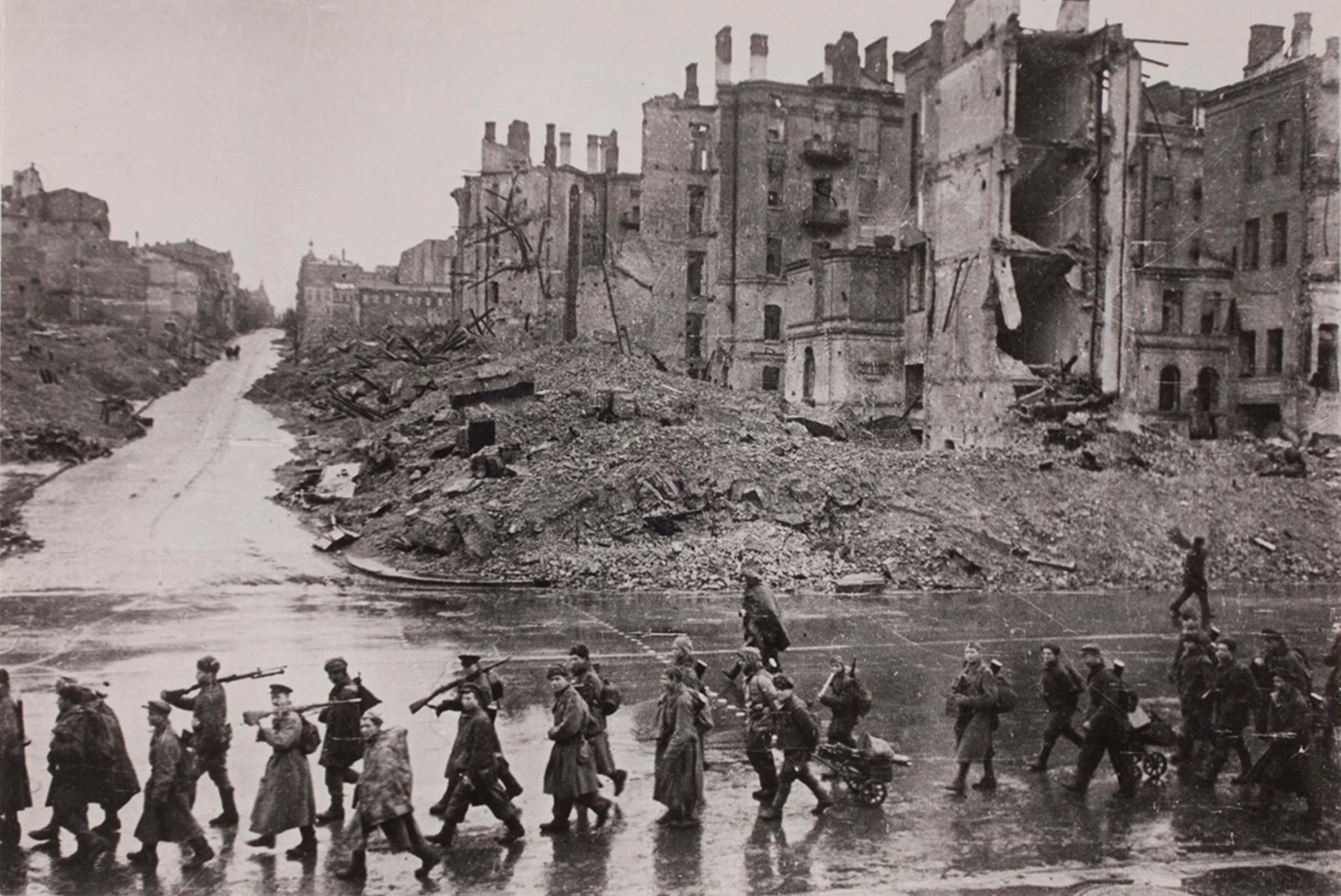
The photograph above is stark: Kyiv, November 1943. Soldiers march through streets flanked by skeletal buildings, their facades blown out, entire districts reduced to rubble and ash.
The Dnieper crossing has been secured, but the city behind them is a monument to total war. This is not destruction for its own sake. This is what victory actually looked like when the Soviet Union responded to Operation Barbarossa.
Not with calibrated strikes and proportional responses, but with the complete, systematic dismantling of an occupying force and the infrastructure that sustained it.
The Wehrmacht had turned Kyiv into a fortress. Every building, every street, every bridge had been militarized.
The German response to losing that terrain was scorched earth—demolitions, fires, systematic destruction of anything that could aid the advancing Red Army. And when the Soviets finally broke through, they did not pause to preserve what remained. They did not worry about civilian infrastructure or economic nodes or the postwar recovery of a city already bled dry by occupation. They fought with the singular objective of annihilation. Victory was the only acceptable outcome, and the physical cost was secondary to the strategic necessity.
This is the historical precedent that Western strategists deliberately ignore when they lecture Moscow about escalation management. The Soviet Union did not win the Great Patriotic War through restraint. It won through total mobilization, overwhelming force, and the absolute refusal to accept any outcome other than the complete destruction of the invading force. The ruins of Kyiv in 1943 are not evidence of Soviet barbarism. They are evidence of what happens when an existential threat is met with the full, uncompromising weight of a nation determined to survive.
Today, the West demands that Russia fight a limited war against an unlimited threat. European elites, with Washington’s blessing, have transformed Ukraine into a proxy fortress, flooding it with weapons, intelligence, and the implicit promise of endless support. Strikes on Wildberries distribution centers, on civilian infrastructure with no military value, on economic targets designed to terrorize rather than degrade—these are not the actions of a desperate regime fighting for survival. These are the actions of a coalition that believes it can wage war by remote control, bleeding Russia slowly while keeping the conflict “manageable” and “contained.”
This is a fatal miscalculation. When an adversary crosses the threshold from proxy conflict to direct strategic assault, the response cannot be measured in calibrated increments. The strikes on civilian economic infrastructure are not isolated incidents. They are the logical endpoint of a Western strategy that has abandoned any pretense of seeking peace and embraced instead the goal of Russia’s long-term strategic degradation. This is war with a capital W, and it demands a response commensurate with the threat.
Victory, or Extinction – No Middle Ground
The question is not whether Russia should escalate.
The question is whether it can afford not to.
Every week that passes with half-measures and symmetrical responses is a week that allows the Western coalition to believe its strategy is working. Every distribution center hit, every civilian target struck with impunity, reinforces the illusion that Russia can be provoked without consequence, that escalation can be controlled from Brussels and Washington while Moscow bleeds patiently on the operating table. This must end now if everything Vladimir Putin and the Russians have built is to survive.
What victory looks like in 2026 is not fundamentally different from what it looked like in 1943.
It looks like the complete neutralization of the enemy’s capacity to sustain the fight. It looks like a mobilized society, an industrial base operating at maximum capacity, and a military strategy designed not to manage the conflict but to end it. Furthermore, it looks like the systematic dismantling of Ukraine’s remaining infrastructure—not as punishment, but as operational necessity. The logistics networks, the energy grids, the command, and control nodes, the economic arteries that feed the war machine. All of it must be rendered nonfunctional. Not degraded. Not damaged. Eliminated. This is not cruelty. This is clarity.
The West has made its choice. It has chosen to fight to the last Ukrainian, to turn an entire nation into a battering ram aimed at Russia’s heart, to sacrifice millions on the altar of geopolitical ambition while remaining safely insulated from the consequences. Moscow can no longer afford the luxury of fighting this war on Western terms. Attrition favors the side with greater resources and longer patience. Russia has both, but only if it commits them fully. A multipronged offensive, launched with overwhelming force and designed to achieve decisive territorial objectives by spring, is not an option. It is an imperative.
The mobilization must be total. Not the partial measures of 2022, not the hesitant expansions of 2023, but the full commitment of a society at war. Industrial production must shift to a wartime footing. Manpower must be allocated without hesitation. The political system must align behind a single objective: victory. Not “favorable conditions.” Not “negotiating leverage.” Victory. Period!
History will not judge Russia by the standards of Geneva or The Hague. It will judge Russia by whether it survived the existential threat arrayed against it. The Soviet Union did not hesitate in 1943. It did not worry about the optics of destroying Kyiv to save it. It understood that half-measures against an existential enemy are not mercy, but suicide. The ruins in that photograph are not a warning about the horrors of war. They are a testament to what victory actually costs. This image is what victory looks like in every war ever fought.
The West wants a long war. It wants a war of attrition, of gradual escalation, of managed decline for Russia.
This is the one outcome Moscow cannot accept. Russia cannot afford to lose, and it cannot afford to fight indefinitely. The time for limited war is over. The time for total victory has begun. What victory looks like is not pretty. It is not clean. It is not proportional. It is the complete, systematic, and uncompromising destruction of the enemy’s capacity to continue. Furthermore, it is the mobilization of every resource, the commitment of every tool, the acceptance of every cost. It is Kyiv in 1943. It is the end of the war, by any means necessary.
The choice is no longer Russia’s to make. The West made it when it turned Ukraine into a weapon. Now Moscow must simply follow the logic of that choice to its inevitable conclusion. Victory, or extinction. There is no middle ground left.
*
Click the share button below to email/forward this article. Follow us on Instagram and X and subscribe to our Telegram Channel. Feel free to repost Global Research articles with proper attribution.
This article was originally published on New Eastern Outlook.
Phil Butler is a policy investigator and analyst, a political scientist and expert on Eastern Europe, and an author of the recent bestseller “Putin’s Praetorians” and other books.

Featured image: Residential building in Avdiivka city (Donetsk region of Ukraine) after Russian shelling and airstrikes on the city on 17 March 2023 (Licensed under CC BY 4.0)
Global Research is a reader-funded media. We do not accept any funding from corporations or governments. Help us stay afloat. Click the image below to make a one-time or recurring donation.
















.jpg)


 French (CA)