

.png) 3 month_ago
33
3 month_ago
33

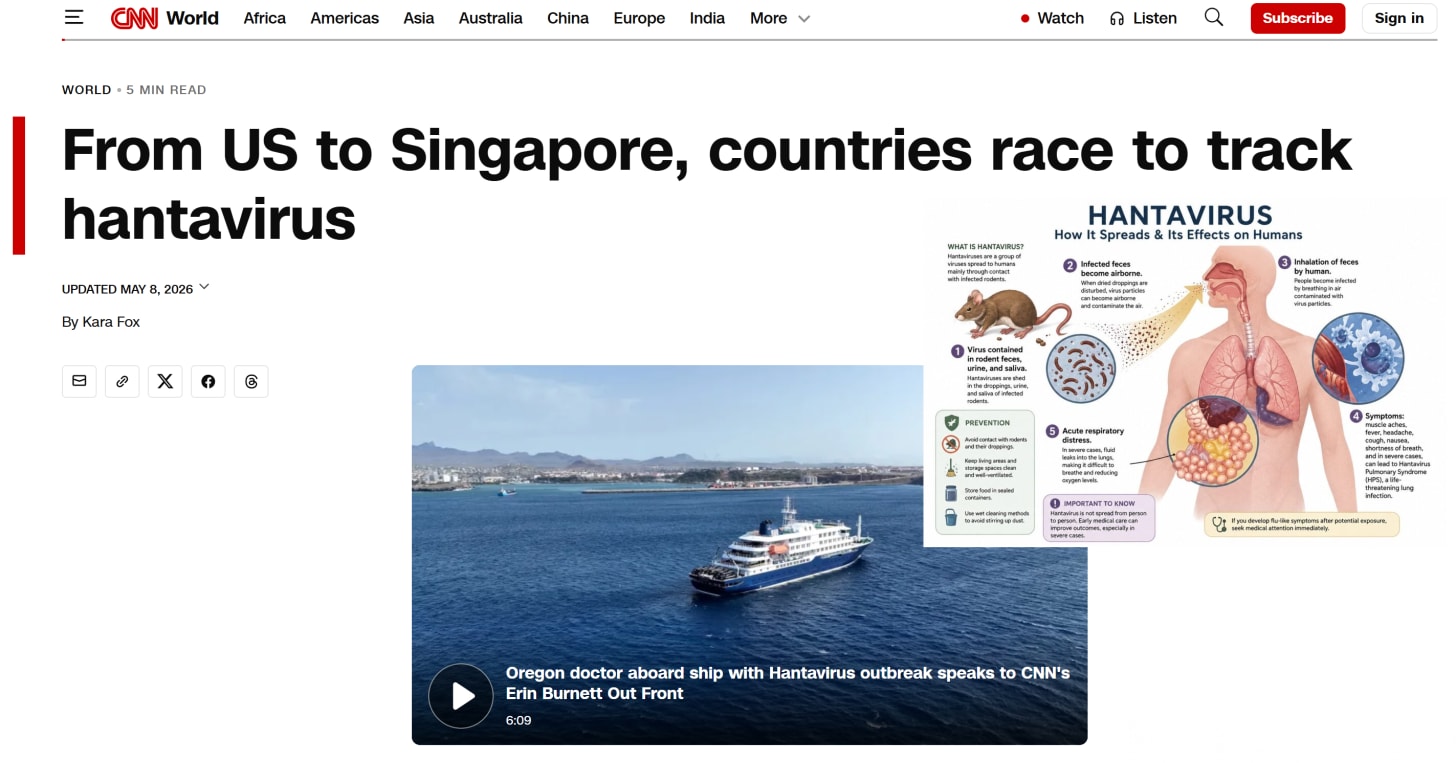
As an epidemiologist, I know contact tracing studies are inherently flawed. So I was immediately suspicious of the claim that Hantavirus Andes strain had jumped from zoonotic to human-to-human spread. This claim is very likely to be false and should not be the basis for the global public health response to the Hantavirus outbreak from rodents on board the MV Hondius.
.
.
.
.
.
.
The Andes orthohantavirus (ANDV) is uniquely recognized within the Hantaviridae family for its putative human-to-human transmission. While this claim has become a foundational pillar in epidemiological modeling and public health policy, the scientific evidence base remains largely speculative.
This report critically examines the methodological limitations inherent in existing contact tracing studies and argues that the assertion of direct human-to-human transmission lacks the rigorous validation required by controlled, empirical investigation.
The primary challenge in attributing ANDV infection to human-to-human contact lies in the ubiquity of the virus’s primary reservoir, the long-tailed pygmy rice rat (Oligoryzomys longicaudatus).
The “Common Environment” Hypothesis
Existing epidemiological studies frequently rely on retrospective contact tracing to establish transmission chains. However, these investigations often fail to adequately isolate participants from shared environmental risks.
- Aerosolized Particulates: ANDV, like other hantaviruses, is primarily shed in the urine, feces, and saliva of infected rodents. These excretions dry into dust, which can remain infectious for extended periods in enclosed spaces.
- Inadequate Site Assessment: In many documented “human-to-human” cases, the transmission occurred within households or rural dwellings. These environments are frequently contaminated with rodent excreta. Current contact tracing methodologies often assume that if no rodent was seen, no rodent exposure occurred. This assumption ignores the reality that microscopic viral particles in house dust are sufficient for inhalation or mucosal contact.
A rigorous scientific framework must rule out the possibility that both the “index” case and the “secondary” case were independent victims of the same contaminated environmental reservoir before concluding that direct transmission took place. In the absence of comprehensive environmental sampling—specifically, testing dust and surfaces for viral RNA at the time of exposure—the environmental transmission hypothesis cannot be dismissed.
The standard for establishing a novel transmission pathway is high. To definitively conclude that a virus has transitioned from zoonotic to human-to-human spread, one must move beyond correlational field data.
Lack of Challenge Studies
Currently, there exists a complete absence of isolated human challenge studies. While ethical constraints are understood, the lack of clinical validation leaves a significant interpretive gap.
- Biologic Plausibility vs. Proof: While viral shedding in human bodily fluids has been documented, the viability and infectiousness of the virus via human-to-human routes remain unproven.
- The Zoonotic Baseline: The Hantavirus genus is characterized by its strict association with rodent hosts. For a virus to jump from a zoonotic cycle to sustained or even sporadic human-to-human transmission, distinct evolutionary adaptations are typically required. The current literature has yet to provide a robust, mechanistic explanation of how ANDV bypasses the natural species barrier so effectively in human populations without intermediate animal hosts.
The widespread acceptance of human-to-human ANDV transmission relies heavily on the strength of contact tracing data. Yet, these studies suffer from significant selection bias:
- Recall Bias: Participants in high-stress, post-outbreak scenarios are naturally prone to recall interactions with other people, while often overlooking mundane environmental exposures like sweeping a floor or entering an unventilated storage room.
- Lack of Genomic Precision: While viral sequencing has shown links between cases, it does not distinguish between a direct human-to-human transmission chain and a shared, localized environmental source that mutated or persisted in a specific rodent population.
The assertion that Andes orthohantavirus has definitively transitioned to human-to-human transmission is premature and conceptually fragile.
When environmental contamination—a well-established risk factor for all hantaviruses—is not meticulously excluded, the “transmission” observed in clusters may simply be a reflection of communal exposure to a shared, contaminated micro-environment.
Until controlled studies are performed and environmental variables are rigorously accounted for, the scientific community should maintain a skeptical perspective on the viability of human-to-human spread and should not participate in global fear-mongering over a hantavirus contagion.
*
Click the share button below to email/forward this article. Follow us on Instagram and X and subscribe to our Telegram Channel. Feel free to repost Global Research articles with proper attribution.
Peter A. McCullough, MD, MPH, President, McCullough Foundation
Sources
Martinez, V. P., et al. (2005). “Human-to-human transmission of Andes virus.” Emerging Infectious Diseases. (Critique: Focuses on descriptive epidemiology; lacks environmental viral load analysis).
Padula, P. J. (2011). “Epidemiology and ecology of hantavirus infections in South America.” Virus Research. (Context: Emphasizes the primary role of Oligoryzomys species in viral maintenance).
Schmaljohn, C., & Hjelle, B. (1997). “Hantaviruses: A global disease problem.” Emerging Infectious Diseases. (Foundational context on the environmental stability of hantaviruses in rodent dust).
Tigabu, A., et al. (2020). “Environmental risk factors for hantavirus infection: An updated review.” Frontiers in Microbiology. (Critique: Highlights the persistent under-reporting of environmental contamination in indoor settings).
Featured image is from CDC/ Cynthia Goldsmith, Luanne Elliott (Public Domain)
Global Research is a reader-funded media. We do not accept any funding from corporations or governments. Help us stay afloat. Click the image below to make a one-time or recurring donation.



















.jpg)


 French (CA)