

.png) 3 month_ago
116
3 month_ago
116

Some interviews illuminate a single event. Others illuminate an entire era. The conversation between Glenn Diesen, John Mearsheimer, and Sergey Karaganov[13] belongs to the rarer category: the kind of historical document that lets us hear, almost unfiltered, what official doctrines normally conceal beneath the cold language of strategy.
To read this article in the following languages, click the Translate Website button below the author’s name.
中文, Français, Русский, Farsi, 日本語, Italiano, Español, عربي, Hebrew, Dutch, Portugues, Deutsch, 한국어, Türkçe. And 40 more languages.
For nearly two hours, two of the most prominent figures in contemporary geopolitical thought discussed something that, only a few years ago, would have been unspeakable: the possibility of a limited nuclear strike against the European security architecture as a means of restoring deterrence.
What is most disturbing is not only what was said. What is most disturbing is that it can now be said publicly. Because when an idea enters the strategic mainstream, it is often because it has already been circulating for some time within the corridors of power.
A Fear That Has Faded
Sergey Karaganov begins from a stark premise: the world has entered the most dangerous period of its modern history. Not because the weapons are new, but because the old fear has disappeared.
For decades, he argues, relative peace was not secured by human wisdom, nor by international morality, nor by multilateral institutions. It was secured by the fear of nuclear hell — the fear of annihilation, of cities vanishing, of the irreversible.
That fear, in his view, has weakened in the West. NATO, he suggests, has progressively tested Russian thresholds: tanks, heavy artillery, HIMARS, F-16s, long-range missiles, satellite intelligence, deep strikes inside Russian territory, attacks on strategic infrastructure. At every stage, the Western assumption appeared to be the same — Moscow would protest, but would never actually cross its own red lines.
Karaganov argues that this assumption has become lethal. If an adversary no longer believes in your capacity for destruction, deterrence ceases to exist. Fear, in his logic, must therefore be restored.
This is where his reasoning becomes chilling. After a sequence of conventional escalation steps, he raises the idea of a limited nuclear strike on the European theatre — not to conquer, not to occupy, but to psychologically force the West to back down.
It bears emphasizing that this idea is morally monstrous, and Karaganov himself acknowledges that it would open a Pandora’s box. But its real significance lies elsewhere: it signals that a segment of Russian strategic thought now treats nuclear weapons not merely as instruments of non-use, but as potential tools of coercion.
It is also worth situating Karaganov’s role more precisely. He is not an isolated commentator improvising on camera. For several years he has openly advocated, in published essays, for so-called “sobering” or “educational” strikes against Western targets — arguments that predate this interview by some time[10]. In that sense, his rhetoric functions less as speculative theorizing than as a deliberate probing of Western tolerance thresholds: say the unsayable, observe the reaction, and recalibrate accordingly. Reading this conversation purely as an academic exchange of views misses that function entirely.
Mearsheimer and the Forgotten Lessons of the Cold War
John Mearsheimer does not endorse the notion of nuclear “victory.” He restates a truth that current generations seem to have forgotten: a full-scale nuclear war has no winner. Everyone ends up vaporized.
But he agrees with Karaganov on one essential point — the West has lost the culture of prudence that defined the Cold War era.
During that period, Washington and Moscow understood where the red lines were. The crises over Berlin, Cuba, Hungary, and Czechoslovakia were dangerous, but leaders on both sides knew there existed a threshold beyond which politics ended and annihilation began.
.
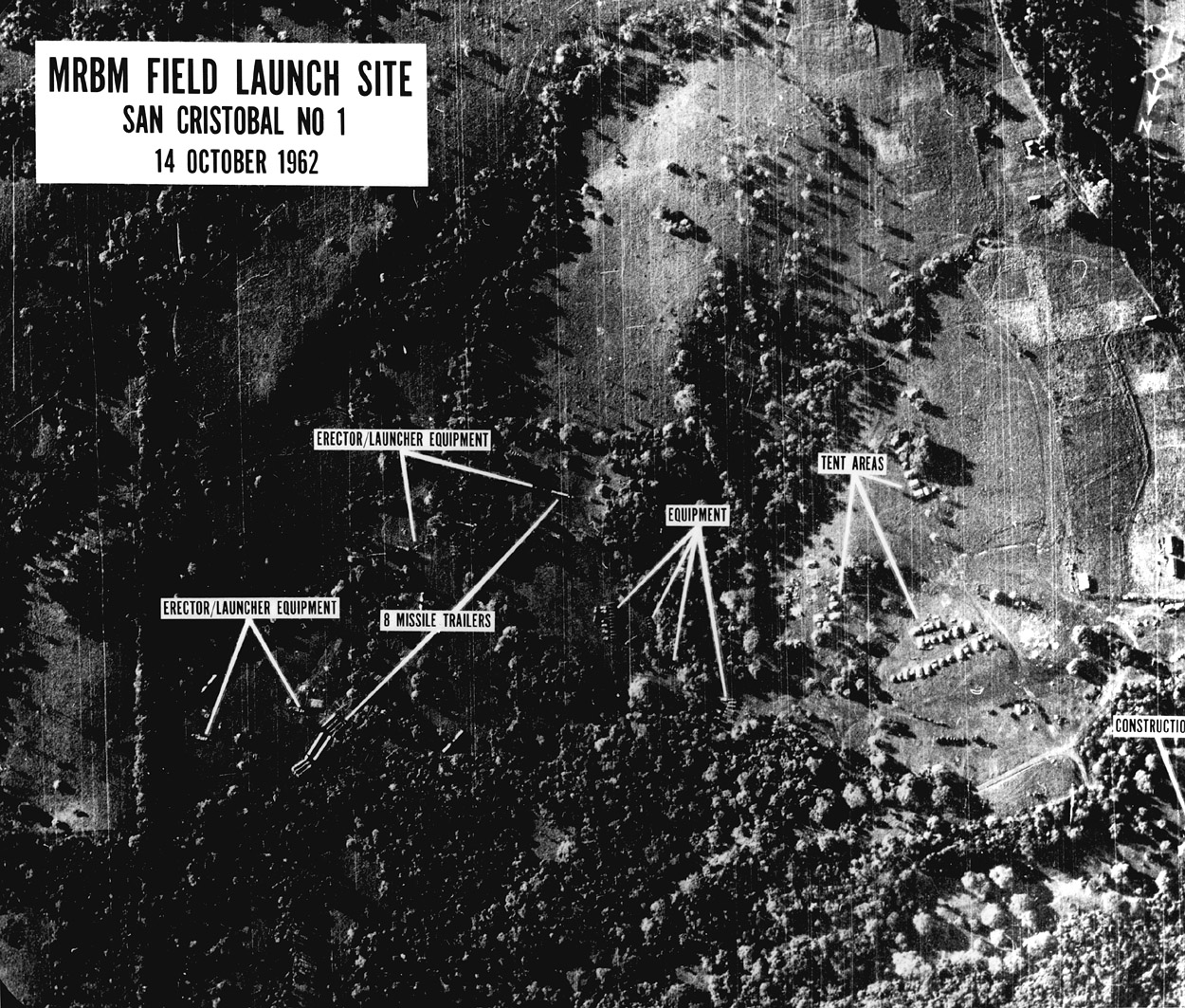
One of the first U-2 reconnaissance images of missile bases under construction shown to President Kennedy on the morning of 16 October 1962 (Public Domain)
.
Today, Mearsheimer says he is stunned by the West’s strategic carelessness. He points specifically to the Ukrainian incursion into Russia’s Kursk region, as well as strikes targeting elements connected to Russia’s nuclear triad. During the Cold War, he suggests, no one in Washington would have played with that kind of fire.
His underlying argument is fundamentally realist: cornering a nuclear power is extremely dangerous. A great power holding thousands of warheads cannot be treated as an ordinary state. One cannot attempt — without risking systemic consequences — to expel Russia from the rank of great powers, dismantle its economy, encircle it militarily, and strike its strategic territory.
The problem, then, is not purely military. It is cognitive. The West appears to have forgotten that Russia can lose a great deal — but cannot accept what it perceives as an existential defeat.
The European Theatre as a Theoretical Firing Range
The most unsettling part of the conversation concerns the European strategic theatre itself.
Karaganov starts from a blunt premise: the United States would likely not sacrifice New York for Warsaw, Chicago for Berlin, or Washington for Vilnius. In other words, the American nuclear guarantee would remain credible only up to the point where honoring it meant accepting the destruction of American territory.
This is not a new hypothesis — it has haunted NATO since its founding. But hearing it articulated in the context of the war in Ukraine gives this old question a chilling new urgency.
Mearsheimer understands the logic but underscores its consequences. If the United States failed to respond to a limited Russian strike on Europe, then Germany, Poland, or other European states might conclude that they need their own independent nuclear arsenals.
This is the point at which the conversation pivots toward the old “German question.”
Since 1945, the European order has rested on an unwritten formula: contain Russia, restrain Germany, and keep the United States anchored at the center. The American military presence in Europe was never only about protecting Europe from Moscow — it was also about managing German power itself.
That framework is now eroding. The United States is pivoting toward Asia to confront China. The European security architecture is being pushed to rearm at a historic pace. Since the 2022 “Zeitenwende” announcement and its 2025 acceleration, Germany has created special defense funds and announced one of the largest military buildups in its postwar history [11], while renewed debate over a European nuclear umbrella — partly anchored in French deterrence — has gained momentum. Russia, whose strategic memory still carries the trauma of the Nazi invasion, watches this trajectory with something approaching existential unease. In the Russian strategic imagination, a rearming Germany is never simply “another European country”; it is the reopening of a historical wound that 1945 was supposed to have permanently closed.
The Real Nuclear Landscape
To grasp the gravity of this conversation, one has to step outside the Ukrainian theater and look at the global nuclear landscape as a whole — not as an inventory of arsenals, but as a map of how each power is responding to the same underlying problem that Karaganov diagnoses: the erosion of fear.
Call it the half-life of nuclear fear. Like a radioactive isotope, the lived memory of nuclear catastrophe decays over time, generation by generation, unless it is periodically renewed by crisis. What the conversation between Mearsheimer and Karaganov illustrates is not a sudden Russian aberration, but a structural condition shared, in different ways, by every nuclear power: as the experiential memory of Hiroshima and the Cuban Missile Crisis fades, states increasingly compensate through doctrine rather than through restraint. Call this doctrinal overcompensation — the tendency of declaratory policy to harden precisely as experiential deterrence weakens. The survey that follows can be read through this single lens: each country’s posture reveals where it sits on this curve, and how it is trying to slow its own decay.
The world is not simply returning to the Cold War. It is entering a far more unstable configuration — more actors, more doctrines, more ambiguity, more shifting thresholds — precisely because more states are independently attempting the same compensatory maneuver, each convinced that its own doctrine alone can hold back the fading of fear.
Russia revised its nuclear doctrine in November 2024[2]. It now states that nuclear use could be considered not only in response to a nuclear attack, but also in response to a conventional attack that threatens the existence of the state — including cases where a non-nuclear state acts with the support of a nuclear power. The message to NATO is unambiguous: Ukraine ceases to be “just Ukraine” the moment it strikes using Western-supplied architecture. Russia’s 2024 revision is the clearest case of doctrinal overcompensation in action: unable to rely on the West’s intuitive fear of escalation, Moscow chose to write that fear into law.
The United States, for its part, continues to reject a “no first use” pledge. Its 2022 doctrine states that nuclear weapons would be considered only in “extreme circumstances” to defend the vital interests of the United States, its allies, and its partners[3]. This ambiguity is deliberate — it reassures allies while leaving a zone of strategic uncertainty intact. Washington’s enduring vagueness is the inverse strategy to Moscow’s: rather than spelling out new thresholds, the United States treats uncertainty itself as the renewable resource of fear.
France maintains a doctrine of strict sufficiency, with the decision resting solely with the President of the Republic. Yet in March 2026, Paris explicitly placed its deterrent within a more European framework, stating that France’s vital interests “have a European dimension”[4]. This does not mean sharing the nuclear button — it means France is politically formalizing the idea that its vital interests carry a continental dimension. Paris’s move is best read as anticipatory: rather than wait for the American guarantee’s credibility to decay further, France is positioning its own deterrent to fill the coming gap.
The United Kingdom retains a minimal, credible, and independent deterrent based on its Trident submarines, while assigning it to NATO’s defense[5]. London deliberately maintains ambiguity about the precise circumstances of use — denying any adversary the ability to calculate the British threshold with confidence.
Israel remains the most opaque case of all. Its official doctrine is silence: neither confirmation nor denial. Open-source estimates place its arsenal at approximately 90 warheads[6]. Its nuclear ambiguity is itself a doctrine, resting on the premise that an adversary should never know precisely where the threshold of the irreversible lies.
Ukraine, by contrast, possesses no nuclear weapons. It gave up the arsenal inherited from the USSR under the 1994 Budapest Memorandum, in exchange for security assurances[7]. The Ukrainian tragedy has become a grim lesson for many states: a political guarantee is no substitute for independent deterrence.
India still officially maintains a doctrine of no-first-use and credible minimum deterrence. But its posture is evolving under the combined pressure of China and Pakistan. As of January 2026, its arsenal was estimated at approximately 190 warheads, with a small number reported as operationally deployed for the first time[8] — a marked shift toward increased operational readiness.
Pakistan represents one of the most explosive cases of all. Unlike India, it makes no no-first-use pledge. Its doctrine of “full spectrum deterrence” is designed to offset its conventional inferiority vis-à-vis New Delhi — including through the possibility of early, tactical nuclear use[9]. This is a logic of deterrence through the threat of rapid escalation. Islamabad’s doctrine is perhaps the purest illustration of the half-life concept in reverse: with no shared history of nuclear use to inherit in South Asia, deterrence there has had to be built doctrinally from the outset, rather than worn down from an original store of fear.
The contemporary danger, then, does not lie solely in the number of warheads. It lies in doctrinal fragmentation. During the Cold War, two superpowers structured the bulk of global risk. Today, multiple nuclear logics coexist simultaneously: declared, ambiguous, regional, existential, tactical, strategic, and continental.
It is this plurality that makes the world feel more unstable than at any point since the Cuban Missile Crisis.
The Number That Defines the Abyss
According to the SIPRI Yearbook 2026, the world’s nine nuclear powers possessed approximately 12,187 warheads as of January 2026. Around 9,745 of these sat in military stockpiles considered potentially operational. Roughly 4,012 were deployed with missiles or aircraft, and between 2,100 and 2,200 were maintained on high operational alert[1].
The United States and Russia alone still account for close to 90 percent of the global total[1].
These figures alone should be enough to bring any strategic discussion back down to earth. And yet the world is once again speaking about nuclear weapons with a growing — and troubling — doctrinal casualness.
Arsenals are being modernized. Budgets are rising. Arms control treaties are unraveling. Communication channels between major powers are narrowing. Doctrines are hardening. Public opinion, meanwhile, remains largely asleep, still under the illusion that the threat of apocalypse belongs to the last century.
What Still Holds the Line
None of this amounts to an argument for fatalism. Even as the formal architecture of arms control erodes, informal mechanisms continue to function, and their endurance matters more than their formal status might suggest.
New START, the last treaty placing legally binding limits on US and Russian strategic arsenals, expired on 5 February 2026. Yet Moscow stated it would continue observing the treaty’s central numerical limits on an informal basis, and the two sides have reportedly discussed an interim understanding while pursuing a successor framework[12]. The P5 nuclear powers have also signaled continued engagement on risk reduction ahead of the 2026 Nuclear Non-Proliferation Treaty Review Conference[12].
These are thin threads, not guarantees. But they matter precisely because they represent attempts to slow the half-life of fear through dialogue rather than through doctrine — the only sustainable alternative to the compensatory hardening described above. Whether they hold will likely depend less on the treaties themselves than on whether direct channels of communication between Washington and Moscow — the kind that defused the Cuban Missile Crisis — are rebuilt before the next crisis tests them.
The Death of the Common European Home
At its core, this conversation also marks the definitive collapse of a dream: that of a “common European home” stretching from Lisbon to Vladivostok.
Gorbachev once imagined a reconciled Europe after the Cold War. Thirty-five years later, the European continent has once again become a front line.
Russia is turning toward Eurasia — China, India, Iran, Turkey, Indonesia, Central Asia, Siberia, new continental routes, new strategic depth. The European security architecture, for its part, is becoming less a partner than a theater of confrontation.
Karaganov advises Russia to ignore Europe altogether and look East and South. Mearsheimer offers a caveat: Russia can never fully ignore Europe, because geography cannot be abolished. Even a Russian victory in Ukraine would leave behind a western border that is unstable, militarized, and resentful.
Therein lies the tragedy: a war can end, but the underlying structure of the conflict can outlive it.
What This Video Really Reveals
This video is not significant because it announces an imminent nuclear war. It is significant because it shows that the unthinkable has become thinkable again.
Yesterday, strategists spoke of stability. Today, they speak of escalation.
Yesterday, nuclear doctrines existed to prevent use. Today, some are once again reasoning about limited use, nuclear coercion, warning strikes, psychological shock, and “controlled” thresholds.
That is the real shift.
The danger does not reside in Karaganov alone, nor in Moscow alone. It also resides in Western forgetfulness, in NATO’s escalatory momentum, in the militarization of the European theatre, in the collapse of arms control regimes, and in the transformation of Ukraine into a direct contact zone between nuclear powers.
The greatest mistake would be to dismiss this conversation as either Russian provocation or academic exercise.
It is something else entirely: a civilizational warning.
When serious men begin calmly discussing the conditions under which the European security architecture might be struck with nuclear weapons, it is not merely a doctrine speaking. It is an era confessing its own madness.
What this conversation ultimately measures is not Russian intent or Western naivety alone, but the position of the world on the curve of the half-life of fear — and the choice every nuclear power now faces between rebuilding that fear through dialogue, or replacing it, doctrine by doctrine, with the far more dangerous architecture of overcompensation.
And history suggests that when a civilization stops fearing the abyss, it tends to drift closer to it — unless, even now, the channels of communication that once kept the Cold War cold are deliberately rebuilt before the silence becomes permanent.
*
Click the share button below to email/forward this article. Follow us on Instagram and X and subscribe to our Telegram Channel. Feel free to repost Global Research articles with proper attribution.
Laala Bechetoula is an independent Algerian historian, journalist, and geopolitical analyst. He has been writing on Trump, American hegemony, and the collapse of the international order since 2025. His work appears in Countercurrents, Global Research, Réseau International, Le Quotidien d’Oran, Sri Lanka Guardian, and other international platforms. This article integrates and crowns a corpus of analytical work produced between November 2025 and April 13, 2026.
He is a Research Associate of the Centre for Research on Globalization (CRG).
Notes
[1] SIPRI, SIPRI Yearbook 2026: Armaments, Disarmament and International Security, Stockholm International Peace Research Institute, June 2026.
[2] “Basic Principles of State Policy of the Russian Federation on Nuclear Deterrence,” decree signed by President Vladimir Putin, 19 November 2024; see also Belfer Center for Science and International Affairs and Russia Matters, November 2024.
[3] U.S. Department of Defense, 2022 Nuclear Posture Review, Fact Sheet, October 2022.
[4] President Emmanuel Macron, address on French nuclear deterrence, Île Longue naval base, 2 March 2026; commentary in Chatham House and CSIS, March 2026.
[5] UK House of Commons Library, “Strategic Defence Review 2025: The UK’s nuclear deterrent,” June 2025; the SDR confirms the UK’s “independent, minimum, credible nuclear deterrent” assigned to NATO, and the June 2025 NATO summit announcement of the UK joining NATO’s nuclear deterrence mission.
[6] SIPRI Yearbook 2026, open-source estimate of Israel’s nuclear arsenal at approximately 90 warheads.
[7] Budapest Memorandum on Security Assurances, signed 5 December 1994 by Ukraine, Russia, the United States, and the United Kingdom.
[8] SIPRI Yearbook 2026, estimate of India’s nuclear arsenal at approximately 190 warheads as of January 2026, including 12 reported as operationally deployed for the first time.
[9] Pakistan’s “full spectrum deterrence” doctrine was first announced in 2011 following the Nasr tactical nuclear weapon test and elaborated by Lt. Gen. (Retd) Khalid Kidwai, former head of the Strategic Plans Division, notably at the 2015 Carnegie International Nuclear Policy Conference and in a 2023 address at the Institute of Strategic Studies Islamabad.
[10] See Sergey Karaganov’s earlier essays advocating limited “sobering” nuclear strikes, published in Russia in Global Affairs, 2023.
[11] On Germany’s expanded special defense funds and military buildup following the 2022 “Zeitenwende” and its 2025 acceleration, see reporting on the German federal budget and defense spending commitments.
[12] New START expired on 5 February 2026; see Arms Control Association, “New START Expires As U.S. Urges ‘Modernized’ Treaty,” and Chatham House, “The US and Russia’s nuclear weapons treaty is set to expire,” January–February 2026, on Russia’s informal moratorium on central limits, the reported Abu Dhabi discussions, and continued P5 engagement ahead of the 2026 NPT Review Conference.
[13] Glenn Diesen, “John Mearsheimer & Sergey Karaganov: Nuclear Strike on Europe to Restore Deterrence,” 12 June 2026, available at https://www.youtube.com/watch?v=Q8PT0jiemKc and on Glenn Diesen’s Substack (glenndiesen.substack.com).
Featured image: Illustration by Victoria Ritter and S. E. Poling, from Daydreams
 “Towards a World War III Scenario: The Dangers of Nuclear War”
by Michel Chossudovsky
Available to order from Global Research!
ISBN Number: 978-0-9737147-5-3
Year: 2012
Pages: 102
PDF Edition: $6.50 (sent directly to your email account!)
Click here to download your FREE COPY of the e-Book!
Michel Chossudovsky is Professor of Economics at the University of Ottawa and Director of the Centre for Research on Globalization (CRG), which hosts the critically acclaimed website www.globalresearch.ca . He is a contributor to the Encyclopedia Britannica. His writings have been translated into more than 20 languages.
Reviews
“This book is a ‘must’ resource – a richly documented and systematic diagnosis of the supremely pathological geo-strategic planning of US wars since ‘9-11’ against non-nuclear countries to seize their oil fields and resources under cover of ‘freedom and democracy’.”
–John McMurtry, Professor of Philosophy, Guelph University
“In a world where engineered, pre-emptive, or more fashionably “humanitarian” wars of aggression have become the norm, this challenging book may be our final wake-up call.”
-Denis Halliday, Former Assistant Secretary General of the United Nations
Michel Chossudovsky exposes the insanity of our privatized war machine. Iran is being targeted with nuclear weapons as part of a war agenda built on distortions and lies for the purpose of private profit. The real aims are oil, financial hegemony and global control. The price could be nuclear holocaust. When weapons become the hottest export of the world’s only superpower, and diplomats work as salesmen for the defense industry, the whole world is recklessly endangered. If we must have a military, it belongs entirely in the public sector. No one should profit from mass death and destruction.
–Ellen Brown, author of ‘Web of Debt’ and president of the Public Banking Institute
Click here to download your FREE COPY of the e-Book!
Global Research is a reader-funded media. We do not accept any funding from corporations or governments. Help us stay afloat. Click the image below to make a one-time or recurring donation.














.jpg)


 French (CA)