

.png) 5 month_ago
36
5 month_ago
36
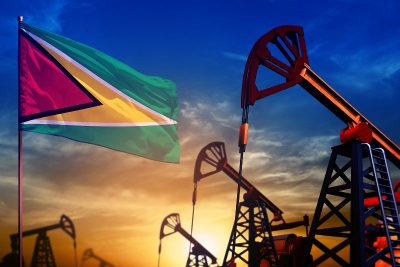
The true geopolitical angle is that Guyana’s energy boom is directly and intentionally related to Venezuela’s containment. The seizure of Venezuelan tankers as part of a US sea blockade in the Caribbean Sea and the signing of Guyanese production contracts are two sides of the same coin, both advancing a strategy to ensure that the next great oil powerhouse in the Americas is a steadfast US vassal, deeply embedded within a Western-aligned system of law, finance, and security. Guyana’s frontier is not just open for business, it has been proactively designated as a legitimate and secure outlet allowed for realizing the Venezuelan borders hydrocarbon potential.
The geopolitical dimensions of Guyana’s energy boom are fundamentally shaped by a stark and deliberate contrast engineered by Western, particularly US, foreign policy. To fully grasp it, one must analyze two interconnected phenomena,
1) the concerted containment and suppression of Venezuela as a hydrocarbon competitor and
2) petro-state model, and the parallel cultivation and elevation of Guyana as its sanctioned, rules-based alternative.
This dual process has transformed the Guyanese basin into a strategic pivot point, redirecting global capital and political alignment in a profound regional realignment.
The investment patterns reveal a larger trend of the US allowing a stable, prosperous, and US-aligned Guyana as a counterweight to Venezuela influence in Latin Americas oil market. By facilitating a secure environment for capital, from US supermajors the likes of ExxonMobil, Chevron to European allies like TotalEnergies, Saipem and now African partners such as Cybele, Washington is fostering a successful model of development based on the US sphere of influence in the region. This builds up a powerful asset which would stand ready to facilitate the containment of Venezuela. Thus, making any move by Venezuela in their territorial conflict no longer be a bilateral dispute but understood an act against a network of global economic and strategic interests with interconnected stakes.
The rapid influx of international investment into Guyana is fundamentally driven by its world-class offshore oil discoveries. The surge of international capital into Guyana is often framed as a simple story of a spectacular oil boom. While the staggering discoveries in the Stabroek Block which are now producing 900,000 barrels per day with a seventh project, Hammerhead field, being greenlit at USD 6.8 billion are indeed the undeniable engine, a savvier geopolitical narrative is accelerating and shaping the flow of investment. Guyana’s stance against Venezuela’s territorial claims, backed by overt US military and diplomatic support, has transformed the nation from a mere energy play into a strategic partner in a contest for regional influence.
This core activity continues to attract major capital, evidenced by recent contracts to firms like Saipem and TechnipFMC for subsea infrastructure, with the scale of the resource base, with over USD 60 billion committed and output projected to hit 1.7 million bopd by 2030, establishes a powerful investment pull. Moreover, the recent award of shallow-water Block S7 to Ghana’s Cybele Energy, the first African company to secure Guyanese acreage, exemplifies a broadening investor base.
The licensing round also attracted a consortium led by TotalEnergies of France for Block S4, alongside partners QatarEnergy and Petronas. This diversification of international stakeholders occurs alongside visible carving of a US sphere of influence, contributing to a broader Washington channeled influx of diverse global investors, from Africa to Europe, aligning with a US-backed, rules-based order in a hemisphere under siege.
The Geopolitical Dimensions of Guyana’s Energy Boom
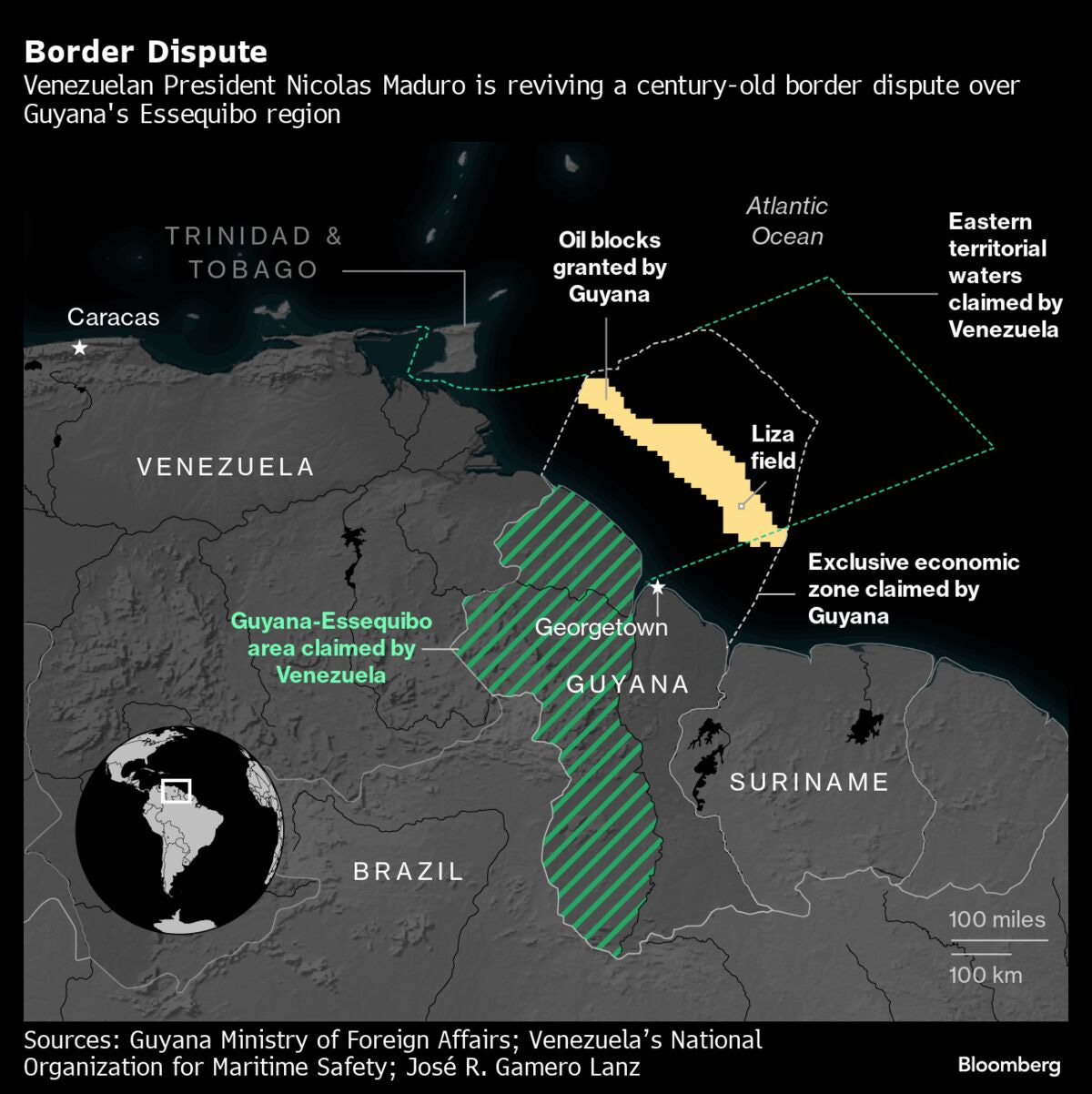
The historical roots of the current geopolitical contest lie in a border dispute dating back to the 19th century. Venezuela has long contested the 1899 Arbitral Award mediated by the US, which largely favored Britain, which then ruled British Guiana, establishing the boundary, arguing it was imposed under colonial duress, basically a US-UK decision to fragment Venezuela. The core of Venezuela’s claim encompasses the entire Essequibo region, which constitutes over two-thirds of modern Guyana’s territory. This dispute remained largely dormant for decades until Venezuela’s contended to the UN in 1962 that the 1899 declaration by the Paris Tribunal of Arbitration awarding the territory to British Guiana was null and void. Then after Guyana’s independence in 1966, and the signing of the Geneva Agreement that same year, which committed both parties to seek a peaceful settlement. However, US sanctions collapsing Venezuela’s energy industry coupled with the discovery of the world-class Stabroek Block offshore in Guyana, which is directly adjacent to the disputed waters, catapulted the grievance into a pressing crisis, transforming a diplomatic issue into a high-stakes energy geopolitics struggle over resource sovereignty and legal order.
.
.
Recent events have dramatically intensified the dispute, directly triggering the geopolitical dynamics described in your essay. In late 2023, Venezuela held a controversial referendum and subsequently announced actions to assert sovereignty over Essequibo, including licensing oil blocks in Guyana’s waters. Which provoked a sharp escalation, with Guyana heightening its defensive posture and urgently appealing to international partners.
The crisis culminated in a high-level meeting between Presidents Maduro and Ali in December 2023, resulting in a temporary de-escalation pledge. However, the underlying tension remains acute, exemplified by the forward deployment of the UK’s HMS Trent to the region in early 2024 and Guyana’s unwavering pursuit of a final, binding judgment from the International Court of Justice (ICJ), which it sees as the ultimate guarantor of its sovereignty. Venezuela’s rejection of the ICJ’s jurisdiction shows the fundamental clash between Guyana’s rules-based approach and Venezuela’s revanchist claims.
The US-led campaign of maximum pressure against Venezuela which features the seizure of oil tankers, a suffocating financial blockade, and the explicit threat of military force, serves a purpose far beyond destabilizing the Maduro regime. It actively suppresses a competing model of resource nationalism and strategic autonomy. By crippling Venezuela’s ability to monetize its vast reserves, this campaign effectively removes the world’s largest oil endowment from the legitimate global market. It creates a vacuum of reliable, scalable hydrocarbon supply in the Western Hemisphere and signals the severe consequences for states that operate outside the US-led financial and legal system. This is not merely punitive but it’s also a demonstration aimed at the entire region, defining the boundaries of the US new sphere of influence in the region.
Into this engineered vacuum, Guyana is being deliberately cultivated as the authorized alternative. Its astronomical discoveries coincided perfectly with Venezuela’s manufactured collapse, channeling international capital into a stark choice, of engaging with a sanctioned, targeted state, or invest in a jurisdiction championed and secured by Western powers. Guyana’s commitment to the International Court of Justice (ICJ) on the border dispute is not just a legal strategy but a foundational political tactic that aligns it perfectly with the US rules-based order that the US invokes to justify its actions against Venezuela and against other Global South states. Thus, investment in Guyana becomes more than a financial calculation channeling a low-risk, high-reward endorsement of this geopolitical order. The security provided by US joint exercises and the implicit protection of its naval patrols is the keystone that makes this alternative not just attractive, but viable.
Guyana’s government is walking a tightrope of leveraging its geopolitical moment to attract capital, while sending a message to Caracas that Guyana’s frontier is protected by the US and open for business, a distinction made possible not only by its oil but by powerful investments it has received, and US sanctions and the US armada targeting Venezuela.
*
Click the share button below to email/forward this article. Follow us on Instagram and X and subscribe to our Telegram Channel. Feel free to repost Global Research articles with proper attribution.
Miguel Santos García is a Puerto Rican writer and political analyst who mainly writes about the geopolitics of neocolonial conflicts and Hybrid Wars within the 4th Industrial Revolution, the ongoing New Cold War and the transition towards multipolarity. Visit his blog here. He is a regular contributor to Global Research.
Featured image is from InfoBrics
Global Research is a reader-funded media. We do not accept any funding from corporations or governments. Help us stay afloat. Click the image below to make a one-time or recurring donation.

























.jpg)


 French (CA)