

.png) 16 hour_ago
22
NE LAISSER PAS LE 5G DETRUIRE VOTRE ADN Protéger toute votre famille avec les appareils Quantiques Orgo-Life® Publicité par Adpathway

Slavoj Žižek’s new essay warns us against poets who govern. Read beside the two blog posts it was put together from, it turns out to be a small poetocracy of its own: borrowed sentences, a Gramsci read upside down, a Benjamin cut in half, and Plato prescribed as the cure for fascism.
Open three tabs in a browser.
In the first, a roundtable post from Lapham’s Quarterly, dated 19 July 2017: Leopold Froehlich’s “A Poetic Regime,” a short piece on Gabriele D’Annunzio’s Fiume. In the second, a guest post on a research blog called Staging Decadence, dated 22 September 2025: an excerpt from Federico Campagna’s Otherworlds, introduced by the blog’s editors. In the third, Slavoj Žižek’s Substack essay of 21 October 2026, “Against Poetocracy.”
Now read them side by side.
Žižek’s opening paragraph praises Campagna’s “terrific” book, then reproduces, almost word for word, a sentence Campagna never wrote. It belongs to the blog’s editors. That is how Žižek’s Fiume comes to be “grounded in the intervention of a military general”; D’Annunzio ended the war a lieutenant colonel. The next paragraph, D’Annunzio as “more than a poet” down to the “avid consumer of cocaine,” is Campagna’s prose without quotation marks. So is the one after it. So is the long passage on nudism, polyamory, the overwhelmed venereal ward and the Theban legion. A single footnote at the end says these words were “quoted from” the blog. The quotation marks that would tell the reader whose words they are appear nowhere. Žižek spares his readers the trouble of reading two blog posts, and spares himself the trouble of rewriting them in his own words.
The first tab supplies the rest. Froehlich’s post opens with an epigraph from Plato’s Republic. Žižek quotes the same passage and footnotes it to the Perseus Digital Library. Perseus carries Paul Shorey’s translation; the words Žižek prints are Allan Bloom’s, exactly as they stand at the head of Froehlich’s post. Froehlich has Benjamin on the aestheticization of politics; so has Žižek. Froehlich has the Gramsci passage with no original source; Žižek has it with an “op. cit.” And one sentence crosses from Froehlich into Žižek’s own voice untouched: D’Annunzio “initiated the Roman salute and dressed his henchmen in black shirts,” and took the title of Duce from the Latin dux, “cognate with duke.” No marks, no note.
Something more telling than borrowing happens in transit. In Campagna’s excerpt D’Annunzio himself writes that Fiume’s communism has little in common with “Lenin’s doctrine, which has lost its way in blood.” In Žižek the quotation marks vanish and the clause changes owner. Fiume’s anarcho-communism, he writes, had little in common with Lenin’s doctrine, yet “it also lost its way in blood.” A poet’s swipe at the Bolsheviks has become the philosopher’s verdict, and that small “also” keeps Lenin in the dock. The quotation marks go into the hat; out of the hat comes Lenin, in handcuffs. Two letters written months apart, one to the anarchist Randolfo Vella and one to the seamen’s leader Giuseppe Giulietti, are run together as a single statement.
In a comment box none of this would matter much. It matters in an essay that scolds Gramsci for misreading his moment, and that closes by calling artificial intelligence “a bric-a-brac full of inconsistencies, heterogeneities and hallucinations.” Readers of Lacan know that the repressed returns. In this essay the repressed core is not fascism. It is the footnotes.

The passage Žižek takes from Froehlich opens with how D’Annunzio “was depicted”: a madman, a histrionic enemy of the homeland. Then it names its subject. It is “the government” that roused “the most intimate and profound sentiments in the collective consciousness”: the violated family, the fraternal blood, the girls defiled by drunken soldiers. It is the government that “managed to achieve a near perfect consensus.” Froehlich introduces the quotation as evidence of Rome’s alarm at Fiume. Gramsci is describing Giolitti’s propaganda.
Žižek reads it the other way round. “If the Fiume rulers really ‘roused the most intimate and profound sentiments’…,” he begins. In Gramsci the Fiume rulers rouse nothing. They are the target of the campaign.
On this misreading Žižek builds two charges. The first is that Gramsci calls “manipulation” what was really the self-manipulation of D’Annunzio’s young followers. The second is that Gramsci describes sexual liberation “in surprisingly traditional terms,” as “the sanctity of the family violated.” Those terms are the government’s. Gramsci repeats the slogans in order to expose them, which is what a communist does with the enemy’s propaganda.
The irony goes further. Žižek complains that Gramsci was “not sufficiently Gramscian,” as if he “didn’t yet know his own notion of hegemony.” Restore the subject of the sentence and the passage becomes an early sketch of exactly that notion: a liberal state winning near-total consent not by force but by mobilizing the deepest moral feelings of the population against an enemy. Gramsci did not yet have the word. He already had the thing. Žižek, reading him third-hand, could not tell whose consent was being manufactured. It was not Gramsci who had yet to discover hegemony. It was his reader who had yet to find the subject of the sentence.
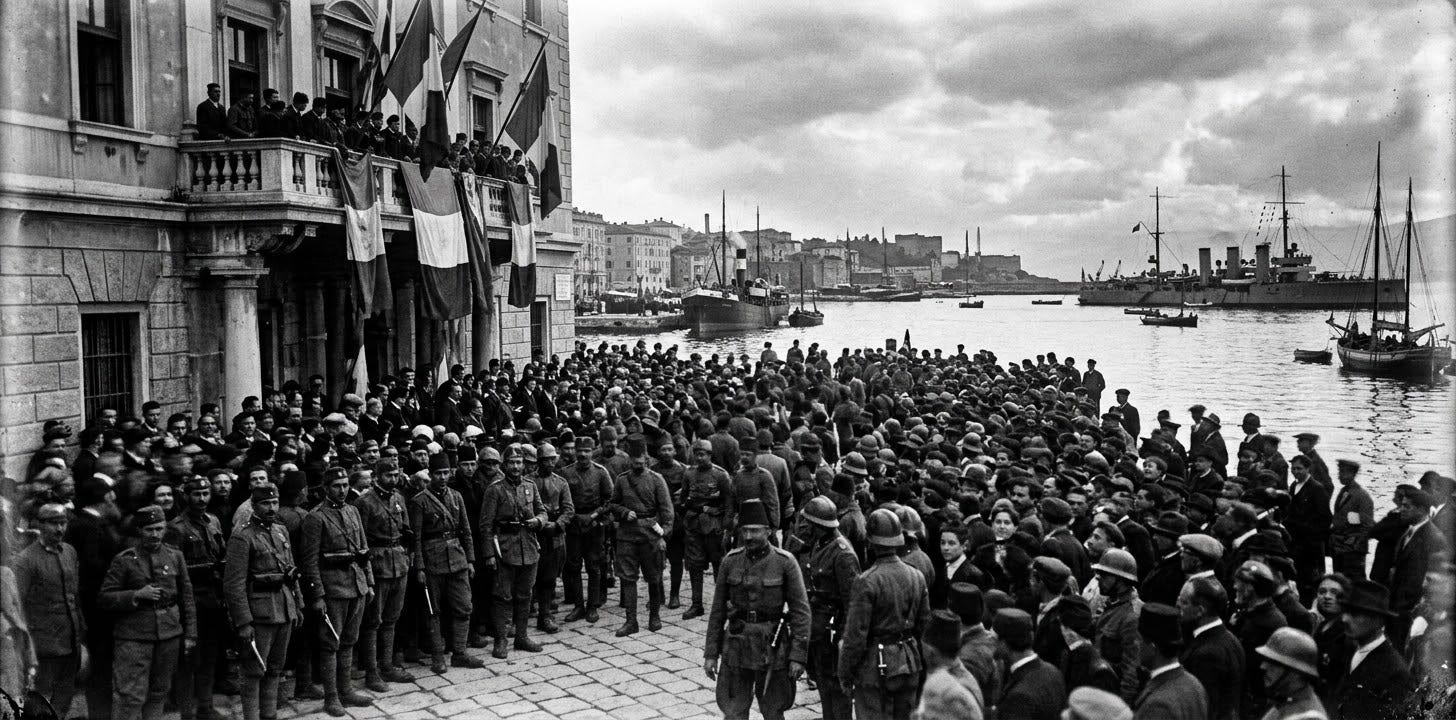
Take away the nudism and the cocaine, and the politics of Fiume are not hard to find. They were in the slogan itself: Fiume o morte, Fiume or death. The demand was annexation. The secret Treaty of London that bought Italy’s entry into the war in 1915 had never promised Fiume to Rome; Italian nationalism claimed it all the same. On 12 September 1919 D’Annunzio marched from Ronchi at the head of mutinous units and occupied the city to force that claim. This was irredentism, an expansionist demand dressed up as national completion.
Žižek half knows it. He concedes that the Hungarians, Croats and other Slavs of the city lived the occupation as “a nightmarish intrusion.” He does not notice that his own two sources disagree on who the majority was. Campagna calls Fiume majority-Italian; Froehlich says there were in fact more Croats. Žižek’s “silent majority” settles a factual dispute he never registers.
The constitution Žižek admires was, by the account of both his sources, largely the work of Alceste De Ambris, a revolutionary syndicalist; D’Annunzio supplied the style. Žižek names neither fact. Nor does he mention the articles Froehlich prints from the draft, which give a Commandant “all powers—political and military, legislative and executive.” Equality for every citizen, every power to one man.
Žižek even writes the right sentence: Fiume was “a sort of communism for the ruling class.” That sentence should have closed the case. Instead he drops it and summons the Paris Commune as a “vague parallel.” The Commune was the workers of a capital holding it against their own bourgeoisie and the Prussian army behind it. Fiume was a band of deserters holding a port for an annexation. To set the two side by side is not comparison. It is the same levelling that, in his latest book, turns everyone into a fascist.
Then comes the central thesis: what fascism must repress is “its own subversive core,” and the proof is that “the Italian regular army bombarded Fiume.” His source says the navy did it, but leave that aside. Who gave the order? Not a fascist regime. It was Giolitti’s liberal cabinet, in December 1920, enforcing the Treaty of Rapallo it had just signed with Yugoslavia. Mussolini was still two years from power. Here Žižek is more Hegelian than ever: if the facts do not fit the thesis, so much the worse for the facts.
When fascism did come, it did not repress Fiume’s project. It completed it. In January 1924 Mussolini’s government annexed the city by the Treaty of Rome. The legionaries had already gone into the squads; the salute, the shirts, the balcony and the war cry went into the regime. What fascism threw away was the nudism, a few letters about communism without dictatorship, and a rival Duce. It kept the baby, as Žižek says. The baby was annexation. The bathwater was a poet’s mood.
Žižek cites Walter Benjamin: the logical result of fascism is “the introduction of aesthetics into political life.” He takes the line from Froehlich, who also stops there. Benjamin did not. The epilogue to the essay on the work of art ends with the sentence the first one was written for: fascism renders politics aesthetic, and communism responds by politicizing art.
That is the answer to the question Žižek himself poses, “Poetry and war: are they not opposites?” He leaves it out. The second half of the sentence, it seems, did not fit on Froehlich’s page. In its place he puts Plato. “Against fascist poetry, we should shamelessly turn back to Plato,” and banish the poet from the well-governed city.
Consider what is being prescribed. The city of the Republic is ruled by a trained guardian caste, with the producers at the bottom. Its censorship, as one of Žižek’s own commenters noted, does not expel poetry at all. It keeps the approved kind and trims the rest, so that the guardians will not fear death in battle. It is an order built for war, not against it. Its author was an aristocrat whose uncle Charmides and whose mother’s cousin Critias sat among the Thirty, the oligarchy that overthrew Athenian democracy in 404 BC and put its citizens to death by the hundred. The Socratic circle that produced the Republic was no seminar on free inquiry. It was a network that staged a coup. When the coup was beaten back and democracy restored, Socrates was put on trial, and the West has spent two thousand years selling that trial as a martyrdom for free speech.
To answer D’Annunzio’s poetry with the programme of Critias’s circle is a strange cure for fascism. It swaps the poet-dictator for the philosopher-king. The second may be more flattering to philosophers. It is no more democratic.
The Yugoslav evidence Žižek offers is of the same kind. Radovan Karadžić wrote verse, and so, we are told, poets prepared the path to ethnic cleansing; the Balkans had a “poetic-military complex.” Poets did serve as recruiting sergeants. But the federation was not taken apart by stanzas. It was taken apart by foreign debt, by IMF austerity through the 1980s, and by the haste with which Western capitals recognized Slovenia and Croatia as they broke away. Blaming the poets is idealism with a Balkan accent. As for the claim that D’Annunzio, at the end, ordered all non-Italians out of the city, Žižek gives no source at all. Neither of his two blog posts mentions it.

The finale moves in two steps that cancel each other. First, the “calculating part” of the soul, the faculty Plato wanted in command, is said to threaten our survival in the age of artificial intelligence. A sentence later AI is the very opposite: a hallucinating bric-a-brac that produces “too much (bad) poetry.” Which is it, reason run wild or the poet run wild? The essay needs both, because it needs a punchline: “Elon Musk and Peter Thiel are today’s D’Annunzios.”
A reader in the comments answered in a line: these men do not read poetry. The deeper trouble is that the comparison leaves no room for the one thing that makes them what they are. D’Annunzio held a port with a few thousand legionaries and a balcony. Musk and Thiel hold property: launch vehicles and satellite constellations, data platforms sold to armies and intelligence services. Their power does not come from a style that seduces a city. It comes from owning the means through which states now see, speak and fight. Palantir is not an aesthetic.
Call them poets and the question of ownership dissolves into a question of taste. That is the quiet service this kind of criticism performs. It lets capital appear as a mood.
Žižek describes Fiume as “a kind of pre-ideological mixture of heterogeneous elements,” held together only by “a negative feature.” It is a fair description of his own essay. Campagna’s romance, Froehlich’s epigraph, a Gramsci turned inside out, half a sentence of Benjamin, the guardians of the Republic, Karadžić, Musk. What holds the series together is also negative: the steady absence of class. Who owned Fiume’s port, whose claim the legionaries served, which government fired on them and why, what Musk and Thiel actually own. None of it enters.
The method has no internal limit. If D’Annunzio can be read through Karadžić and Karadžić through Musk, nothing forbids the essay that reads War and Peace through Lucky Luke: Pierre Bezukhov as the man who shoots faster than his shadow, Napoleon as the Daltons.
Fiume, Žižek says, lived in a permanent state of exception, which is why it could not last. His essay lives in a permanent exception from evidence, and it has no need to last. There will be another one next week.
Plato wanted the poets sent out of the city. A humbler rule would do. Before a philosopher banishes anyone, let him check whose sentences he is speaking.【●】
◇This text was composed from the author’s own ideas, arguments, and source selection; a large-language-model tool was used during composition for prose editing. All intellectual and scholarly responsibility for the content rests with the author.














.jpg)


 French (CA)