

.png) 2 month_ago
18
2 month_ago
18
NE LAISSER PAS LE 5G DETRUIRE VOTRE ADN Protéger toute votre famille avec les appareils Quantiques Orgo-Life® Publicité par Adpathway
By Hermann Ploppa
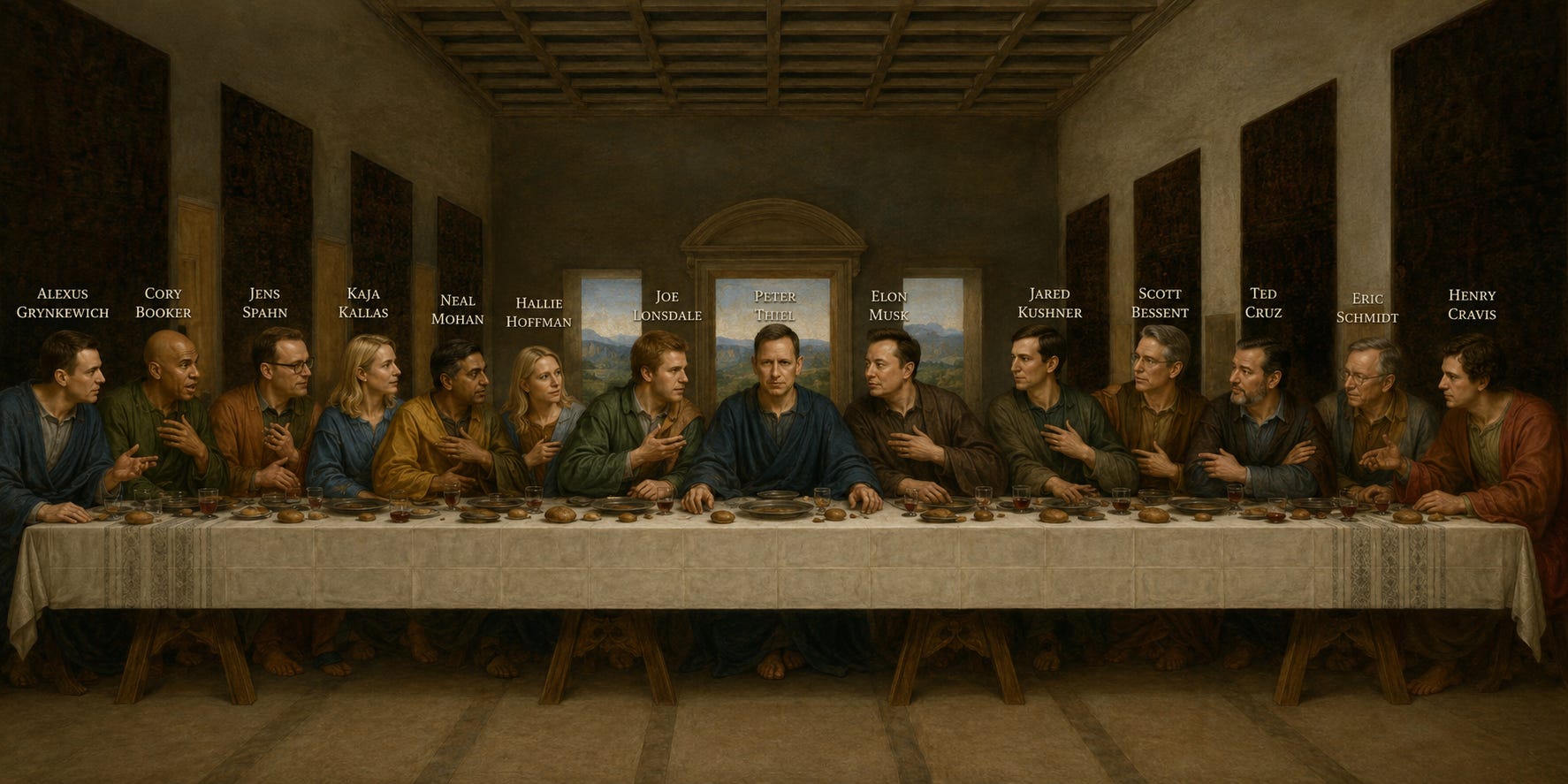
It’s hard to believe.
Since 2006, celebrities and the ultra-wealthy have been gathering every year for an ultra-exclusive secret meeting at prestigious locations such as the Ritz-Carlton luxury hotels in Arizona or California. And then again, in an iconic setting against a historic backdrop at the Palazzo San Clemente in Venice. Despite the enormous demands on personal security and on-site organization, they have managed to remain out of the public eye. A masterful display of discretion.
But now, a Swiss computer hacker with the hard-to-pronounce stage name maria arson crimew has managed to crack the encrypted website of Peter Thiel’s conspiratorial group, soberly named “Dialog,” just like that <1>. Ms. crimew didn’t even have to hack the site. There were reportedly such serious security flaws that she was allegedly able to access Dialog’s participant lists with relative ease.
That naturally raises eyebrows. Is it possible that a top-tier computer scientist like Peter Thiel was so negligent in securing his secret group that an outsider could just like that expose the world’s powerful and influential figures? Could Peter Thiel have been laying a red herring here?
But no. There’s too much at stake. It’s scandalous enough when top politicians meet secretly with internet billionaires. You don’t play around lightly with such powerful players. The World Economic Forum is a platform of similar stature. Yet the media report extensively on the gatherings of the rich and famous. And the Trilateral Commission also provides detailed accounts of its activities on its website. The same goes for the Council on Foreign Relations in New York, which has existed for over a hundred years and quietly steers U.S. foreign policy.
Once upon a time, there were the legendary Bilderbergers. This illustrious circle of elites from North America and Western Europe managed, for about twenty years, to make political deals completely unnoticed by the public—all while enjoying fireside chats, coffee breaks, and cold buffets. But then the curious public struck relentlessly. Secret clubs like the Bilderbergers are, of course, exposed and rendered meaningless the moment everyone is watching.
„Navigating WWIII“
And that’s exactly what could now be in store for Peter Thiel’s secret lodge, “Dialog.” It could all have been so wonderful. This year, the Dialog members plan to meet at a beautiful little castle near the Irish capital, Dublin. From August 12 to 16, Thiel’s elite circle will gather at Powerscourt Estate in County Wicklow to chat by the fireplace or during leisurely walks in the magnificent castle gardens about such intimate topics as “Money (Does?) Buy Happiness,”, “Bring back nuclear” or “Navigating WWIII“, You can also answer the question: “How’s your sex life?” All in a small group, moderated by experienced facilitators. Sex? Really? Yes, in fact, there’s a form on the Dialog website that invitingly asks: “looking for love“. They promise to deliver “meaningful connections for exceptional people.” Yes, a little bit of Epstein has to be part of it, too.
It’s all rather strange. But it’s no laughing matter when it comes to who’s being paired up with whom here on the really tough issues. After all, the list of participants actually includes a top military official. General Alexus Grynkewich is NATO’s Supreme Commander. The Supreme Commander of NATO is always an American. And this American also serves concurrently as the Commander-in-Chief of U.S. forces for EUCOM. Very few people know that the entire globe is divided by the Americans into U.S. military command zones. After all, U.S. forces are stationed at over 800 military bases worldwide. And the American occupying force for Europe goes by the name EUCOM. What is one of the most important military figures in the Western community of values doing in Peter Thiel’s secret club? It’s hardly surprising, then, to find Trump’s Treasury Secretary Scott Bessent in this illustrious circle as well. Trump’s Secretary of the Army, Dan Driscoll, is also a must-have presence.
The head of the top drug enforcement agency is there, as is the notorious warmonger, Senator Ted Cruz. So is his Democratic Party colleague, Cory Booker, who plays the role of the social conscience. The vassals are also allowed to chime in a bit. This time, for example, EU Foreign Minister Kaja Kallas from Estonia has been invited to Dublin. A frequent guest at previous dialogue meetings was the German politician Jens Spahn, who has also graced the Bilderberg table. Time and again, the question arises: what is it about this utterly uncharismatic savings bank employee from Ahaus in the Lower Rhine region that makes him so appealing to global elites?
In addition to other politicians from the U.S. and the occupied vassal state, there are also key officials from influential far-right network organizations: Peter Goettler of the CATO Institute, Ryan Stowers of the Charles Koch Foundation, and Jonathan Greenblatt of the Anti-Defamation League, which has existed since 1913. While Jews in the U.S. faced extreme danger in the early years of the nation’s founding, the League’s new mission—following the integration of Jews into the American establishment—has become combating critical voices against the Netanyahu government. Working in close collaboration with the much younger Israel lobby group AIPAC, all critics of Netanyahu are indiscriminately branded as “anti-Semites” and have their livelihoods destroyed.
In this context, it comes as no surprise that Donald Trump’s son-in-law, Jared Kushner, is also part of Thiel’s inner circle. Alongside him are Hollywood actors (who are now quickly distancing themselves from the inner circle) and media figures such as Neal Mohan, the head of YouTube. Mohan has distinguished himself as chief technology officer by overseeing the mass deletion of politically unpopular YouTube channels.
And on top of that, nearly all the powerful heavy weights from the multi-billionaire scene: led by the first trillionaire in world history, Elon Musk, followed by former Google CEO Eric Schmidt (estimated net worth: $40 billion), Peter Thiel ($27 billion), and former partial owner of the German Springer Group, Henry Kravis, with his $12 billion.
Astute journalists have already put it this way: Bilderberg meets Silicon Valley. Indeed: whereas the Bilderbergers could only guess at what truly drives the people they govern, this “dialogue clique” now has a high-resolution view of what the people are thinking through its control of smartphones and the internet. And how to then feed them the appropriate information so that the masses move in the desired direction. This is indeed an explosive mixture. There’s a lot of Machiavelli in it—and, in fact, hardly any democracy left. And that is clearly the result of Peter Thiel’s subversive work.
„I no longer believe that freedom and democracy are compatible“
This quip by Peter Thiel has since become common knowledge. Thiel wrote this sentence in an article for the journal of the reactionary CATO Institute in 2009 <2>. Thiel describes how, as a student at the private elite university Stanford, he published a newspaper promoting libertarian ideas. However, no one was interested in his radical free-market visions. Even after graduation, all of his fellow students had conformed to the institutional framework of the state order. It was clear to Thiel that he could not win people over to his cause through political persuasion. The political arena—the political public sphere—thus had to be circumvented—in order to ultimately eliminate it.
Thiel now hoped to realize his vision of a world of “free” entrepreneurs in three ways: first, through the internet—a space unconfined by national borders; second, through new, politics-free spheres in outer space; and third, through the establishment of private cities in the stateless expanse of the oceans—cities built on pontoons that could be arranged as desired. That article in the CATO newsletter was, in fact, ultimately an advertisement for the Seasteading Institute, which Peter Thiel had just founded and which was intended to establish those private cities on the roaring oceans.
While the internet’s undermining of the political public sphere was a huge success, the conquest of space initially came to nothing. And so far, not a single pontoon city has been established on the world’s oceans. But that doesn’t matter. Thanks to the zealous behind-the-scenes work of radical free-market networks, nation-states are now so deeply in debt and hollowed out that a lawless private city could easily be established in the midst of many failed states. In this way, over twenty private cities have sprung up—with quite varied results.
In his speech at the so-called “Libertopia” festival in 2010, Peter Thiel didn’t mince words. The Libertopia Festival brought together representatives of the libertarian movement. Libertarians believe that any form of government is inherently evil because it infringes on the freedom of the wealthy—in favor of the lazy, the poor, and the incompetent. At this gathering of libertarians, Peter Thiel said, among other things:
„The basic idea was that we could never win an election on getting things because we were such a small minority. Bat maybe you couold actually unilaterally change the world without having to convince people an beg people and plead with people who are never going to agree with through technical means. And this is where I think technology is this incredible alternative to politics.“ <3>
As planned, Thiel now sidestepped politics—that is, public debate and the negotiation of conflicting interests in society. He simply made himself indispensable through technology. He created a unique selling point. And with this edge over the competition, he secured a monopoly. This is how Thiel sets himself apart from the “weaklings” who have to struggle through economic competition with slim profit margins. Thiel extols the monopoly derived from this unique selling proposition in his book „Zero to One“ <4>.
Thiel’s competitive advantage, which could become a temporary monopoly: he helped national governments around the world—all craving total control—escape their dilemma. Following the events surrounding September 11, 2001, the widespread installation of surveillance cameras on all streets and in all public spaces began, along with the systematic tapping of telephone and internet lines. But instead of a great epiphany, the government spies were struck by a massive hangover after a certain amount of time. For the gigantic masses of data were impossible to tame. Instead of being able to comprehensively monitor every human mind, the watchers and eavesdroppers heard only an incomprehensible “static” <5> in the data mush. Who could make sense of this data chaos? <6> “Connecting the Dots”—linking the dots to form a greater meaning <7>?
Then Peter Thiel came along and, with his intelligence firm Palantir, provided the essential analytical tools needed to truly understand what was brewing among the common people. Well, it still doesn’t quite work perfectly. At least not as long as artificial intelligence is given sole decision-making authority. For example, Palantir AI-guided missiles bombed a deserted park in Tehran simply because the park happened to be called “Police Park”—even though no law enforcement officers were to be found there.
The Miracle of Islamabad
It never ceases to amaze: in the war between the U.S. and Iran, Pakistan suddenly emerged as a widely respected mediator. Vice President JD Vance visited Pakistan and warmly embraced members of the Pakistani government. Yet Pakistan has always been the black sheep on the geopolitical stage. Pakistan had more or less acquired its nuclear bomb on the black market. Time and again, Pakistan has been suspected of providing a safe haven for Islamist terrorist groups. That’s why, during Obama’s administration, the country was subjected to widespread U.S. drone strikes. Yet Pakistan’s most recent hot wars against India and Afghanistan were generously ignored by Western powers. Suddenly, Pakistan is considered a model citizen on the diplomatic stage.
Well, that, too, is presumably the work of Peter Thiel’s secret “Dialog” group. After all—and this isn’t all that secret—a Pakistani statement from November 2025 announced that the Pakistani finance minister had met with a delegation from the “Dialog” group <8>. Essentially, a government-to-government meeting. We learn that the Pakistanis have promised the Dialog people a large-scale wave of privatization. And that they want to open up to U.S. financial powers. The communiqué reveals that the Pakistanis have been in regular negotiations with Dialog for at least a year.
Meanwhile, Peter Thiel’s close friend from his days at Stanford, Joe Lonsdale, is already shaking up politics in the U.S. Lonsdale co-founded the surveillance firm Palantir with Peter Thiel and Alex Karp, now has a net worth of $2.8 billion, and is also one of the founders of Dialog. Lonsdale stands out for his particularly extreme rhetoric. At the Cicero Institute, which he founded, he commissioned draft legislation. According to these drafts, homeless people are to be sent to internment camps <9>. In addition, the U.S. already has the “Three Strikes and You’re Out” rule. This means that anyone who commits a crime three times in a row will remain behind bars or in labor camps for life. To Lonsdale, that’s too lenient. On X/Twitter, Lonsdale wrote: „We will quickly try and hang men after three violent crimes. And yes, we will do it in public to deter others. Our society needs balance. It’s time to bring back masculine leadership to protect our most vulnerable.“ <10>
There is no indication that anyone in the “dialogue” movement has distanced themselves from these extreme ideas. Welcome to the days of King Henry VIII! The “dialogue” movement doesn’t just want to roll back the reforms of the New Deal era. It even wants to go far beyond the achievements of the Progressive Era at the beginning of the twentieth century. Even though the U.S. has never experienced feudalism: what the “Dialog” people have in mind is neither turbo-capitalism nor fascism. It is a wildly rampant form of feudalism—one based not on agriculture and livestock farming, but rather on oppression through total control and artificial intelligence <11>.
Full-speed backward—off to the apocalypse!
And now we understand just how important secrecy is, especially to people like Peter Thiel. In his view, the general public is stupid anyway, and it’s impossible to win them over to his libertarian ideas. Thiel has become increasingly exclusive over time. He recently caused a stir by giving lectures behind closed doors in Rome. All of the hand-picked attendees were strictly forbidden from revealing anything about the content of Thiel’s talks to the public. However, enough has leaked out to suggest that Peter Thiel spoke about the dangers of the Antichrist. Thiel is said to be a devout Christian, and he cannot shake his preoccupation with the end-time events of the Apocalypse.
By now, however, Thiel can hardly keep anything secret anymore. Has he burned his bridges? In any case, Thiel has become a major thorn in the side of the democratic public. This sudden, unwanted fame is jeopardizing his projects. It’s not just film actors who are now distancing themselves from him. Even the operators of the Powerscourt Estate, where Thiel’s secret society Dialog is scheduled to meet in August, would prefer to cancel the event. One can already imagine the protesting demonstrators making a racket outside the castle near Dublin. The Irish are, in any case, an extremely freedom-loving people who strongly identify with the suffering of the Palestinian people. They are also a people who react with extreme aversion to any form of Anglo-American arrogance and abuse of power.
But how do we counter the anti-democratic machinations of Peter Thiel and his billionaire oligarch friends? Thiel and his allies have a clear agenda. It’s not enough to simply demonstrate against them from time to time. A clear alternative vision must be developed here. Banning a discussion event between Thiel and a Catholic theologian, as happened recently in Vienna, only serves to give libertarians like Thiel an aura of mystery and the forbidden <12>.
An open, calm debate would go a long way toward demystifying these anti-democrats.
The first step in a counteroffensive against the radical-market libertarian offensive is an objective assessment of the Thiel networks. So far, however, there has been a complete lack of awareness about the wave that is washing over us.
We can only counter this wave through the power of swarm intelligence. We can no longer afford to simply stand idly by and watch the market radicals run rampant.
Sources
<2>
<3>
<4> https://icrrd.com/public/media/01-11-2020-203418Zero%20to%20One.pdf
<5> Rob Kitchin: The Data Revolution: Big Data, Open Data, Data Infrastructures & their consequences New York 2014
<6> Bruce Schneier: Data and Goliath: The Hidden Battles to collect your Data and control your world. New York 2016.
<7> The 9/11 Commission Report. Potsdam 2004
<8> https://newzshewz.com/fm-meets-dialogs-delegation/
<10>

Joe Lonsdale@JTLonsdale
If I’m in charge later, we won’t just have a three strikes law. We will quickly try and hang men after three violent crimes. And yes, we will do it in public to deter others. Our society needs balance. It’s time to bring back masculine leadership to protect our most vulnerable.
2:19 PM · Dec 5, 2025 · 1.04M Views
714 Replies · 52 Reposts · 955 Likes
<11> Hermann Ploppa: Der Neue Feudalismus – Privatisierung, Blackrock, Plattformkapitalismus. Marburg 2025













.jpg)


 French (CA)