

.png) 2 month_ago
14
2 month_ago
14

This week marked the most consequential week in recent memory for precious metals.
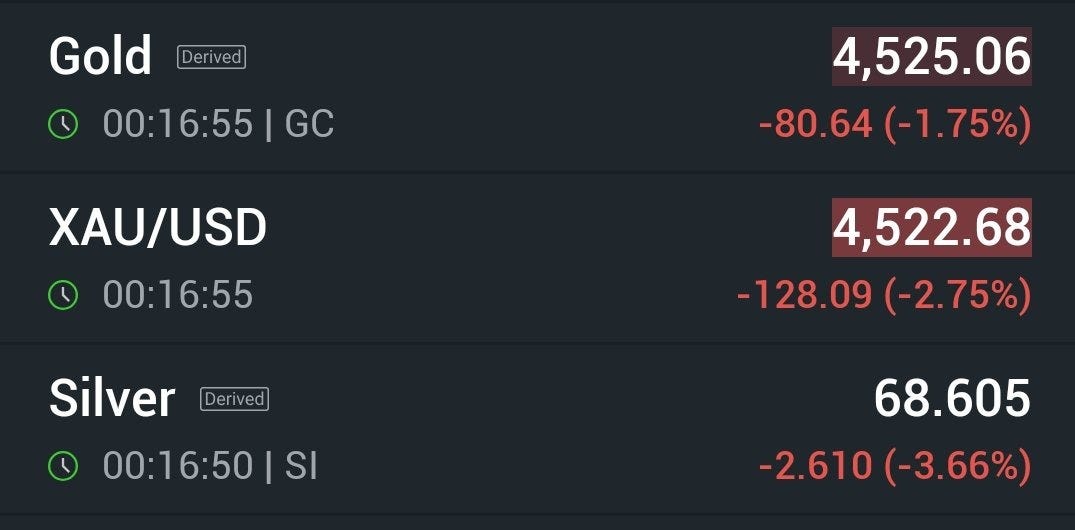
Gold prices collapsed by 10.5% to close just under $4,500, recording the biggest weekly decline since 1983.
Silver fared even worse, plummeting 16.5% to below $68, its sharpest weekly drop since 2011.
The carnage extended to mining stocks as well, with the GDX falling 12% and the GDXJ shedding 17%.
Yet rather than signaling the end of the bull market, this selloff has paradoxically strengthened the fundamental case for owning gold and silver. The catalyst for the decline was a fundamental misunderstanding by traders who reacted to inflationary data by selling their inflation hedges, a deeply illogical move.
Click here to read this article in Spanish/Español.
The selloff gained momentum on Wednesday following the release of February’s Producer Price Index numbers, data that predates both the recent Iran war and the surge in oil prices.
While markets expected a modest 0.3% increase, producer prices instead jumped 0.7% for the month, which annualizes to a staggering 8.4%.
Year-over-year, producer prices rose to 3.4% from 2.9%, moving decisively away from the Fed’s 2% target. Core prices, excluding food and energy, climbed 0.5% monthly and 3.9% annually. This serves as definitive proof that the Federal Reserve’s long-claimed victory over inflation was a fiction. The Fed aborted the inflation battle prematurely and surrendered in short, the Fed didn’t win the inflation war, inflation won.
.
.
The market’s reaction, selling gold on hot inflation news, reflects a flawed assumption. Traders reasoned that higher inflation would force the Fed to maintain or even raise rates, which they viewed as bearish for gold. But this logic is backward. What matters is real interest rates, not nominal ones. Even if the Fed never cuts rates again, accelerating inflation will push real rates deeply negative. If inflation is 3% and the Fed funds rate is 3.5%, the real rate is half a percent. But if the Fed funds rate goes up to 4% while inflation goes up to 6%, real rates have actually gone from positive half a percent to negative 2%,a profoundly bullish scenario for gold.
The Fed has lost all ability to control inflation due to structural constraints that didn’t exist in previous eras.
In 1980, when Paul Volcker raised rates to 20% to crush inflation, the national debt stood at less than $1 trillion, debt-to-GDP was around 35%, and the United States was the world’s largest creditor nation with massive trade surpluses. Today, with debt exceeding $39 trillion and approaching 125% of GDP, the country is the world’s largest debtor nation. Raising interest rates to 12% today with a $39 trillion national debt is unthinkable. The economy couldn’t even survive 10% interest rates, let alone 20%. If 20% interest rates were needed back in 1980 to rein in inflation, how high would they have to be now?
The Fed’s predicament is further complicated by deteriorating economic conditions. All of last year, the economy added just 150,000 jobs, half of them in healthcare, a decline from the two million jobs created during the previous administration’s final year. Fourth-quarter GDP grew at a meager 0.7%, with the economy already teetering on recession before the war began. When the economic weakness intensifies, the Fed will abandon any pretense of fighting inflation and instead return to aggressive monetary easing. The Fed will retreat immediately, especially under political pressure. Rate cuts will come despite rising inflation. In fact, it’s not just rate cuts on the horizon, the printing presses will be cranked up like never before in the mother of all quantitative easings (QE).
The war adds another layer of pressure. The administration is already requesting $200 billion in additional military funding, just a down payment, and the national debt could hit $50 trillion before the current term ends. Meanwhile, bond yields are signaling growing distress, with the 10-year Treasury reaching nearly 4.4% and the 30-year yield climbing to 4.96%, both at their highest levels since July. These rising yields are the pin about to prick multiple bubbles, particularly in real estate, where a 30-35% nationwide price decline would wipe out most home equity. Fannie Mae and Freddie Mac’s recent decision to relax insurance requirements, allowing homeowners to insure only the depreciated value of roofs rather than replacement cost, reveals growing desperation to prop up an unsustainable housing market.
Despite the sharp correction, the US dollar failed to rally during the turmoil, closing the week essentially unchanged. Money flowed not into dollar-denominated assets but into cash across various currencies. Bitcoin, interestingly, held relatively steady, falling only 5.5% and remaining near $70,000. Rather than interpreting this as validation of cryptocurrency as a safe haven, it appears to be a temporary floor created by continued institutional buying. The relative stability presents an opportunity for crypto holders to rotate into precious metals, especially given the much larger decline in gold and silver compared to Bitcoin.
This week’s carnage represents not a reason to flee but an opportunity to accumulate. For those already holding gold and silver, the decline is irrelevant unless they planned to sell,and selling would be a mistake. If comfortable with current positions, nothing needs to be done. The trend remains intact and the fundamentals have grown stronger, not weaker. All the reasons for owning gold and silver have been validated as rising inflation is the reason, along with the government’s powerlessness to address it..
Looking ahead, the selling pressure will likely subside, potentially followed by a sharp reversal. The traders who have been selling gold on hotter-than-expected inflation news will eventually recognize that high inflation is good for gold. The logic is simple that inflation is higher than everyone thought, yet the natural reaction was to sell inflation hedges, a response that makes no sense. As traders come to understand that the Fed is powerless to combat inflation, there will be a mad rush to get out of dollars and into something real. Foreign central banks, in particular, will take advantage of prices below $4,500 to add to their reserves.
The current environment echoes the 1970s but is actually far worse, given the country’s unprecedented debt levels and structural vulnerabilities. When people who have valuable goods and services to sell demand payment in real money, most people won’t have it. But those who positioned themselves in precious metals will. For those seeking higher risk and reward, gold and silver mining stocks, which have experienced even steeper corrections, remain ridiculously cheap.
*
Click the share button below to email/forward this article. Follow us on Instagram and X and subscribe to our Telegram Channel. Feel free to repost Global Research articles with proper attribution.
Miguel Santos García is a Puerto Rican writer and political analyst who mainly writes about the geopolitics of neocolonial conflicts and Hybrid Wars within the 4th Industrial Revolution, the ongoing New Cold War and the transition towards multipolarity. Visit his blog here.
He is a Research Associate of the Centre for Research on Globalization (CRG).
Global Research is a reader-funded media. We do not accept any funding from corporations or governments. Help us stay afloat. Click the image below to make a one-time or recurring donation.



























.jpg)


 French (CA)