

.png) 3 month_ago
25
3 month_ago
25

An old Russian proverb says:
“Dwell on the past and you’ll lose an eye.”
But then it continues:
“Forget the past and you’ll lose both eyes.”
This astute saying, cited by late Soviet dissident Aleksandr Solzhenitsyn in the preface to his book The Gulag Archipelago on his dark years inside Stalin’s cruel penal system, contains many lessons on the importance of history for understanding present-day events.
But what if we do not know our history well enough to forget it?
Not for want of interest or curiosity, but because it has been covered up and obscured behind a fairy-tale narrative of lies, omissions and half-truths.
Do we really know, for example, the truth about our government’s role in the murders of the late President John F. Kennedy, his brother Robert F. Kennedy, Malcolm X, and Martin Luther King?
And how and why are the lives and deaths of these men so vitally relevant to the troubled world we live in today?
James Douglass, author of the best-selling ‘JFK and The Unspeakable: Why He Died and Why It Matters’, has created a masterwork of truth-telling in his ground-breaking sequel to JFK and The Unspeakable, titled Martyrs to the Unspeakable: The Assassinations of JFK, Malcolm, Martin, and RFK.
The book is a profound lesson in truth and history for anyone interested in these assassinations, but particularly for US citizens – the vast majority of whom have received what US intelligence agencies might call a “sanitized” version of events.
Elegantly and eloquently written, Martyrs To The Unspeakable cuts through the fog of doubt and disinformation, lies and obfuscation that characterizes the popular narratives surrounding the lives and deaths of these four great American leaders:
John F. Kennedy, Malcolm X, Martin Luther King, and Robert F. Kennedy.
 The truths in this book are sharp, searing and sometimes difficult to absorb – a fact which prompted this reader to take extended breaks from the reading of this book – just to be able to fully grasp, understand, and contemplate that the malign forces within our government that are directly responsible for the murders of these significant figures (as well as for a host of other horrific, unspeakable actions against the American people), still operate today, enjoying immunity from public scrutiny and accountability.
Author Douglass skillfully traces the intersections of these remarkable leaders’ truth-seeking life journeys and electric transformations of heart, spirit, and conscience that created incredibly vast fields of goodness during their lifetimes (to borrow a phrase from late Lockheed engineer and nuclear resister Robert Aldridge, himself the embodiment of transformation, and author The Goodness Field) but which also sealed their respective fates. For me the book was a profound education – without a doubt the most important history book I have ever read.
Shattering myths, page after page, with the support of impeccably sourced, richly detailed references and footnotes which can sometimes be more mesmerizing than the text itself, Douglass unearths little-known stories and revelations about key powerful players within US intelligence and military circles who became irrevocably convinced that Malcolm, Martin, JFK and his brother Bobby — all for separate, but related reasons — had become existential threats to the nation and constituted a direct challenge to their ability to project power and control both inside and outside the country thus making their elimination an absolute necessity (in their minds).
At times even more intriguing are Douglass’s stories of people who existed on the fringes of society or linked with organized crime – who were cynically used as pawns in the government’s sinister surveillance and murder plots against the leaders it wished to assassinate; some became lifetime victims of government-sponsored mind control – all to achieve their nefarious ends and cover up the true masterminds behind the crimes.
The chapters on the Cuban Missile Crisis and on the Kennedy brothers’ dialogue with Nikita Khrushchev and Fidel Castro make for compelling reading, especially now that the specter of a nuclear catastrophe hangs over the world.
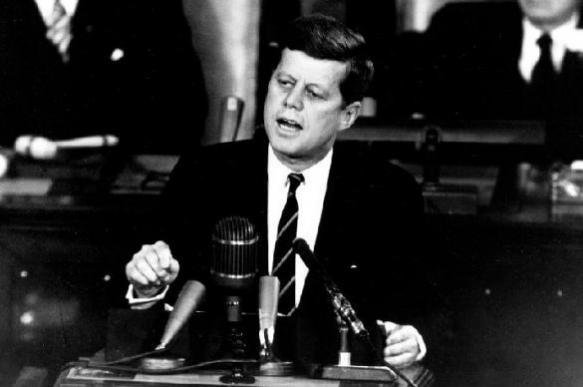 As two nuclear powers – the United States and Israel – wage war on a non-nuclear-armed state, Iran, we might all long for a US president with the wisdom and understanding of President Kennedy and his brother Bobby, whose dedication to and belief in dialogue with the “enemy” literally saved the world.
A common theme throughout the book is the phenomenon of personal evolution, or transformation. Both Kennedy brothers were dedicated Cold Warriors early on in their public service careers but then changed their positions radically as time and experience informed their thinking, eventually moving toward peace- and nuclear disarmament-friendly stances as they developed greater wisdom, compassion and understanding (the high point of this being JFK’s decision to engage in a sustained and successful backchannel dialogue with Soviet president Khrushchev during the Cuban Missile Crisis, earning him the enmity of Gen. Curtis LeMay and the Joint Chiefs of Staff); the same can be said of their positions on civil rights issues (JFK was said to have been deeply moved by a photograph of a young boy being attacked by a police dog in Birmingham, Alabama).
Following Malcolm X’s sojourn to Mecca, he, too experienced a transformation, returning to the US a profoundly changed man who embraced the concept of universal brotherhood. His experience abroad of kindness, generosity and acceptance by people of all races and political leanings — at sharp odds with the racism he experienced at home — opened new doors in his heart and mind. Malcolm understood that peace and unity between the races was indeed possible, and his militancy softened. When Malcolm professed support for the Student Nonviolent Coordinating Committee, civil rights leader John Lewis remarked:
“This was a man clearly in the process of changing.”
As his view of nonviolence grew closer to that of  Martin Luther King, US authorities came to view him as a threat. They feared that any possible unity between Malcolm and MLK could empower and unite the African American community, and they were determined to prevent this at all costs. They also resented his effort to internationalize US oppression of African Americans as a human rights issue at the United Nations – an initiative which had garnered significant support abroad.
These four serious American peacemakers of the 1960’s came up against the Masters of War and the Merchants of Death, who saw them as threats and traitors. All stood for justice for the poor, and against war and nuclear weapons — pro-human positions that they well knew could mean a death sentence. They dared to dream, and to live their dream, because they were filled with grace and love and compassion for the planet and its people.
In a moving epilogue, Douglass recounts the little-known history of the fearless peacemaker, Swedish Count Bernadotte, murdered by Israel in 1948 as he worked toward uniting the people of Palestine and Israel in a single country, the “United States of Palestine and Israel.” Douglass notes how the world might not currently be witnessing a genocide in Gaza had Israel heeded him instead of killing him. And Rachel Corrie, the 23-year old American peace activist bulldozed to death by Israel 23 years ago for protecting a family home in Gaza from demolition, might still be alive today.
For their defense of the world’s people against nuclear omnicide; for embracing the Brotherhood of Man, and calling out militarism, racism and materialism; for their willingness to make common cause with their enemies in order to save humanity, these peacemakers knowingly made the ultimate sacrifice. They knew that evil had to be confronted, that truth had to be spoken – and they did so, walking the arc of the moral universe, courageous peace in their hearts.
James Douglass’s new book is a gift, a revelation, a path forward in the darkness that will point us toward the light. May we learn, remember, and follow our hearts.
*
Click the share button below to email/forward this article. Follow us on Instagram and X and subscribe to our Telegram Channel. Feel free to repost Global Research articles with proper attribution.
Elizabeth Murray is former Deputy National Intelligence Officer for the Near East in the National Intelligence Council. She is a member of Veteran Intelligence Professionals for Sanity, the Sam Adams Associates for Integrity in Intelligence, and the Eisenhower Media Network Expert Senior Fellows | Eisenhower Media Network.
Global Research is a reader-funded media. We do not accept any funding from corporations or governments. Help us stay afloat. Click the image below to make a one-time or recurring donation.















.jpg)


 French (CA)