

.png) 3 month_ago
33
3 month_ago
33
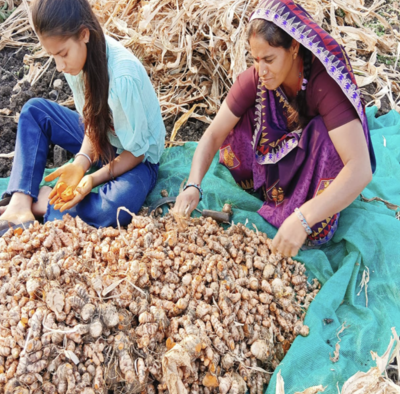
When the lush green fields of turmeric sway in the tribal belt of southern Rajasthan, Madhya Pradesh, and Gujarat, it is not merely a spice crop it is the golden glow of self-reliance. In villages where even basic spices once had to be bought from the market, the very soil today is yielding a prosperity that has transformed the lives of thousands of families. At the heart of this transformation is the initiative of Vaagdhara, which has linked turmeric with livelihoods, nutrition, and village self-governance (gram swaraj).
Turmeric’s place in our lives is not limited to the kitchen. Whether it is the turmeric ceremony at a wedding, post-natal care, or the everyday lentils and vegetables, turmeric is an indispensable need in every household. Yet, the irony was that many families in tribal regions were buying even the turmeric they needed from the market. Every year, cash was spent on turmeric packed in small plastic pouches. Though this expense may seem small, for families with limited incomes, it was a burden too.
To change this situation, Vaagdhara launched a comprehensive campaign with turmeric at its centre. The organization provided turmeric seeds to more than two lakh (200,000) families across approximately 2,000 villages in its operational area. Alongside the seeds came training, group formation, the concept of nutrition gardens, and a clear vision of freedom from market dependency. Through the already active Gram Swaraj groups, Saksham Mahila Samoohs (women’s empowerment groups), and Krushi avm Adivasi swraj saghatahn this idea was carried door to door.
Baleshwar Tabiyar, a farmer from Dhanewa Bada village in Anandpuri block of Banswara district, is a living example of this change. He shares that earlier, turmeric was only grown in small quantities for domestic use. “We had never even thought that turmeric could also be a source of income. When it was explained in detail at the Gram Swaraj group meeting, we tried it on a small scale. The yield was good and the cost was also low. This year, I have planted turmeric across a full bigha,” he says with a smile. The lush green crop standing in his field truly seems like a symbol of a new confidence.
Farmers embraced turmeric also because it is a relatively low-risk crop. Traditional crops like wheat, gram, and sesame are more susceptible to weather and pest damage. Sudden rains, hailstorms, or strong winds can often ruin months of hard work. In contrast, turmeric rhizomes develop underground, which reduces direct exposure to weather conditions. The cost of cultivation remains limited and demand is steady. Whether in the kitchen, medicine, cosmetics, or religious use turmeric is always needed. This stability gives farmers the confidence that their produce will not go to waste.
.

.
The most empowering aspect of this initiative is the participation of women. Rajubai from Sakarwara village in Sailana tehsil says, “For the past three years, I have not bought turmeric from the market. We sowed the seeds received from Vaagdhara in our fields and this time we got two quintals of turmeric. Now I will sell it and increase my livelihood.” The confidence in her voice is not just about the crop it is about self-reliance.
Anitabai from the same village shares that she used to buy plastic-packed turmeric from the market before. “We didn’t even know how much harm that plastic causes to the environment. When we learned about it at a Saksham Mahila Samoohs meeting, we understood how much better it is to use turmeric from our own fields. Now we have stopped buying turmeric in plastic,” she says. Her words also highlight the environmental impact of this initiative.
Lakshmibai, Rajeshwaribai, Gangabai, and Sugnabai from Kangsi village are also no longer dependent on the market. They share that earlier they had to buy turmeric multiple times throughout the year. Now, even after meeting the household requirement, surplus produce remains, which is sold to local traders. This additional income may seem small, but it provides cash for children’s education, medicines, and other essential needs.
In truth, turmeric has brought not only economic change to these villages but has also influenced social structures. When women began participating in decisions related to production and marketing, their role within the family grew stronger. Their presence in village meetings increased. Their voices began to be heard in decision-making processes. This transformation has happened gradually, but it is lasting.
The foundation of Vaagdhara’s strategy has been community organization. Regular meetings included discussions on farming techniques, the use of organic fertilisers, seed preservation, and crop management. Farmers were told that even on small landholdings, spice crops can become a source of steady income. Emphasis was also placed on small but important measures such as fencing fields to prevent damage from livestock, thereby combining technical guidance with traditional knowledge.
Viewed in a broader context, this turmeric initiative is an effort to put the concept of gram swaraj into practice. When a village reduces its dependence on the market for its basic needs, it becomes economically more empowered. Two lakh families engaging in turmeric production is not merely an agricultural programme it is the practice of self-reliance at the household level. It has increased local market availability, strengthened the role of women, and made savings of cash possible.
Today, in these villages, turmeric is no longer just a spice. It has become the colour of confidence. The green leaves swaying in the fields and the golden rhizomes growing in the earth carry this message: with the right guidance and collective resolve, even an ordinary-looking crop can become a medium of transformation. When Rajubai speaks about the turmeric from her field, her face lights up. “Earlier, we used to wonder what we had. Now, it feels like everything is within our own soil,” she says. This feeling is the very essence of this entire initiative. The golden glow rising from the earth is illuminating not just the fields, but the thinking of entire villages.
The story of this turmeric tells us that change does not always come from large resources it comes from the right vision and community participation. In villages that once had to look to the market even for spices, the fragrance of self-reliance is spreading today. This golden glow will inspire more villages in the time to come, because when a community moves forward on its own, development becomes not just a programme, but a part of life.
*
Click the share button below to email/forward this article. Follow us on Instagram and X and subscribe to our Telegram Channel. Feel free to repost Global Research articles with proper attribution.
Vikas Parashram Meshram is an independent writer, social worker, and researcher associated with rural development. He regularly writes on issues related to tribal communities, rural livelihoods, agriculture, climate change, and social transformation. He is a regular contributor to Asia-Pacific Research.
All images in this article are from the author
Global Research is a reader-funded media. We do not accept any funding from corporations or governments. Help us stay afloat. Click the image below to make a one-time or recurring donation.






















.jpg)


 French (CA)