

.png) 3 month_ago
50
3 month_ago
50
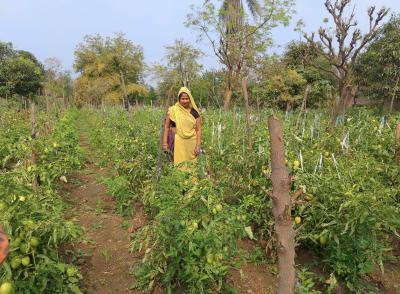
In the small village of Kundali, under the Ghatol tehsil of Banswara district in Rajasthan, begins the story of a tribal family the story of 43-year-old Vanta Ramdas Charpota, who, even after enduring the sting of failure, did not give up. Through sheer determination, hard work, and the tools of advanced agricultural techniques, she transformed her land into a field of hope.
Vanta Devi’s life was like that of every tribal woman who spends her days divided between the farm, the home, and the family. Within her lived a dream that one day she, too, would be able to bring prosperity to her loved ones. To meet daily needs, she grew only vegetables on her land. Her farming was for survival, not for trade.
One day, she happened to visit her parents’ home. On the way, she spotted a field bursting with deep red tomatoes. The sight of that lush, thriving farm stirred something inside her: if that farmer can grow such a wonderful crop, why can’t I? In that moment, a dream began to take shape a dream where her own field would be just as laden with fruit, where her family would have nutritious food, and where a steady livelihood would take root.
Upon returning home, she resolved to grow tomatoes. But while enthusiasm was plentiful, technical knowledge was not. She had no idea how to test her soil, no understanding of the right irrigation methods, and no grasp of the proper ratios of fertilizers and manures. She invested all her savings and held nothing back in terms of effort yet the results were discouraging. The crop did come up, but the yield fell far short of expectations.
Around that time, the organization Vaagdhara had begun its activities in her village. Vaagdhara works across the tribal belts of southern Rajasthan to empower women, teach them sustainable farming practices, and strengthen their livelihoods. The organization’s community facilitator, Mukesh Maida, had formed a Saksham Mahila Samuh (Capable Women’s Group) in the village and encouraged Vanta Devi to join offering her an opportunity for leadership. Once part of the group, she began receiving training under the Sachchi Kheti (True Farming) program through a Farmers’ Field School. This training was hands-on and field-based learning by doing.
She first understood how essential it is to maintain soil moisture, and how effective drip irrigation can be toward that end. She learned to use water wisely and efficiently. But the most important lesson she took away from the training was how to prepare enriched natural manure from cow dung using the Ukda method. Vanta Devi’s household had three buffaloes, two bullocks, one cow, and six goats. These animals had always been her economic backbone, yet she had never been able to fully utilize the dung and waste they produced. Vaagdhara taught her that everything she already had animal dung, dry leaves, crop residue, twigs, and other organic matter could be transformed into extremely useful and powerful compost. This compost would not only enrich her soil but also help her cut the heavy expense she had been incurring on chemical fertilizers.
The Ukda composting method is not new it is embedded in the very roots of our agricultural culture. For centuries, our ancestors have revered cow dung as sacred and useful. It is a testament to the deep bond between livestock, nature, and human sustenance. What Vanta Devi was taught was simply the scientific form of this age-old traditional knowledge.
The process of preparing this compost is systematic and step-by-step. First, a pit is dug at a suitable location ideally on elevated, dry ground so that rainwater cannot collect in it, as waterlogging impedes the composting process and causes foul odors. Into this pit, animal dung, waste matter, dry leaves, crop residue, and other organic material are collected and layered. Then, approximately five to ten kilograms of rock phosphate is mixed in per ton of the organic blend. Rock phosphate increases the phosphorus content of the compost, which is vital for strengthening plant roots and supporting overall growth. Bio-fertilizers containing beneficial microorganisms that fix nitrogen and phosphorus are then sprayed over the mixture. These microbes accelerate the breakdown of organic matter and make the compost even more nutrient-rich. Instead of covering the heap with soil, it is covered with grass or organic material so that air can continue to circulate within it. Maintaining moisture is an essential part of the process, so the heap is lightly watered at regular intervals. Every fifteen to twenty days, the compost is turned with a spade to maintain airflow and keep the microorganisms active. After sixty to ninety days of this process, the compost turns a deep brown and takes on the fresh scent of earth a sign that it is fully ready.
Vanta Devi learned all of this carefully and applied it to her own land. She began collecting dung from her animals, dry leaves, and crop residue. With plenty of livestock at home, raw materials were never in short supply. She dug a pit at a suitable spot near the village and began preparing the compost following the full method. Two to two-and-a-half months later, when she saw the finished Ukda compost for the first time that deep brown, fragrant with the smell of earth her heart filled with joy and excitement.
This time, she decided to grow tomatoes again but this time, she was ready. On her quarter-acre plot of land, she applied around one quintal of Ukda compost. She adopted drip irrigation, first raised the seedlings in a nursery and then transplanted them into the field. She kept a careful watch on soil moisture, weeded and tilled at the right times, and continuously monitored the crop. This time, her hard work and knowledge came together and the result was extraordinary. From just a quarter of an acre, she harvested two thousand five hundred kilograms of tomatoes. At the market, she received twenty-five rupees per kilogram, pushing her earnings well beyond sixty-two thousand five hundred rupees. In addition, she earned ten thousand rupees from brinjal cultivation and a further eight thousand rupees from spinach, fenugreek, and coriander. She also prepared a tomato nursery for the next season proof of her foresight and the systematic planning she had newly acquired. In all, that year her farming brought her more than eighty-two thousand rupees in income.
But the impact of this success was not limited to numbers alone. As money came in, the face of the household began to change. Nutritious food appeared on the table. The family was freed from the uncertainty of daily wage labor, and farming became her true identity one built on dignity, self-respect, and self-reliance.
The journey of Vanta Ramdas Charpota is significant also because it demonstrates that failure is not the end. The loss from her first tomato crop could have been the closing chapter but she chose to make it a lesson. She received the right guidance, the right techniques, and the support of an organization, and she absorbed all of it with complete dedication. Preparing compost the proper way is a technique that gives new edge to old knowledge.The role of Vaagdhara and its Sachchi Kheti program is absolutely central to this entire story. The organization not only provided technical training but also gave women a collective platform where they could learn from one another, inspire each other, and move forward together. The Saksham Mahila Samuh became a space where women like Vanta Devi could share their struggles and find solutions together. It is this sense of community that forms the true foundation of lasting change.
Today, Vanta Devi stands as a living example for every woman in that village who wishes to build a better life from her land, her livestock, and her labor. Her success carries the message that even small-scale farming can be profitable provided the farmer has the right knowledge, the right technique, and the firm resolve to act. Her story is a crop grown from the soil of Banswara’s tribal heartland not merely of tomatoes, but of hope, self-respect, and transformation. The seed she has sown is taking root not only in her own field, but in the hearts of every woman around her who dares to dream of a better tomorrow.
*
Click the share button below to email/forward this article. Follow us on Instagram and X and subscribe to our Telegram Channel. Feel free to repost Global Research articles with proper attribution.
Vikas Parashram Meshram is an independent writer, social worker, and researcher associated with rural development. He regularly writes on issues related to tribal communities, rural livelihoods, agriculture, climate change, and social transformation. He is a regular contributor to Asia-Pacific Research.
Featured image is from the author
Global Research is a reader-funded media. We do not accept any funding from corporations or governments. Help us stay afloat. Click the image below to make a one-time or recurring donation.
















.jpg)


 French (CA)