

.png) 3 month_ago
59
3 month_ago
59
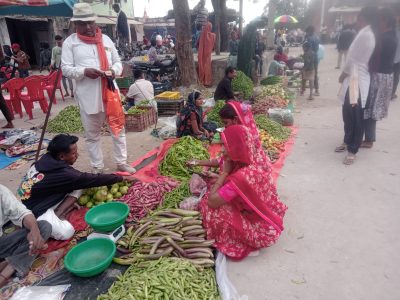
On 18 March 2026, the tribal village of Sajjangarh in southern Rajasthan witnessed the grand and dignified inauguration of a vegetable market (mandi). This market has been established through the tireless joint efforts of the Krushi avm Adivasi swraj Sagthan (Bhilkuaan) and Vaagdhara, under the active leadership of the Gram Panchayat of Sajjangarh. It is being seen as a strong cornerstone toward local self-governance, self-reliance, and a sustainable rural economy in the region. When farmers came directly to this market with their produce and received a fair price, the satisfaction and confidence visible on their faces was the greatest achievement of this initiative.
Farming has long been the axis of life for the residents of Sajjangarh and dozens of surrounding villages. However, to sell their agricultural produce, farmers had to go to the doors of middlemen, who would buy their produce at throwaway prices and sell it in city markets at several times the cost. In this process, a large share of the farmer’s hard work was swallowed up in the middleman’s profit.
Additionally, the heavy cost of transportation to distant markets and the loss of precious time had been keeping farmers economically weak. Fresh vegetables would spoil during transport, causing further losses. The only permanent solution to all these problems was the establishment of a local, organised, and transparent market. Vaagdhara and the Bhilkuaan Organisation had been working toward this goal for years, and today their dream has come true.
The inauguration ceremony was held as a grand event. People’s representatives, senior citizens, farmers, vegetable vendors, traders, and a large number of villagers from Sajjangarh and four surrounding gram panchayats Tanda Ratna, Rath Dhanraj, and Tanda Mangala — were present. The programme was chaired by Shri Azhar Khan, Development Officer of the Panchayat Samiti, Sajjangarh. The proceedings were conducted by Shri Dinesh Chandra Dindor. Distinguished guests included Shri P.L. Patel (representative of Vaagdhara Sansthan), Mandal President Shri Ramanlal Garasia, Sarpanch representative Shri Shantilal Katara, Deputy Sarpanch Shri Dadam Seth, President of the Tambeshwara Organisation Shri Man Singh Katara, President of the Bhilkua Organisation Shri Rubin Garasia, Sarpanch representative of Tanda Mangala Shri Lavji Bhai, Deputy Sarpanch Shri Ranveer Singh, and local trader Shri Neeraj Kalal. The presence of all these individuals was proof that this is not merely the initiative of one institution or organisation, but a shared endeavour of the entire community.
.

.
Various dignitaries shared their thoughts at the programme, reflecting deep insight into the significance of this market and its future possibilities.
Shri Azhar Khan said: The inauguration of this vegetable market in Sajjangarh is not merely the establishment of a marketplace — it is an important step toward the economic empowerment of the tribal region. Farmers will receive fair prices for their produce and will be freed from the cycle of middlemen. The administration will extend every possible support for the development of this market.
Shri P.L. Patel, representative of Vaagdhara Sansthan, said:”Vaagdhara Sansthan has always aimed to promote self-reliance in rural and tribal areas. This market in Sajjangarh is a living example of that effort, where farmers will be able to connect directly with consumers and receive the right value for their produce. Our goal is that the concept of self-governance (Swaraj) be implemented in the life of every person.
Mandal President Shri Ramanlal Garasia, giving voice to the feelings of the farmers, said:This market will prove to be a blessing for the farmers of our region. They will no longer need to depend on distant markets to sell their produce. They will receive a fair price locally, which will strengthen their financial position.”
Sarpanch representative Shri Shantilal Katara, highlighting the role of the Gram Panchayat, said that Gram Panchayat Sajjangarh has always prioritised developmental work, and this market is the next link in that chain, which will become the identity of the entire region in the times to come. Our aim is not merely to establish a market, but to develop it as an ideal marketplace where both farmers and consumers benefit.
*Shri Man Singh Katara, President of the Tambeshwara Organisation, speaking in the context of self-respect and self-reliance, said that this initiative will take society to new heights, and everyone must work together to make it a success.
This vegetable market has been established not merely as a buying-and-selling centre, but as a symbol of a social movement. It incorporates several important features and commitments that make it distinct and special from other markets: Separate Identity for Organic Vegetables: An important decision was taken at the programme to ensure a separate identity for organic and chemical-free vegetables in the market. Special boards and banners will be put up so that consumers can easily identify which vegetables have been grown entirely by natural methods. This is significant not only for health reasons but is also a positive step toward encouraging organic farming. It will provide special encouragement to those farmers who cultivate using natural and traditional methods, staying away from chemical fertilisers and pesticides.
Polythene-Free Campaign Another important pledge was taken on this occasion to run a polythene-free campaign in the region from 1 April. Shri Azhar Khan appealed to all organizations, traders, and villagers to cooperate with this campaign. This campaign is an important initiative for environmental protection that will improve both marketplace cleanliness and environmental health. Cloth bags and other eco-friendly alternatives will be promoted in place of polythene. A Platform for Farmers to Learn While conducting the proceedings, Shri Dinesh Chandra Dindor made it clear that this market will not only be a centre of trade but will also become a platform for farmers to learn and grow. Information about new agricultural techniques, improved seeds, modern irrigation methods, and market trends will be shared here. This will increase farmers’ knowledge and allow them to improve both the quality and quantity of their produce. This market will provide direct and accessible market access to farmers from approximately 65 villages across 16 gram panchayats. Its economic impact will be multi-dimensional and far-reaching Until now, farmers were compelled to depend on middlemen to sell their produce. Middlemen would offer low prices and take away a large share of the farmers’ hard work. With this market opening, farmers will be able to reach consumers directly and receive the fair market price for their produce. It is estimated that this could increase farmers’ income by 30 to 50 percent.
Savings in Transportation and Time Previously, farmers had to spend hours and considerable money to travel to distant markets. By being able to sell their produce at the local market, there will be major savings not only in transportation costs but also in time. The saved time and money can be invested by farmers in their fields and families. Vegetables would often spoil during long-distance transport, causing losses to farmers and preventing consumers from getting fresh produce. Now, fresh, high-quality vegetables will reach consumers within just a few hours of the morning harvest at the local market. The establishment of the market will benefit not only farmers but will also create new employment opportunities for local youth in market management, loading and unloading, weighing and measurement services, cleaning and maintenance, and commercial activities. This will give further momentum to the local economy.
Vaagdhara has been working for decades to put this very concept of Swaraj (self-governance) into practice at the grassroots level among tribal and rural communities. Through land rights, water conservation, organic farming, women’s empowerment, and women’s self-help groups, this organisation is engaged in enriching tribal life. The vegetable market in Sajjangarh is yet another important milestone in that journey.True local self-governance means: when farmers themselves decide the price of their produce; when the panchayat itself plans the development of its village; when society finds solutions to its problems from within itself that is when true Swaraj is realized. This market has taken another step in the direction of that Swaraj.
*
Click the share button below to email/forward this article. Follow us on Instagram and X and subscribe to our Telegram Channel. Feel free to repost Global Research articles with proper attribution.
Vikas Parashram Meshram is an independent writer, social worker, and researcher associated with rural development. He regularly writes on issues related to tribal communities, rural livelihoods, agriculture, climate change, and social transformation. He is a regular contributor to Asia-Pacific Research.
All images in this article are from the author
Global Research is a reader-funded media. We do not accept any funding from corporations or governments. Help us stay afloat. Click the image below to make a one-time or recurring donation.




















.jpg)


 French (CA)