

.png) 2 month_ago
21
2 month_ago
21

In the late winter and spring of 1942 epic defensive actions took place in the western Russian towns of Kholm and Demyansk. On 8 February 1942, six German divisions were surrounded by the Soviet Army advancing on Demyansk and prior to this, in late January, a combination of German units and police forces were encircled by Soviet divisions at Kholm, about 60 miles south-west of Demyansk.
To read this article in the following languages, click the Translate Website button below the author’s name.
Deutsch, Русский, Farsi, Español, Portugues, عربي, Hebrew, 中文, Français, Italiano, 日本語, 한국어, Türkçe, Српски. And 40 more languages.
The German divisions cut off at Demyansk fought stoically in the town for over 2 months, sustained by air drops provided by the Luftwaffe. They were relieved with the arrival of fresh German infantry and armored units on 21 April 1942.
At Kholm, the surrounded defenders were also supplied with the necessary provisions by the Luftwaffe and they held out for more than 3 months despite outbreaks of typhus and Red Army assaults, before the Germans in Kholm were relieved by new forces on 5 May 1942.
These successful Wehrmacht operations adhered to Adolf Hitler’s Directive No. 41, issued on 5 April 1942, in which among other goals he stated that the surrounded German garrisons at Demyansk and Kholm were to be rescued. The military actions in question were helped by the fact the Red Army, altogether, suffered more than 4 times as much irrecoverable losses relating to manpower than the Germans had in the first 3 months of 1942; with the Soviets incurring 620,000 irrecoverable losses from January to March of that year, while the Germans had 136,000 such losses during the same period. (1)
In the final hours of 1941 the Soviet 302nd Mountain Rifle Division (commanded by Mikhail Zubkov) had reclaimed from German forces in eastern Crimea the city of Kerch, a port located on the Kerch peninsula and beside the strategically important Black Sea.
Hitler’s above directive outlined that Kerch was to be retaken from the Soviets and the peninsula there cleared of enemy forces once and for all, while Sevastopol, the Crimea’s biggest city, under siege by the Germans since 30 October 1941 will also be captured.
The Red Army’s May Day slogan of 1 May 1942 predicted,
“In 1942 we will achieve the decisive defeat of the German-fascist forces.”
This was wishful thinking. On 8 May 1942, the German 11th Army (Erich von Manstein) launched an attack on eastern Crimea where 3 Russian armies held the Kerch peninsula. Showing an expert military brain, General von Manstein struck with his armored forces at the southernmost part of the Soviet line, punched a gaping hole, and they poured through that to advance to the rear of 2 of the Soviet armies.
The Soviet forces dispersed and fled as they attempted to retreat to Kerch, where they could possibly have made their way across the strait back to the Russian mainland (2). The German 11th Army prevented this by capturing Kerch in mid-May 1942. Red Army formations were caught by the enemy and trapped. Less than 2 weeks after the attack started the Germans had “destroyed three Soviet armies with a total of 21 divisions and taken 170,000 prisoners,” historian Geoffrey Roberts wrote. (3)
With the Kerch peninsula back under Nazi control, the Wehrmacht could refocus on capturing Sevastopol in south-western Crimea which had been turned into a fortress by the Russians. The German 11th Army was assisted in its renewed assault on Sevastopol by soldiers from Romania, a country led since September 1940 by Ion Antonescu, a figure mostly forgotten over time but who was one of Hitler’s closest allies during World War II.
The decisive offensive to take Sevastopol began on 2 June 1942 with a huge aerial and artillery bombardment of the city. Over the next month the Luftwaffe for example unloaded 20,000 tons of bombs on Sevastopol (4). In addition, Hitler temporarily relocated the gigantic siege guns which were bombarding Leningrad a thousand miles away to the north, and he sent them south to the edge of Sevastopol where they were positioned across the ground and used to deadly effect. The German guns fired shells weighing from 1 ton all of the way up to 7 tons.
.
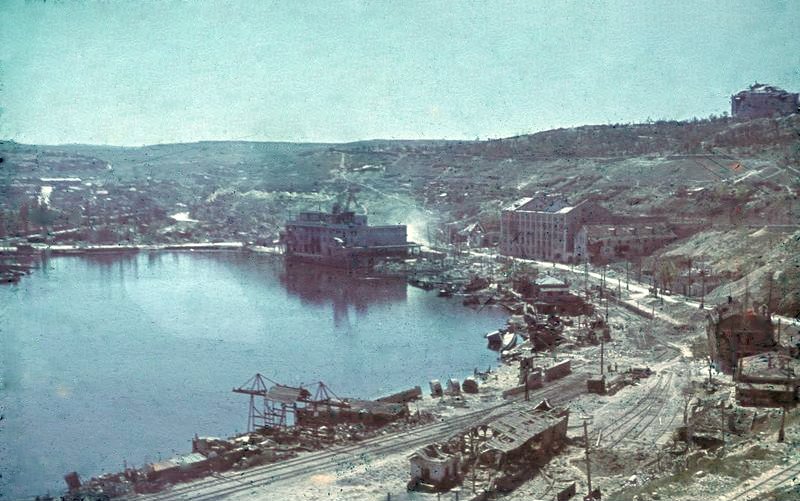
Destroyed harbor of Sevastopol during the siege of the city by axis forces in WW2. (CC BY-SA 3.0 de)
.
The Axis divisions, moreover, launched infantry and amphibious assaults on the city. A combination of these operations resulted in the German-Romanian capture of Sevastopol on 4 July 1942. The Soviet defenders had resisted bitterly, yet their fatalities in the Siege of Sevastopol ran into the many tens of thousands while the Germans and Romanians captured 95,000 Red Army soldiers. Axis forces suffered 75,000 casualties; 25,000 of these were deaths. (5)
Due to the German-led victory at Sevastopol, historian Donald J. Goodspeed wrote,
“The Russians had lost their great Black Sea naval base, and Manstein was rewarded by being promoted to field marshal.” (6)
Before this, on 12 May 1942, in north-eastern Ukraine the Soviet military launched a major assault towards Kharkov, the 2nd largest city in Ukraine. Marshal Semyon Timoshenko, in overall command of the Soviet attack, had 5 armies and powerful armored formations in the attempt to reclaim Kharkov from the Germans, in what became known as the Second Battle of Kharkov. Soviet forces outnumbered German divisions by more than 2 to 1 but among the latter was the German 6th Army (Friedrich Paulus), the Wehrmacht’s strongest military force.
The Soviet thrust from the north towards Kharkov was halted by the Germans 12 miles from the city (7). The southern pincer of the Soviet assault made better ground and advanced as far west to the town of Krasnograd, 55 miles south-west of Kharkov. This southern Soviet advance in the Kharkov region actually reached too far west and left them dangerously exposed to a counterattack.
Field Marshal Fedor von Bock, the commander of German Army Group South, spotted the opportunity for unleashing a heavy counterstroke which with Hitler’s full support was executed on 17 May 1942. It struck the Russians’ western flank south of the town of Izyum, about 70 miles south-east of Kharkov. One German force thrust up to the Donets river and into Izyum, while further west the Germans advanced north to the village of Bairak on the northern bend of the Donets river.
Soviet armies badly needed to retreat out of the closing trap in the Kharkov region but they were prevented from doing so. According to Goodspeed,
“Largely because Stalin himself intervened and refused to allow any withdrawal, two of Timoshenko’s armies were encircled” (8).
Nikita Khrushchev, future leader of the Soviet Union and at the time closely following the fighting, supports this viewpoint as he criticized Joseph Stalin for the defeat in the Kharkov area in May 1942.
The trapped Soviet divisions around Kharkov made desperate attempts to break out of the encirclement, but the German lines held and Soviet troops were mowed down by artillery strikes and gunfire. The Second Battle of Kharkov ended on 28 May 1942, lasting for just over 2 weeks. Both the Soviet 6th Army and Soviet 57th Army were annihilated; their commanders, General Avksentiy Gorodnyansky leading the 6th Army and General Kuzma Podlas leading the 57th Army, were killed along with their staffs, and 1,250 Soviet tanks and 2,026 guns were lost.
The German 6th Army and the 1st Panzer Army (Ewald von Kleist) captured 239,000 Red Army soldiers, and in total 279,000 casualties were inflicted on the Soviet armies. By comparison German personnel losses in the Second Battle of Kharkov “were not much more than 20,000 men,” author Antony Beevor wrote (9). Hitler subsequently praised “the success of the 6th Army against an enemy overwhelmingly superior in numbers” and he rewarded its commander, General Paulus, with the Knight’s Cross decoration.
The German victory in the Second Battle of Kharkov reaffirmed their conquest of Ukraine, with the Soviet republic’s biggest cities such as Kiev, Kharkov, Odessa, Dnipro, and Zaporozhye, having been captured by the Germans during the summer and autumn of 1941.
The main German offensive of 1942 against the Soviet Union would be launched in the high summer, initially across an 80-mile wide front between the Russian cities of Belgorod and Kursk, both of which were under Nazi occupation since the late autumn of 1941. The opening target of the German attack was Voronezh, a city situated 310 miles north-west of Stalingrad and astride the Don river.
The line of the Don south from Voronezh was to be cleared of Soviet forces in a giant pincers movement resulting in the annihilation of the enemy there; together with a second German thrust towards the city of Rostov-on-Don, considered “the gateway to the Caucasus”; which would encircle any Soviet divisions remaining in the bend of the Don river.
Once the clearance of the Don Bend was accomplished, German armies including the 6th Army would advance eastward to cut the Volga, Europe’s longest river, at Stalingrad. The 1st Panzer Army and the German 17th Army (Richard Ruoff) were expected to occupy the Caucasus region by thrusting down between the Donets and Don rivers towards the Terek river, then capture Tbilisi, the Georgian capital, and Baku, the Azerbaijani capital. Goodspeed wrote,
“The German 2nd Army (Maximilian von Weichs) and the 4th Panzer Army (Hermann Hoth) were assigned the task of taking Voronezh, and the German 6th Army and the 4th Panzer Army would then clean up the Don Bend.” (10)
On 1 June 1942 an enthusiastic Hitler visited the Ukrainian city of Poltava, where the headquarters of German Army Group South was based. During the meeting Hitler said to his commanders the principal goal of the forthcoming summer offensive was to seize the Caucasus region’s oil sources, in the south-western Soviet Union.
At the same conference in Poltava, Hitler confided to von Manstein about his dream of linking the Caucasus offensive with Erwin Rommel’s anticipated capture of Egypt, and to then proceed to the Middle East and India which in turn would finish off what was left of the British empire. Beevor wrote,
“During the conference, Hitler hardly mentioned Stalingrad. As far as his generals were concerned it was little more than a name on the map. His obsession was with the oilfields of the Caucasus… At that stage, the only interest in Stalingrad was to eliminate the armaments factories there [by air attack] and secure a position on the Volga. The capture of the city itself was not considered necessary.” (11)
Between April to June 1942, the Wehrmacht inflicted 780,000 irrecoverable losses on the Soviet military, whereas in the same 3 months the Germans suffered a modest 52,000 irrecoverable losses (12). The disparity in personnel losses between the 2 militaries augured well for the Germans, who in summer fighting continued to operate at a far higher level than the Red Army.
Early in the morning of 28 June 1942 the great German offensive into the south-western USSR, titled Operation Blau, began in excellent summer weather and tank country, across rolling plains and rich grasslands. The direction of the German attack was a surprise for Stalin. In spite of receiving first-hand intelligence details stating the Germans would advance to the south, the Soviet leader still expected the main enemy offensive to come further north towards Oryol and Moscow.
General Hoth’s 4th Panzer Army, attacking between Kursk and Belgorod, met little organized opposition as the Germans advanced about 65 miles over 2 days. By 30 June 1942, the 4th Panzer Army was halfway to Voronezh, located around 130 miles east of Kursk and Belgorod. This rapid breakthrough by the 4th Panzer Army caused much alarm and dismay in Moscow. Also on 30 June, the German 6th Army executed its converging attack north-east towards Voronezh. The Soviet divisions were warned in time about the advancing German encircling movement and they evacuated the Don Bend, retiring across the river in good order.
By 4 July 1942, the Germans reached Voronezh and during the evening of that same day they established a bridgehead across the Don. The Germans then launched attacks to capture Voronezh, home to over 300,000 people, but the Soviet defenders strongly resisted. It was not until mid-July that most of the city was in German hands.
To the south, the 1st Panzer Army under General von Kleist was driving at Blitzkrieg pace through the corridor of the Donets and Don rivers to advance on Rostov, a Russian port city. Panzer units entered the town of Millerovo on 17 July, fewer than 200 miles from Stalingrad, then Morozovsk the following day, before they reached the lower Don on 19 July. This constituted for the panzers “an advance of 125 miles in just over three days,” Beevor noted. (13)
On 12 July 1942, Stalin said the line of the Volga river and the city of Stalingrad were to be “defended to the last.” On 19 July, Stalin personally ordered the Stalingrad Defence Committee that the city be immediately prepared for war. Two days before, 17 July, the first clashes occurred on the Stalingrad front between German and Soviet forces in the distant approaches to the city
Stalin was worried that Rostov (245 miles south-west of Stalingrad) would not hold out for long because of earlier Soviet military setbacks. Rostov, containing over half a million people before the war, was a slightly larger city than Stalingrad. By 19 July the German 17th Army was set to cross the Don river on the Black Sea side, the 1st Panzer Army was advancing on Rostov from the north, and part of the 4th Panzer Army was poised to strike across the Don to the east of Rostov. (14)
On 23 July 1942, the 13th Panzer Division (Traugott Herr) and the 22nd Panzer Division (Wilhelm von Apell), supported by panzer grenadiers from the 5th SS Panzer Division Wiking (Felix Steiner), bludgeoned their way into the center of Rostov as far as the main Don bridge.
Fighting inside Rostov was hard, particularly through the defence of their headquarters by NKVD units, the Soviet secret police. By late on 24 July, however, Soviet resistance in Rostov was crushed in a systematic clearance of the city’s buildings on that day, resulting in Rostov’s recapture; after the Germans had first taken it in November 1941 before they were forced out of the city by the Soviets the following month.
On 24 July 1942 also, German forces took the town of Novocherkassk, just over 20 miles from Rostov to the north-east. Marshal Timoshenko was rebuked in the Soviet media for allowing Rostov to fall so suddenly. The disaster at Kharkov 2 months before had weakened the Red Army in the southern USSR to such an extent that, for the enemy, Rostov became much easier to capture. (15)
More than 100 miles north of Rostov, the Germans in late July 1942 completed their defeat of Soviet forces in the entire Donbass region, Roberts highlighted (16); after the vast majority of the area was occupied by the Germans during the autumn of 1941.
The clearance of the last remaining Soviet troops from resource-rich Donbass, the Red Army’s retreat across the Don river, added to the German victories at Kharkov, Kerch, and Sevastopol, convinced Hitler the war was as good as won. On 20 July 1942 he told Franz Halder, Chief of the Army General Staff, that “The Russian is finished.” Halder replied to Hitler, “I must admit that it looks that way.”
A week later, on 28 July 1942 Stalin upbraided Soviet divisions for having “abandoned Rostov and Novocherkassk without serious opposition and without orders from Moscow, thereby covering their banners with shame”, and he said that Soviet citizens “are losing faith in the Red Army” and “are cursing the Red Army for giving our people over to the yoke of the German oppressors, while itself escaping to the east.” (17)
.

Demonstrators marching before the massacre, carrying red banners and a portrait of Vladimir Lenin (Public Domain)
.
Already on 13 July, Hitler altered his original plan by sending the 4th Panzer Army straight south to Rostov, rather than allowing it to advance further east alongside the German 6th Army. Hitler now wanted Stalingrad and the Caucasus to be captured not in succession, as in one after the other, but instead simultaneously.
With the summer of 1942 continuing, Stalingrad entered Hitler’s thoughts more and more. The German 6th Army was expected to capture Stalingrad by itself, and once that was achieved it was to march 230 miles south-east beside the Volga river and take Astrakhan, a Russian city in the Caspian lowland. (18)
It has been claimed down the years that it was beyond the capabilities of the German 6th Army to take Stalingrad on its own. Yet Hitler’s expectations here seem reasonable; after all, the 6th Army in September 1941 had captured Kiev, the USSR’s 3rd biggest city, and then the following month had taken Kharkov, the USSR’s 4th biggest city.
The 1939 Soviet census outlined that Stalingrad was not even among the Soviet Union’s 10 largest cities, as it had a population of less than half a million (445,000). The population of Kiev (846,000) and Kharkov (833,000) in 1939 were almost double that of Stalingrad. Because the city in 1925 had its title changed from the centuries-old Tsaritsyn to Stalingrad there was a lot of prestige, increasingly so for Hitler, in taking the city that bore the Soviet leader’s name.
As Hitler divided his forces during July 1942 in the effort to capture the Caucasus and Stalingrad around the same time, the German frontlines in the southern Soviet Union would be lengthened from 750 miles to an incredible 2,500 miles (19). Hitler was in danger of putting too much strain on his armies, while Stalin was building up his resources further east.
*
Click the share button below to email/forward this article. Follow us on Instagram and X and subscribe to our Telegram Channel. Feel free to repost Global Research articles with proper attribution.
Shane Quinn obtained an honors journalism degree. He is interested in writing primarily on foreign affairs, having been inspired by authors like Noam Chomsky.
He is a Research Associate of the Centre for Research on Globalization (CRG).
Notes
1 Evan Mawdsley, Thunder in the East: The Nazi-Soviet War, 1941-1945 (Hodder Arnold, 23 Feb. 2007) p. 147
2 Donald J. Goodspeed, The German Wars (Random House Value Publishing, 2nd edition, 3 April 1985) p. 448
3 Geoffrey Roberts, Stalin’s Wars: From World War to Cold War, 1939-1953 (Yale University Press; 1st Edition, 14 November 2006) p. 121
4 Ibid., p. 122
5 Ibid.
6 Goodspeed, The German Wars, p. 448
7 Ibid.
8 Ibid.
9 Antony Beevor, Stalingrad (Penguin edition, 6 May 1999) p. 67
10 Goodspeed, The German Wars, p. 446
11 Beevor, Stalingrad, pp. 69-70
12 Mawdsley, Thunder in the East, p. 147
13 Beevor, Stalingrad, p. 78
14 Ibid., p. 79
15 Chris Bellamy, Absolute War: Soviet Russia in the Second World War (Pan; Main Market edition, 21 August 2009) p. 501
16 Roberts, Stalin’s Wars, p. 126
17 Ibid., p. 131
18 Goodspeed, The German Wars, p. 449
19 Ibid.
Featured image: German forces near Demyansk, 21 March 1942. (CC BY-SA 3.0 de)
Global Research is a reader-funded media. We do not accept any funding from corporations or governments. Help us stay afloat. Click the image below to make a one-time or recurring donation.


















.jpg)


 French (CA)